Search This Blog

Showing posts with label Creamed Honey. Show all posts

Sunday, January 12, 2014

Creamed Honey and Seed Saving

Having extracted the honey yesterday the next step was to cream it. Such a surplus means it will be ages before we get through it or give enough away and rather than let it crystallise with age we crystallise it ourselves but into fine crystals that taste terrific. We kept one jar of the previous creamed honey as the seeding material.

A few small jars of natural honey is bottled for gifts and as a comparison to the creamed product. The rest is mixed with the contents of the seed material jar for an hour on the pedestal drill with a squirrel mixer and then bottled predominately into small jam jars kept from when we ate jam.
 
Natural honey kept as samples

We don't eat jam any more preferring to have the fruit and fibre fresh or if desperate for a sweet flavouring either honey or dextrose (in moderation).

The previous batch of creamed honey now out of the fridge

By the time the mixing and filling and cleaning is completed another half day went by.
 
Creamed on the left and natural on the right

This time rather than use the cheese fridge to keep the honey cool while the crystals form we activated the bar fridge someone gave us that has an adjustable thermostat allowing us to keep the honey at 14 C for two weeks.
 
In the refrigerator for setting
 

While I was fiddling around with honey Jean got stuck into seed saving. Samples of various tomatoes we grow have been soaking for a few days and now she washed and sieved and lay the seeds out onto paper to dry.
 
 
One batch of seeds drying with the oyster opening gear in front

The rest of the seeds drying with a sprouting carrot top and some Avocado seeds
 
We also went through our tomato planting plan for next year over morning tea. Too many varieties are being grown. Some were eliminated on taste and others because they didn't do well. Usually we give them a couple of attempts before dropping them but today we were having an aggressive clean out. And still next July when we look at the issue again we may add some back or come across yet another one to try.


Thursday, December 19, 2013

Creamed Honey, Roasted Peanuts

This morning the last four frames went back into the hive. The bees had already cleaned and tidied the four that went back yesterday.

Last year a batch of honey we harvested creamed naturally into a really finely textured grain and was delicious. Honey will always tend to crystallise over time unless kept warm. Usually the crystals are coarse and don't have that silky mouth texture. By seeding the fresh honey with the fine crystallised honey and mixing well you can initiate the process. Fresh honey will duplicate whatever crystals are first encountered. If they are really fine crystals it is called creamed honey.

The creaming process is pretty simple. Each of the two stainless steel buckets were about three quarters full and half a jar of starter material was added. The starter material is just creamed honey from the previous batch which had been set aside.

Each bucket was taken down to the workshop and mounted on the drill press. A Squirrel mixer is used to mix the the starter material gently with the freshly harvested honey. Some people aerate the honey but this eventually escapes leaving a prominent gap in the bottled jar and a thin scummed surface. Neither attractive or true creamed honey.

Our squirrel mixer was the smallest model available and made of plastic. The larger models are made of metal. It stirs the honey in a way that doesn't incorporate air and pulls the honey from the bottom and top of the bucket, pushing it out through the sides. Thirty minutes is plenty of time to ensure a thorough mixing. We use a pedestal drill press on a very slow setting but a good hand drill will work as well.

The squirrel mixer

A plastic lid is mounted between the mixer and the drill press to keep out any fallout


The drill press will be unattended during the 30 minutes of mixing. Just so there are no accidents some blocks of wood are clamped around the bucket.

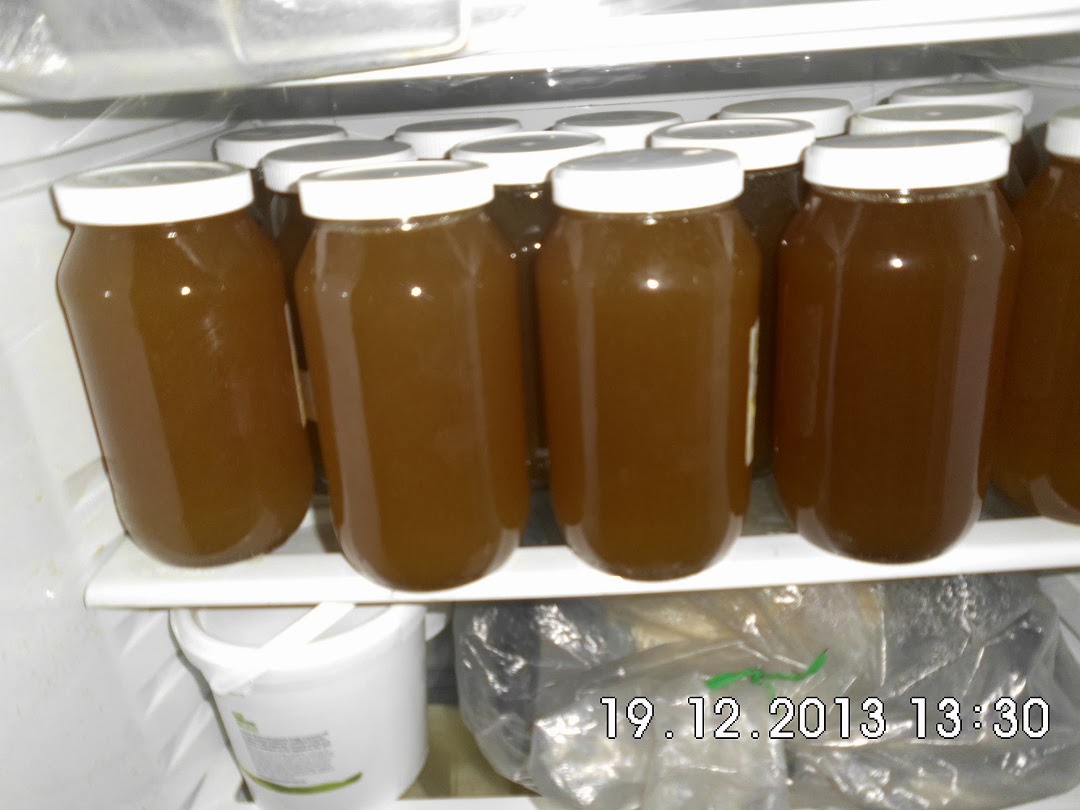
There was one final filter through a finer stainless sieve. Just to remove any stings or other debris. The honey was then bottled in one kilogram honey jars we had accumulated from before we had our own hive. The jars are then stored in the cheese fridge. The ideal temperature for crystallising honey is 14 C. Our cheese fridge fluctuates between 9 and 14. It takes about two weeks for the crystals to form. Its easy to see when this is completed as the honey will have clouded. Once complete the honey will stay that way unless it is heated but once it cools it returns to the same state of crystallisation.
 
Final filtering

Nineteen and a half kilograms into the cheese fridge
 
While waiting for the stirring to complete all the capping's were melted in water and poured into moulds. This will need to be done a second time to remove all the contaminants and then set aside to use as cheese coating.
 
The melted capping's cooling
 
As a Christmas treat we roasted some raw blanched peanuts in the oven at 200 C until they were nicely brown and as soon as we took them out poured and stirred in a salt and water mix. Only a table spoon of water is required and a teaspoon or two of salt. The heat evaporates the water and the salt adheres to the nuts. No oils involved.
 
Freshly roasted and salted peanuts
 

Tuesday, June 25, 2013

Creamed Honey


Just opened a jar of our creamed honey. We had robbed the hive just before the hive went into decline. Only took a few frames and left the bulk for them. It yielded 6 KG which we creamed despite being told it can't be done in Summer. Creamed honey is nothing more than crystallised honey where the crystals are really fine. This provides a lovely mouth feel. We had a couple of jars from another robbing which had naturally crystallised with very fine crystals and kept this aside to use as seed material.

The process is simple, add some seed material to your batch of freshly robbed honey. I have heard you can use previously crystallised honey with large crystals by heating it gently until it is liquid again. I tried this but had no success. But that could be just me. The recommendation is 1 part seed to 10 parts honey. I have used less with success.

The stirring is the critical part. Not too fast otherwise air is incorporated and you get foaming. Just a gentle central vortex. We use a Squirrel mixer. These are available on the web in various sizes, we bought the smallest. Our drill press was set at a slow speed and we stirred for 30 minutes with 6 KG of honey. The beauty of using a drill press is that it can be setup and run without having to stand in attendance. A hand drill will work but it is difficult to maintain a slow speed. One experiment we tried was using different paddles in various types of electric mixers. The problem with all these was too much speed. They also have a tendency to overheat because of the viscosity of the honey. You may need longer for bigger batches or a bigger Squirrel Mixer.

The honey was then bottled in 1 KG jars and stored in a refrigerator at 7-18 C. The ideal temperature being 14 degrees C. Ours stayed in the refrigerator for 2 weeks. Once it had crystallised it stayed that way.


References:


Creamed honey's perfect caramel colour

The Australian Supplier of the Squirrel Mixer


The Magical Squirrel Mixer