Search This Blog

Showing posts with label Shellgrit. Show all posts

Thursday, May 15, 2014

On Mulcher/Chippers, Shell Grit and Bio Char

Since our Mulcher/Chipper was out and dirty from making the NZ Compost it was deemed a good time to knock out some Bio Char. I'd used the last of the previous batch yesterday.

Last Winter we had cleared out the wood heater every morning and stored the contents. The reason for a daily clean was to ensure that we collected not only the ash but also any charcoal that remained unburnt. If we had not cleaned out that charcoal would have been consumed in the next fire.

Some of these lumps of charcoal are very large. The simplest way to break them into Bio Char is running them through the Mulcher/Chipper. Dead simple and quick. The only thing to remember is to wear breathing protection and don't do this near the washing line. The amount of fine dust is incredible. Leaves you with a blackened face. If desired a solution is to wet the contents.

Bio Char exiting the Mulcher/Chipper

A better view of sizes against the grass background

The final volume was about 100 litres of Bio Char from about 6 feed bags of fireplace cleanings. Enough to keep us going for 12 months.

Now that the mulcher/chipper was really filthy we went for broke. We have three 70 litre garbage bins that were almost completely full of Oyster Shells. That is a lot of Oysters. We digested these ourselves i.e. the Oysters not the shells.

Oyster Shells

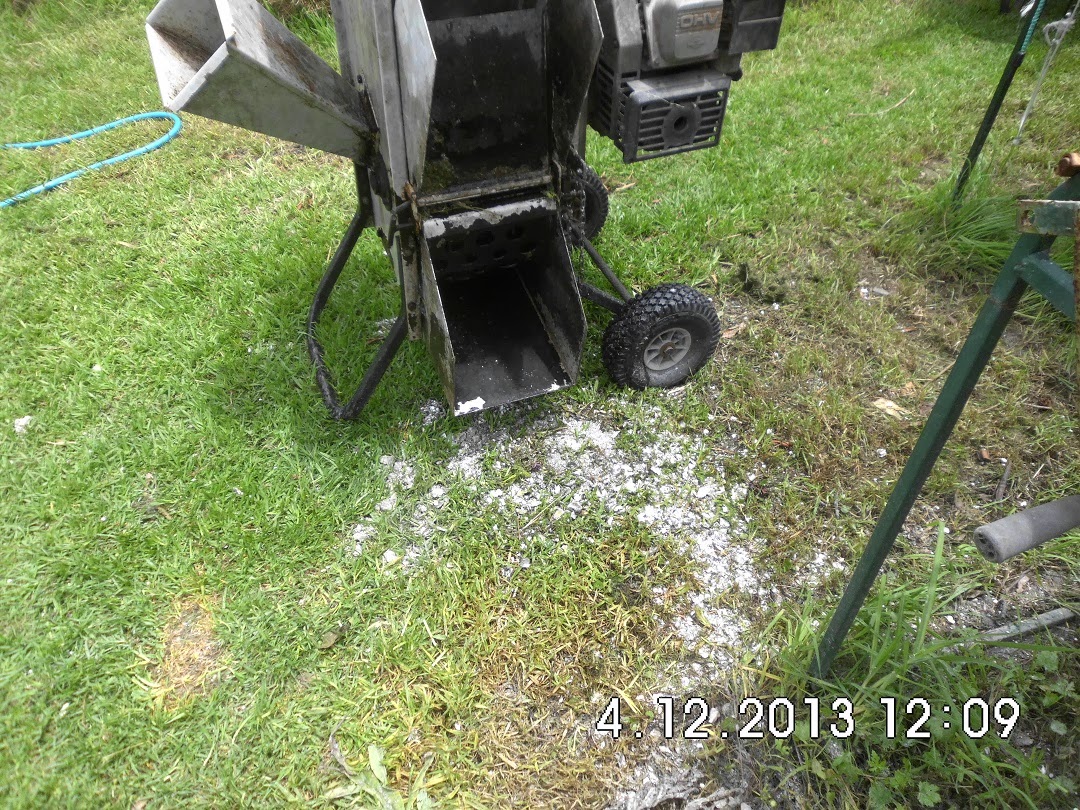
With the mulcher/chipper rolling at full speed the shells are slowly fed in to the entry schute and the output collected in feed bags at the bottom. We get a fairly good variety of sizes especially if the material is allowed to build up in the out schute slowing down the exit speed and allowing the shells to bang around in the mulcher/chipper innards.

Fairly good mix of Fines and Coarse

The final result was two very full feed bags which should see the girls producing very hard eggshells for some time. These were stored in an old plastic garbage bin.


Final Result


It is just as well we completed all our mulching tasks because just as I was giving it a good hose out, one of the main bearings supporting the flail system disintegrated.  Ah another workshop job.


Wednesday, December 4, 2013

Wine bottling, Shellgrit

Performed the final bottling of the 2013 vintage filling some 6 dozen bottles with two red wines. The wine making notes are below for anyone interested in the detail. These two wines had extended time on the skins i.e. 22-24 days. This is the first year we have tried this and it has made a significant difference to the intensity of the wine as well as maximising the extraction of anthocyanins. The other positive change has been the use of a 50/50 mix of French and American Oak. The flavours are much richer getting the best of both worlds.

2013 Tempranillo (batch 305)

3/2/2013 picked 10 am 52 Kg Brix 21 Baume 11.4 pH 3.63 crushed 2 pm
4.6 Kg whole bunches, 4 gms Potassium metabisulphite
Chilled overnight
4/2/2013 Bled off 6 litres for Rose added CRU56 and BDX yeast, 2 gms nutrient, put under header boards
10/2/2013 Brix 7, taken out of chiller and allowed to go to room temperature
13/2/2013 stirred
21/2/2013 Header boards removed and stirred twice daily
28/2/2013 Pressed added 3gms/litre French Oak and 3 gms/litre American Oak
4/12/2013 Bottled – bloody lovely

2013 Chambourcin (batch 309)

21/2/2013 picked 44.3 Kg 12md, Brix 23.4, Baume 12.6, pH 3.5, crushed immediately, sulphur 5.13 gms, BDX yeast, 2 gms nutrient
22/12/2013 regulated temperature to 21-24 C and removed 2 litres for Rose
23/2/2013 Header boards used. Aerated twice daily by draining 4litres from below the header boards and pouring back over. Performed this for first 4 days.
28/2/2013 Temperature raised to 27-28 C
15/3/2013 Pressed, added 3gms/litre French Oak and 3gms/litre American Oak
4/12/2013 Bottled, superb even better than the Tempranillo

Karl the day visiting rooster showing his devotion by sitting with Bootsie while she lays an egg. What a man.


We eat fresh oysters most weeks resulting in a growing collection of shells. When the three garbage bins are filled the shells are then put through the mulcher to produce grit for the chooks. All three bins were overflowing and two went through the mulcher very quickly producing almost one full garbage bin of grit.