Search This Blog

Showing posts with label Garlic. Show all posts

Saturday, April 26, 2014

Ciabatta, Watermelon, Rose, Perry, Garlic, Yogurt

Part of the preparation for lunch guests is some bread. In this case Ciabatta which requires starting a day earlier with the making of the Biga which is pretty much just a sourdough but using a little yeast. Tomorrow it will be used to produce those chewy free form loaves that go so well with baked Camembert and other dips.

Biga after 24 hours

Summer is finally at a close as we consume the last watermelon. Orange Glo a melon we tried for the first time appears to be late season ripening. If this is the case and not just good luck it will be perfect to carry us through until other fruits are ready. The fruit on offer at the moment is the last of the Dragon fruit and the first of the Cherry Guava. In less than a month the first of the Citrus i.e. Mandarin will be ready.

Orange Glow Watermelon

It is the time of month where some wine work needs to be completed i.e racking some of the reds that were pressed and demijohned a little over a month ago. This is the process to take them off the coarser sediment to prevent any unpleasant flavours in the wine. Today the Tempranillo was done. While in the Cave the Packam/Williams Perry was bottled. Only 15 litres or so producing about 40 half bottles. This Perry has a magnificent yellow/orange colour. Will look forward to sampling in a couple of weeks.

While bottling it was decided to also bottle the very small amount of Rose that we made. Only seven litres. The Merlot Rose was incredibly good. It had a balance of fruit and oak flavour and not that sickly sweet Rose that is prevalent in the shops. Just a refreshing luncheon wine. Will serve some to the guests on Sunday.

Merlot Rose

The Garlic planted last week has started to pop out of the ground. The bulk of the 450 cloves have now sprouted. A wonderful sight to the gardener.

Garlic

Unlike house work, food production is an ongoing task. Because of a slip up in planning on my part we had to go two nights without yogurt. But a batch is now made and a little draining tomorrow will provide us with a few weeks supply. There is a steady flow of production in the kitchen that doesn't always rate a mention in the blog. Cheeses, Butter, Yogurt, breads, scones and various other essentials are always in steady production in the background. All part of the process of a healthy lifestyle.

Yogurt made but not drained.


Friday, April 18, 2014

Garlic Planting, More on Mustard

A big day in the garden today. Jean is the chief Garlic planter - I'm too rough and ready. While she was away last week three panels of one of the garden beds was prepared with chopped green manure and compost. Now Jean adds Lime and Sulphate of Potash as recommended in one of the gardening books. Then the bed is gone over with a small hand fork to ensure a finer tilth. She measures out distances and lays down the first grouping of bulbs to see how they will fit without crowding. We plant a little closer than most. The soil is rich and the closeness will reduce the weeds.

There are 13 groups of Garlic to plant. The first four groups fill the three panels with 177 cloves. Jean takes a break to wash the dogs while I chop green manure in another two panels and fork in loads of compost. With the dogs done she returns to perform the final preparation and continue planting. It's obvious that she will need more panels to complete planting all 450 cloves. There is some spare space at the other end of the bed. It gets a good weeding and a really heavy application of compost. Later in the day she found herself a foot short of a finished task and dug over the last little bit herself. It was a big job this year and we are both very pleased to have completed such a large and important task.

Almost the entire bed devoted to Garlic.
When the garlic is reaching maturity the watering needs to be stopped to enable the corms to fully set. Having an almost full bed of Garlic will make it easier to stop automatic watering and hand water the couple of panels that hold other plants.

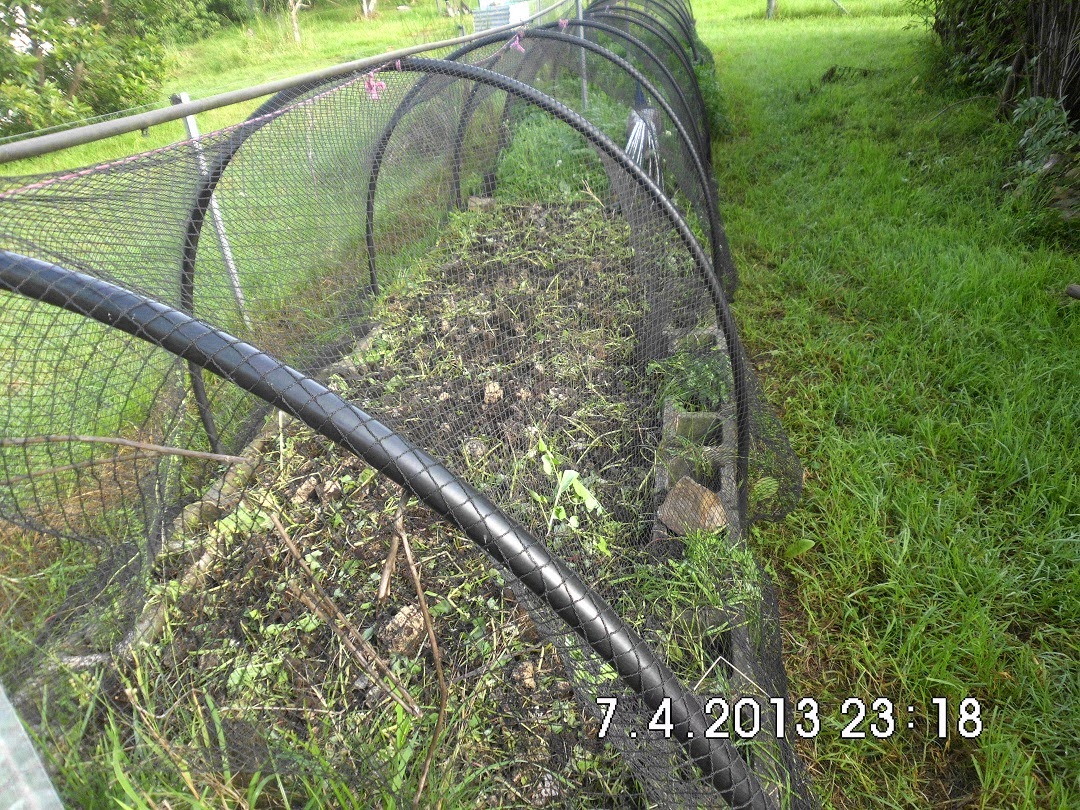
In the mean time the Broccoli needed attention. The plants had grown sufficiently large enough to allow the pesky Peacock to continue his leaf pruning over the existing mesh guards. resurrecting some tall mesh panels from storage an exclusion zone is installed.

Chewed

Protected

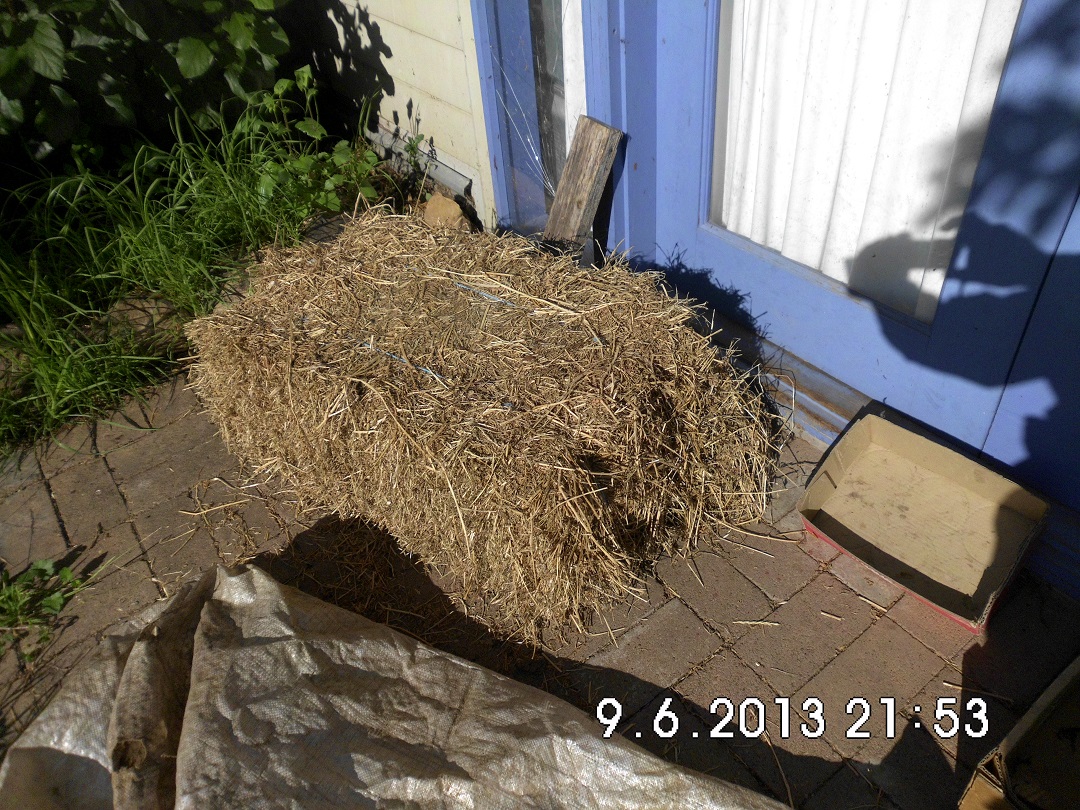
The Orchard and Vineyard are heavy with Autumn growth and the ride on mower is given some exercise. While out and about one of the large silage one ton bales which we chainsawed into four sectors is broken up and various garden beds get a heavy application of mulch. All part of the plan to reduce watering needs next Summer.


MUSTARD.
When making mustard always use cold water/verjuice/wine/vinegar when adding to Mustard powder. There is a chemical reaction that occurs producing the pungent odour and sharp taste. If  using warm or hot liquid the burning sensation remains bur with a slight bitterness and complete lack of flavour. If you cook Mustard the pungent overtones are lost.

Wednesday, April 16, 2014

Garlic and Dried Beans

Today Jean went through our stocks of garlic to collect good specimens for planting. We had already put aside good sized corms into paper bacgs back when we harvested in November/December.


 After a couple of hours of work we ended up with 450 cloves ready for planting compared to 330 last year. There was one minor problem with some of the stocks. A powdery residue which seemed to be the result of something eating a few cloves. Next year we will try hanging the garlic rather than use the drying racks.

The cloves are divided into 13 groups. Some are specifically known varieties such as American White and Allsun. Others are varieties collected from retail outlets that labelled them as Australian Grown. We kept each outlet separate even when we collected from the same outlet but on a different date. There is even one bag that contains garlic grown by a friend who is able to keep hers for up to two years - amazing.

13 bags of Garlic


The beds for the garlic were prepared last week and Jean's job now is to get them all in the ground.

Keeping Jean company in the Cave while she sorted garlic it was an ideal time to shell the dried beans that had been collected. This is the first year we have tried growing (and being self sufficient) in dried beans. It most probably will be the last year.

Despite a substantial planting the harvest was small. The Borlotti bush beans were successful. The plants grown in our house yard did well. Although I find bush beans a pain as they fall over and pods drag on the ground.

Borlotti

The Borlotti planted in the outside Tomato/Vine bed were eaten by Wallabies and/or rabbits.

The Haricot beans out there had their base leaves nibbled but survived long enough to have the stand knocked over in a storm. But like their namesakes in our protected garden they grew enormous plants with lots of pods. The pods were mainly empty or had diseased beans. Either something missing in the soil or too much nitrogen or just bad luck. Consequently despite the mass of foliage the result was only a cup full of beans.

Haricott


Miniscule volume of Haricott Beans on the left

We planted Lima beans from dried beans in the pantry. The vines grew and flowered beautifully but there was nothing but distorted tiny beans in the shell. Again, was the problem our soil preparation, hybrid beans or just bad luck?

Front of the Lima/Christmas Bean Curtain with Green snake bean on the extreme right and a Red Snake Bean on the extreme left.

Rear

Christmas Beans were planted beside the Lima. The end result was a curtain of healthy green. With the Christmas beans there was a small harvest but even smaller than the Haricott.

Christmas beans on the right
Strangely though in the same curtain were two Snake bean plants one on the right was a green variety and the one on the left a red variety. These grew perfectly and provided us with a steady supply of steamed green and red beans for the table.


Wednesday, April 9, 2014

Autumn Planting

The last few days have been consumed (not entirely) with planting seeds and a few seedlings.

There were a few seedlings in the nursery that went out i.e a couple of Kale and some more Kohl Rabi (most of the previous planting were eaten).


Kale and Kohl Rabi seedlings

A punnet of Coriander we picked up last week and a punnet of tricolour Spinach from Aldi. The Spinach was a bit straggly but it was an opportunity to get a head start. As a backup a row of Spinach seeds also went into the ground.

Tricolour Spinach and Coriander

Climbing Snow peas are in and have emerged despite something digging in the bed. A few potatoes have gone into the area in front of the peas. An area next to the snow peas has been dug over to remove the Nut grass and a good stand of Broad Beans planted.

Broad Beans at the back, Potatoes on the right and the Snow Peas on the left with their climbing strings and protective mesh


Snow Peas Germinated

An attempt is being made to germinate onion seed in situ. Onion seed is a mystery to us and usually we end up buying advanced seedlings. They seem to be a touchy seed losing viability quickly and germination rates very poor but then that could just be our lack of knowledge on how to get the best out of them. We try every year. It didn't help when Belle the cat decided to use one of the onion plots as a toilet stop.

Belle (fully recovered from the tick bite) awoken from slumbers after digging up the Onion seeds

A row of Onion seeds fitted into a spare section

In went a row of shallot seeds, these are a good standby in place of onions. Some Radish seeds and a row of Pak Choi seeds.

Beetroot seed were soaked in Boron overnight and they've gone in as well as some Carrot seeds and a small stand of Rocket (Arugula).

Carrots covered in plastic to aid germination alongside Beetroot, Radish and Pak Choi

Finally, a large section of green manure crop has been chopped with the hedge trimmer and dug in with some well matured compost and lime. When Jean returns next week from Benalla she will want to plant out the annual Garlic crop.

The Garlic bed prepared and in the top right just barely visible is the Peacock inspecting the workmanship


Wednesday, January 1, 2014

Hispanico (Cows milk Manchego), Harvesting Onion and Garlic

Time to try something different in the cheese making area. Came across this recipe on NECMSC. It looked pretty simple and having tried Manchego a few times in the past it went on our list of things to try. The process turned out to be very straight forward. We haven't been using the heavy duty cheese press of late but with a block of cheese this size it came in handy especially as the pressing process involved different pressures at various timings. Gauging the pressures was a bit of a guess. 5KG is easy as that is the exact weight of the metal door stop. But 10 KG was a shot in the dark i.e. the screws turned down a bit and 30 KG was the screws turned down a lot. In hindsight maybe making a couple of smaller ones might have been a better idea so that tasting them at different ages would be easier but sometimes it's just nice to have a big wheel for aesthetics.


There was a bit of stirring involved but as luck would have it a handy book and the art of reading and stirring work well. Stirring, coffee, Christmas cake and reading is a touch more difficult but can be achieved.


Some of the alliums were ready in particular the one called French Shallot which looks like a bunching onion. It keeps really well. We used the last one only two weeks ago. They are also exceedingly strong flavoured. Definitely eye watering material. This years crop did not contain the larger sized bulbs that came last year. Our assumption is that weather conditions were a little different and not ideal. It could also have been that the compost used was not up to scratch but we don't think so. Sometimes nature has a little mystery. Still the quantity was good enough and there will be plenty to use as seed stock this coming July.
 
 
The last of the garlic was pulled as well. Again the quality was not present. The odd good corm but nowhere near as good as last year. It just didn't bulb up. Normally we would have finished harvesting in November so this is more than a month late. Still there will be enough across all the varieties to keep us going. Especially now that we have started freezing some of the crop to prevent it shooting before the next years crop is ready.
 
 
We finished the day by sitting in and around a friends swimming pool having a drink and chatting about the world, books and every thing else. Something we plan to do more of in 2014.

Saturday, November 9, 2013

Collecting Manure, Bees and wax, Garlic, Mulberry Pruning

According to the Bureau of Meteorology the rain is on the way. We shall see.

The vineyard was in need of a splash of water and we used the opportunity to feed the vines with some seaweed and carp mix from Seasol. Although we drip watered for 2 hours it would be good to get some real rain to soak into the ground and give the vines a good drink.

As it is the pressure pump is playing up. It won't come to pressure it can't get more than 50% of the way. The suspicion is that the impeller may be loose or damaged. It will be dismantled in the morning now that everything has had a water. If it rains it will be even better if parts are needed to ordered. What do they say at The Survival Podcast - "two is one. one is none"

The morning was overcast but warm and we took the time to go to the pool and get some real exercise as opposed to just working hard. The water was beautifully refreshing.

Yesterday afternoon two hours were spent bent over putting cow poo into bags. Almost every spare bag was used as the cattle had been in that paddock for two weeks. This afternoon it took two trips in the tractor to bring it all to the top of the hill - over 27 bags.


Over coffee we read that it was a good time to prune Mulberry and force it to lay on a second crop. And so it was done. Conveniently the cattle were now on top of the hill and became the beneficiaries of the green leaves. Apparently it is very good for them. They must think so as they demolished the lot.

The sun finally came out making the weather even more oppressive but you can't keep a bee keeper down. The safety gear was donned and the smoker primed. Some more sugar and water was put into the feeder and just as well they aren't getting all that much nectar judging by the small amount of honey in the top super. However the brood chamber looks good and the hive is very active. The hive opening forced another batch of Small Hive Beetle into the death trap. A satisfying sight.


Before smoking
After smoking

 
Back in the kitchen it was time to perform another melting of the harvested wax from earlier in the year to get it even cleaner. It's a simple procees. Put some water in a container you don't plan to use for anything else. Put in the wax and heat gently until it melts. Pour it into an appropriately shaped container via a sieve to cool. The slower it cools the more time impurities have to settle out. Gavin Webber from Greening of Gavin was talking about Soy candles because of the cost of bee wax. Maybe his solution is to get a hive or two. Bee keepers don't get all that much for their wax when they swap it for new foundation. I'm sure it wouldn’t be that difficult do a deal for cash.

An old saucepan for wax melting, note the impurity in the top right quadrant

Plastic container for moulding and the filtered and slowly cooled cleaner wax
The finished product
 
An inspection of the garlic stands showed that two more varieties were ready for harvest. Allsun and Purple Glamour. These two had excellent sized bulbs. We usually grow six or seven varieties although sometimes up to a dozen. Each year is different for the varieties and some do better than others depending on the conditions. Our main variety is J&M named after the people from whom we sourced the original stock. Well now its not a main variety as it had a disastrous year. We will be lucky to get enough for seed stock. Hopefully J&M didn’t have the same experience and we can get some more.

Allsun and Purple Glamour


We have this little brick paved area in front of the cave which has a clear Perspex roof. It is used  to process grapes, Apples and Pears during all the messy operations as it is easily hosed out. It is also perfect for drying Garlic and Onions. They'll stay here for a week or so before having the roots and stems trimmed and the dirty outer rubbed off.

Purple Glamour


Wednesday, June 12, 2013

Mulching


Regular weeding is an ongoing task with any vegetable garden and it is not one of our strengths. Always on the lookout for a time saving technique we have tried various mulching processes to reduce weed dominance. Garlic and Onions are very difficult to mulch and tedious to weed. One useful and effective technique we have been using recently is to run old Lucerne through our mulcher producing a fine chaff. This is easily sprinkled over younger seedlings to cover the soil.

Originally used mulch hay but it held too many seeds. Lucerne or straw bypasses that issue.

Our Chipper/Mulcher is over 15 years old and has proven to be a versatile and useful garden tool. Its list of achievements are:

  • Chipping and mulching garden prunings
  • Chipping fish heads and frames for chook food
  • Mulching straw and lucent bales into fine chaff
  • Mulching oyster shells and Cuttlefish frames into shell grit for chooks
  • Mulching fireplace charcoal into bio char
Spoilt Lucerne

The versatile Chipper/Mulcher


Garlic Mulched with fine Chaff

Wednesday, December 8, 2010

Sawdust, Garlic, Mower Blades, Camembert, Cucumbers, Beans and Zucchini, Roasted Tomato Chutney

Sawdust

At the beginning of Spring all the sawdust in the chook yard was shovelled out and most of it used to make beds for the tomatoes and melons and some put aside for use in other vegetable beds. After nearly 12 months of being scratched and manured by the chickens it was full of nutrients and well broken down. Finally this week it was replaced with fresh sawdust, 150-200 mm thick. If it is made too thick it forms a hard pan and needs to be chipped part way through the year to ensure it is fully aerated and exposed to droppings. The easiest way to obtain sawdust is from any nearby sawmill by the truck load. 20 cubic metres lasts many years as long as there is somewhere to store it. Luckily in this area there is also a small holder with his own mill who cuts the odd log. He happily lets you take his waste for nothing. He even loads your trailer with his bobcat.
One of the advantages of having a few acres is the space to use a tractor, and one of the advantages of a tractor is its ability to have an hydraulic bucket on the front. One of the advantages of a hydraulic bucket is the ability to move large volumes of sawdust. There is nothing like a little mechanisation to speed up tasks. The tractor has a slasher attached partly to counter balance a full bucket and partly because it is the most used implement. Rather than remove the slasher to tow the trailer of sawdust to the chook run there is a tow ball welded to the slasher. This makes quite a long train moving through the orchard, but it works.
It is also useful to have one end of the chook run opening completely with a large, hinged panel. The panel is large enough to enable the tractor loader to fit through.

Garlic


Garlic in Drying Racks
The annual supply of garlic was harvested this week. Looking at some of the varieties it seems we may have left a couple a little late as the corms had split open. Some of this is due to the wet conditions. There are seven varieties we have collected over the years. Some have been found in supermarkets and some through seed suppliers. Mainly we keep the purple (tinged) varieties because they have higher levels of allicin – the stuff that is good for health. There is some variation in corm size. Since the beds were identically prepared this must be just a seasonal variation. We always plant the largest bulbs to ensure we maximise the end result.

Mower blades

With a property resplendent with rocks no matter how many are removed to a rock repository, more seem to emerge from the ground. These sneaky little beasts cause the ride on mower a lot of problems. Not so much it seems in blunting the blades as in curving the blades upward. The end result is a very poor cutting edge. A simple solution has been to grip the leading edge of the blade in a shifting spanner and twist the blade back to horizontal. A little angle grinding also helps provide an edge. After every mowing, some time is spent digging out newly exposed rocks with the hope that one day they will stop growing.

Camembert


The Raw Product

As an extra treat for Christmas, some camembert was made this week. About 12-15 litres of raw milk resulted in 15 small rounds which should be just about ready in time for Christmas day. At the very least it will be pleasantly edible even if it hasn’t reached that runny stage. Normally the mould spore added would be Penicilium Candidum but just for a change Geotricum Candidum was used. Because of the change, the recipe was followed meticulously. Past experiments have involved using the Brie recipe but the Camembert size small rounds. That blend has worked well for us. However, when trying something new for the first time, past results have shown it is always better to be exacting with the first trial batch before deviating.


Camembert Forms


Once made, the small rounds need a humid environment in which to mature. Refrigerators will dry out anything left uncovered. The solution is simple: place the cheeses on a tray and place the tray inside an air tight plastic bag. Seal the bag with a couple of twists and a twist tie. The moisture in the cheese will provide sufficient humidity; if it doesn’t just put a table spoon of water in the bag underneath the tray. The bags can be cleaned in the washing machine and reused many times.


Under wraps ripening

A nice big slice runny Camembert on some toast, with a glass of chilled wine is a most pleasant experience. Unfortunately, once it ripens, there is only a short period before it begins to get an ammonia smell and then sadly for us and happily for the chickens it is consigned to the girls. Progressively we have reduced the number made and increased the frequency to try and balance this situation. In addition, eating a few just that little bit earlier has provided some longevity in consumption.


Some Finished Product


The cheese fridge is reasonably full at the moment. The door has 7 Parmesans aging while in the shelving there are a few Swiss and Cheddars maturing. As always, a goodly amount of Fetta is in a light brine – this keeps very well and is easily made in large batches. As Summer is with us and tomatoes are coming on, a reasonable amount of Haloumi is on hand. Again, this is one that keeps very well in its brine solution. A short soaking in water removes much of the salt and then fried both sides so that it gets a little golden brown provides a nice topping to thick slices of fresh tomato. It has got to be one of the best Summer nibbles around with the harder texture and saltiness of the cheese balancing against that enticing tomato smell and flavour.

Asparagus weed update

Previously there was a mention of an invasive weed that appears to have held back the growth of the 4 year old asparagus. Well, the non chemical solution seems to be working as far as removing its presence. Initially, a number of hours of thorough weeding were completed, then on successive days much less time was spent going over the bed as a follow up, picking out any roots that were missed. Starting with a daily weeding in the first week, moving to weeding every couple of days for another fortnight, and then once a week. Finally, it is now just casting an eye over the bed for the telltale leaf structure and spot weeding as necessary and carefully following the root down until it is completely removed. The edges of the bed have been closely examined and weeded to depth. It appears this constant harassment has weakened the plant to a point of near extinction. The asparagus has suffered a little with having some roots disturbed and occasional minor damage to the crown. Hopefully it will now be free to grow robustly for the remainder of the season. To ensure maximum benefit no further picking was conducted allowing all energy to go towards plant strength.

Cucumbers, Beans and Zucchini

As always happens at this time of the year, there is a surplus of cucumbers, beans and zucchini. Many friends also grow vegetables, these three are not in short supply with them. Fortunately there are always a few city friends who appreciate a gift of fresh produce. The cattle have developed a taste for fresh garden produce and have no trouble eliminating any bumper harvest every day. So tasty are these vegetables, they’re whipped straight from the hand with a long, snaking tongue. It’s good to see nothing being wasted.
While speaking of cucumbers, it is only fair to mention the Japanese Climbing Cucumber. This incredible plant grows relatively slowly, as does its fruit. The fruit reaches large proportions at maturity, in the vicinity of 400 mm. Until it reaches full size, the seeds are still immature it is delicious and tender.

Tomato recipe

After having made the generalisation that no recipes will be published in this blog unless they are simple and delicious it seems that the very next posting will contravene that rule. But, this recipe is incredibly delicious even if not all that simple. It can be made in large batches and stored in small jars and eaten in smaller amounts to spin out the supply so the memory of the hard work involved fades. It goes really nicely with meat.
The recipe comes from Gay Bilson’s book Plenty.
Roasted Tomato Chutney
2 tbs black mustard seeds
400 ml malt vinegar
5 kg ripe tomatoes
300 ml Olive oil
200 g chopped ginger
20 cloves garlic
10 birds eye chillies
2 tbs turmeric
4 tbs roasted cumin seeds
2 tbs sambal olek (chillies in salt) (or just some ground chillies as we used)
250 gms palm sugar
100 ml fish sauce
Soak the mustard seed overnight in malt vinegar
Peel (we don’t) the tomatoes and roast in olive oil for up to 3 hours at 200 degrees Celsius. Don’t roast too many at once otherwise the steam will stop the roasting process. They should be dark and almost dry.
Blend all the remaining ingredients and simmer the resulting paste for up to an hour.
Add the tomatoes and their roasting oil. Add more oil if necessary.