Search This Blog

Showing posts with label Chardonnay. Show all posts

Tuesday, February 4, 2014

2014 Vintage Update

Shiraz, Merlot, Tempranillo

After having frozen these three batches to below 0C it was time to defrost them so as to add the yeast. It took all day and night to have the temperature rise into the high teens early twenties. This morning The yeasts were rehydrated in grape juice taken from each batch that had been warmed to 38 C. Then after allowing the fermenting yeasts to cool to within 10 C of the main batches these starter batches were added back.

Two new yeasts are being tried both from Vintners Harvest an American company. The yeasts were sourced from a local home brew shop.

The Shiraz has VR21 which will go up to 15% alcohol the Shiraz has a high Brix reading of 24 and will need this.

Exceptional strain for full fruit red varietal wines with good structure, balance and colour. Excellent strain for red country wines.” Says the manufacturer.

The Merlot and Tempranillo have R56.

Perfect for rich full bodied red wines with exceptional full flavoured complexity

Chardonnay

The Chardonnay was racked after the intial fermentation slowed. Now it rests in airlocked demijohns, occasionally giving off a little CO2 as the last bits of sugar are consumed by the yeast cells. Some of the demijohns wee racked to remove the gross lees and now it was time to try some further experiments. Some of the batches that had good skin contact now had few American Oak chips added. Just to see if there would be any flavour improvement. And yes an un-oaked demijohn was kept of each as a comparison.

Sauvignon Blanc

These batches are in demijohns under refrigeration to keep the fermentation temperature between 12 and 15 C. They are bubbling away slowly. The airlocks aren't bubbling because they don't have water in them. Instead there is a little wad of cotton wool. This was recommended in one technical reference to enable H2SO2 to more readily escape. And it is escaping. There is a distinct rotten egg smell when the doors of the refrigeration units are opened.

Rose

These draining's from the Shiraz, Merlot and Tempranillo batches are all fermenting under airlock also under refrigeration. Once they are nearly finished they will be racked and a little addition of oak chips made just to add another dimension.

Chambourcin

Has pretty much finished its fermentation but some skins are still apparent on the surface. The goal is to have these skins in contact with the wine for a minimum of 22 days before pressing and storing in demijohns with Oak chips to settle and age. There is a plastic sheet covering the container to keep out bugs and every day a little CO2 is squirted over the surface to add some further protection against infection. This is the nervous part of the process. While it was madly fermenting the CO2 gas produced as a by-product protected the wine but now the only protection is the small amount of Potassium metabisulphite that was added at the crush and the daily burst of CO2.

Pinot Noir

The fermentation has slowed but not finished. The skins rise but not much and a once or twice daily plunging occurs. This is also now under plastic protection and also getting a whisp of CO2.

Saturday, January 25, 2014

Chardonnay, Pinot Noir, Chambourcin - update

The Chardonnay is out of the chilling units. Once the Brix got down to below 15 i.e. it was a third of the way through the sugar it was time to let it come back to the ambient temperature and ensure a robust ferment finished of the sugars.

This didn't take long and when the airlock slowed to an intermittent gurgle it was racked into clean demijohns fully filled to eliminate any air. It will now rest until bottling in a few months.

 
Chardonnay - various test batches

This was an opportunity to perform an early tasting. All the now four batches have slightly different characteristics and nothing unpleasant. A very pleasing progress report.

The Pinot Noir had its chilling unit turned off and in the morning the yeast was rehydrated. A  Specific Gravity (SG) test showed a potential alcohol level of a touch above 16%. I couldn't bring myself to adulterate the must with water. I'll take a chance all will be well. The BDX yeast is rated to 16%. An interesting test.

Pinot Noir with the cap of skins formed

Pinot Noir after plunging, the fermentation very active
 
 
The Chambourcin slowly increased in temperature peaking at 31 C briefly. Because we were going away for a day a header board was inserted so as to negate the need to plunge. This worked well and it was removed the next day. The temperature commenced dropping but the Brix level was still high. Rather than risk a stuck ferment a little yeast nutrient was stirred in to feed the yeast cells. This worked a treat and 12 hours later the ferment was vigorous but not foaming any longer and the temperature rose.

Chambourcin, note the deeper colour and less vigorous activity as it moves past the half way in fermentation


Wednesday, January 22, 2014

Pint Noir, Chardonnay, Chambourcin Update

The Pinot Noir is resting in a freezer at 4 C and is now just entering its 4th day. Tomorrow Friday it will be time to let it regain its warmth and introduce it to some yeast. I'm still undecided what to do about the high Brix reading of 26. First up, tomorrow I'll perform a Specific Gravity test to confirm the reading. The previous readings were with a Refractometer which may not be completely accurate. 26 Brix converts to 15.6 % alcohol which is at the upper limit tolerance of the BDX yeast I'd like to use. If the yeast fails to convert all the sugar the wine may end with too much residual sugar. Not what was being planned. The options open to me are do nothing or add water to dilute the sugars. I've been trying to keep this batch of wine as natural as possible. The fruit is perfect and any interference can only lead to potential disaster - well maybe not just a lesser quality than would be possible.

The Chardonnay (in demijohns) is still fermenting in various cooling units (freezers) at 15 C. There are three batches B1 is pure fresh juice, B2 is juice soaked on skins for 16 hours, B3 is juice soaked on skins for 26 hours and there is a B4 which is a few litres that continued to be pressed out over 24 hours. I just wanted to see how much fluid would extract if the skins were loosened and pressed a second time.

The Chambourcin is fermenting nicely. The temperature has been rising at a steady rate. Ideally I would like not to exceed 30 C and it is just below that now. As it is fermenting the skins rise to form a cap. This cap prevents the heat from escaping. By plunging the skins back below the juice the heat is released. During the day the plunging is performed every couple of hours or pretty much whenever I walk past. Today we are both away for 8-9 hours and I'm worried that the temperature may shoot up. I could use the last spare freezer to help dissipate some heat. Decisions.

Friday, January 17, 2014

Chardonnay and Chambourcin

Somehow I woke at 1.30 am.

The lounge room in dark

Going into the cave

The passion was there. Fed the cat (Lucinda) on the way to the cave and started the process of pressing Batch 3 (B3) which had soaked on skins for 36 hours. The hope is that it does not turn out to be fantastic otherwise this early morning pressing will have to become the norm.

B2 had started fermenting well and was despatched to the freezer to idle along at 15 C.

The pressing went on all day as a background task.

The vet called to say Belle (the cat) was making a good recovery. we will collect her on Sunday.


Nets up on the Chambourcin


The last row of Chambourcin was picked and the entire 71.2 KG went through the crusher/de-stemmer with a goodly lot of whole bunches kept. This time I didn't weigh the whole bunches so can't record percentage. It truly was a gut feel occasion. This is regrettable in hindsight.


Add caption

The sugar came in at 24 Brix which for what was trying to be achieved  was absolutely perfect. Now wait for it ... the pH was 3.5 the exact mid range of what is recommended. How satisfying. The pressure is on now. The fruit is perfect and only the wine maker can stuff it up.

temperature control

The goal is to let it soak at 5 C for 2-3 days. A little sulphur has been added just 50 ppm. A plastic wrap has been place over the container with the temperature probes poking through. A little CO2 would be just the ideal protection while the soaking process occurs. Some ingenuity here. Using the newly acquired soda stream with a plastic tube to provide a dosage of CO2. Rather than buy bottles of soda water we now make our own and avoid the disposal issues associated with buying the stuff.

The mighty Sodastream
The SodaStream gadget is impressive. 2-3 presses on a bottle of water and you have a refreshing bubbly drink. And in this weather - what can you say. The CO2 bottles can be exchanged at both Big W and Kmart at a reasonable price making it very easy to maintain. The bottles are of a special type but spares are cheap and we also purchase a spare CO2 cylinder for convenience.

Thursday, January 16, 2014

Wine Making with Chardonnay

Most of today was spent working on the three batches of Chardonnay.

Batch 1 (B1) was pretty straightforward. It was all juice and the only job this morning after leaving overnight to chill down to below 10 C was to run it through another finer sieve. There was a lot of sediment in the bottom of the demijohn which was added to B2. I didn't bother filtering it as B1 was at the 10 litre mark and it didn't need any more volume.

B3 was still in the freezer at 10 C it will be 2 am tomorrow morning before it reaches 36 hours on skins. Having worked out that it meant getting out of bed there was some thought about doing it later today and making the test closer to 24 hours or leaving it until normal wake up time and making it 40 + hours. We will see what happens.

B2 needed pressing in the basket press. As there were other jobs to do elsewhere it was an ideal opportunity to do the right kind of pressing i.e. very slow. This slow method means less of the bitter parts of the skin are released. So all day it was just a few clicks on the handle of the press using just finger tip pressure.

As the juice came out and the pressure relieved it was onto the other tasks. Measuring out the yeast getting it ready to rehydrate. A sample of juice s raised to between 35 and 38 C and the yeast added. Once it has started bubbling the temperature is lowered with cold juice a little at a time and the yeast allowed to bubble again. Never more than a 10 C change in any one step. Once the yeast is working at a temperature within 10 degrees of the pressed juice it is added. The slow pressing meant the pressed juice was gradually rising in temperature and it need to be at or above the planned fermentation temperature of 15 C.

Also tested was the pH which came in at 3.55. The ideal pH is between 3 and 3.5. Aim was taken at the midpoint t3.25. To get there Tartaric Acid the largest acid type in grapes needed adding. There is a simple formula to achieve the desired result. After checking and double checking the calculations the acid was stirred into the demijohn. The calculation is a little tricky for B2 as the grapes are still being pressed and the final volume is only an estimate based on previous years yields. But by choosing a mid point there is some wiggle room.

When B1 started fermenting comfortably it went into the freezer at 15 C. B2 because of the much larger volume will not see much activity until the early hours of tomorrow morning.

Measuring out the yeast required

pH meter

Getting some juice at the correct temperature to rehydrate the yeast

Pressing Chardonnay B2

While waiting between applications of more pressure other jobs got some attention including a few trips across the river to setup and then fix an irrigator that was playing up. And which continued to play up. At least one patch of ground got a very good watering.

And the baby Roquefort needed the final application of salt.

Weigh each cheese and calculate the 2% salt and pour on top

Five little Roquefort altogether

Just after lunch confirmation was received that the Pinot Noir would be ready for picking on Monday next. This meant tomorrow (Friday) was free - well sort of.

 Our Chambourcin was close to picking. A couple of rows had readings of 21 Brix but lower down the slope the readings went much higher varying between 23 and 25. The aim was to get a final Brix of 23 to 24 if possible.

With the windfall spare day it was decided to pick at least the ripest rows and chill the fruit. Jean reminded me that our thermometer was showing 42 C. Much higher than the forecast.

Slow and steady picking and lots of water and breaks resulted in all but one row being harvested. The volume is greater than last year by about 20%. We can put that down to two factors. The first is the near absence of bird damage. The lack of bird damage was also mentioned when the Chardonnay was picked. This seems a valley wide phenomena this vintage.

The second factor is just a perfect season. Steady sunshine, good flowering and fruit set and a little added water at the appropriate times. Some vines had lovely full bunches. Something we don't often get at HHF on our rocky outcrop.

One last increase of pressure on the ongoing B2 and off to bed. Lets see whether passion for wine making will see a 2 am rising.

Wednesday, January 15, 2014

Chardonnay Day

The Vineyard at 5.50 am
Well it took a little more than an hour to get to the vineyard but still I was there talking to the early morning crew by 5.40 am. Then off to pick.


The Chardonnay fruit has a very short stem making snipping really hard. On top of that part of the row had some bird damage which needed cutting off to ensure the purity of the fruit. It took closer to three hours to get the required quantity. Then there was the stop for fuel on the way home. Back by 10.30 am.


To find ...

One cat taken to the vet with what seems to be paralysis tick symptoms. The quoted $3-500 was added to the cost of ownership spread sheet. First entry for her as she was a free to good home from same vet. Must inquire about warranty or any evidence of a pre-existing illness before she was taken home by us? Just kidding. Belle is a valued member of our family and although an outside cat she does check on us every morning and every evening. If she finds we are ok she will accept a little food as a courtesy then head out for more ratting. Has been guilty of bringing the odd snake into the bedroom. Most of the day you will find this small tuxedo laid out in a quiet spot recuperating from the nightly patrols. Poor Belle will not like being cooped up for a month needed for a full recovery.

Weaners over the river have broken out and found their way into a paddock that was greening up nicely after some heavy irrigation. Oh well they might as well stay there it was for them after all. The break out was because the boss had turned off the electric fence and forgot to switch it on again. Reminder to self to test fences each Monday.

The pipe into the irrigation pump had burst out of its fittings. Not a serious problem. Used multigrips to really tighten the fittings. They are a brand that I'm not fussed on because if you don't fit them just so they fail. The competing brand has a design that works even if you just think about tightening.

Now back to the grapes.

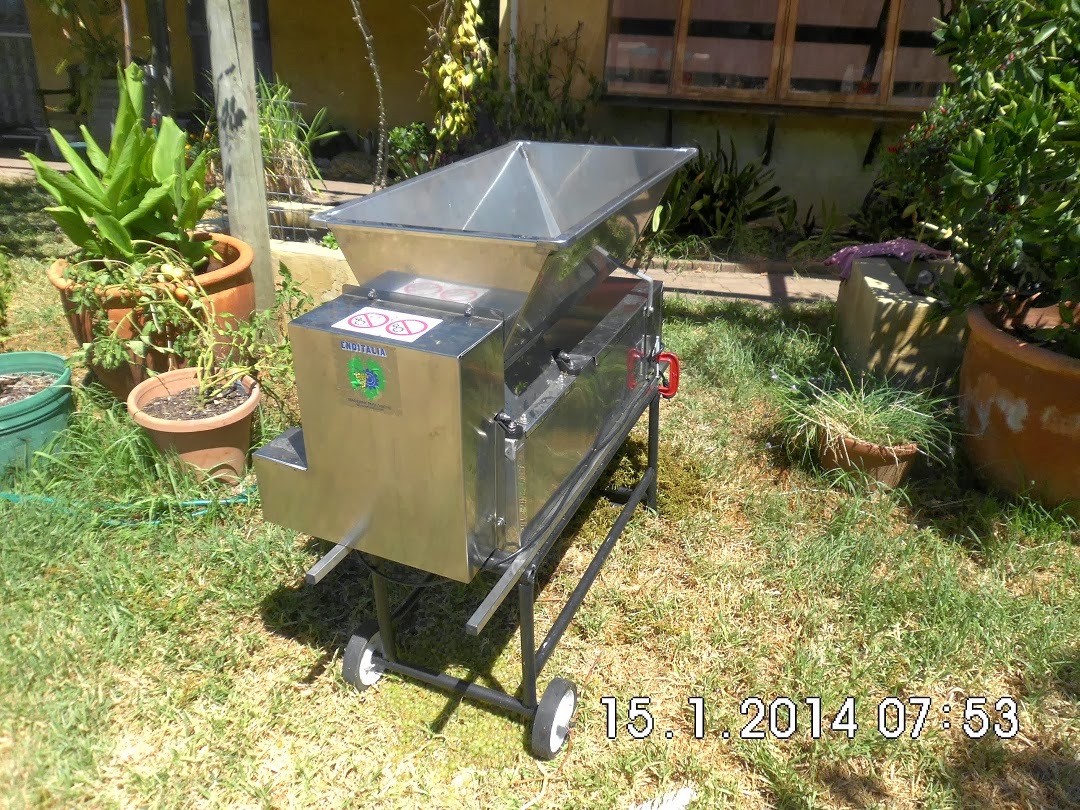
Crusher de-stemmer out on the grass as the crush pad is drying Onions

De-stemmed Chardonnay in the chiller

Batch B2 is soaking on skins for 16 hours

Batch B1 is juice only and being chilled while batch B3 below it is being soaked on skins for 36 hours maybe

And while all that was going on we knocked out a 9 small rounds of Camembert. And did some paid work. Busy day.

Sunday, June 9, 2013

Bottling Wine


Bottled most of the whites today, Muscat, Semillon, Chardonnay and Sauvignon Blanc. The first dozen of each was made into sparkling by adding fermenting yeast and sugar. 15 ml of 25 Beaume water and sugar with yeast added while it was 40 degrees C. Then 12 grams sugar then filling the bottle. Using recycled champagne bottles to make sure they handle the pressure.

A nearby resident celebrates Friday night with a bottle of French champagne. Rummaging through their recycling bin once a week has resulted in a good collection of top quality bottles.

The rest of each batch of wine went into Stelvin sealed bottles also collected from recycling. The screw caps can be reused several times just need to check the wadding inside has stayed intact.

Not a bad days effort six dozen whites and four dozen sparkling. Should get us through the year. When opening the sparkling it just needs to treated like a home brew i.e. decant gently into glasses or another bottle and leave the sediment behind. Getting crown seals for the champagne bottles is not all that difficult as a lot of home brew places carry them.

Prettied up with a nice label

The underground wine cellar filling up and getting some order with neck labels
Freshly bottled still wine alongside a nicely shaped sparkling wine.
 

2013 Vintage


Well 2013 vintage in the Hunter Valley NSW Australia is shaping up to be another disaster. The whites are mostly in. I managed to get some Chardonnay, Semillon and Sauvignon Blanc from a good vineyards. Also a little Pinot Noir.

It's surprising how some vineyards are so generous in allowing amateurs to pick (and pay) for a few small quantities of grapes for home winemaking. It always seems to be the viticulturists who are happy to oblige and generous with their time. Some liberal and sincere praise for their efforts in producing a quality product does not go astray. I suspect sometimes that the vineyard's winemaker may not offer as much praise. I'm of the opinion which is shared by many that it's easy to make good wine with good grapes. The winemakers skill is required to make a silk purse from a sow's ear.

Picking grapes from a large commercial vineyard isn't simple. Got to remember the samples taken by the viticulturist reflects an average from the entire variety.

Last year we picked the Chardonnay from the short bottom rows to save the vineyard having to run a picking machine through them. Well that was a mistake as being at the bottom of the hill they were maturing in a slightly cooler environment and consequently the sugar levels lagged behind. This year we picked the same stand but did an entire row half way up the hill with a good result. With the Semillon where the tests showed sugar a little short of desired levels we picked ripe bunches only from all over the plot, again a good result.

Didn't quite get it right with the Sauvignon Blanc as we picked from the eastern side (sun rising end) instead of the western end and so the sugar levels were a little lower.

The whites were destemmed, sulphured to 50ppm and the berries chilled to 10 degrees Celsius in 100 litre plastic containers using old freezers. Upright freezers seem the best. About 16-20 hours on skins before pressing. The yeast was acclimatised to a lower temperature and the must inoculated. After about 24 hours, when things were fermenting well the must was gradually cooled to between 15 and 20 Celsius. A timer on each freezer kicks in and cools. How often is adjusted depending on outside temperature and heat generated by the fermenting must. The must is in demijohns with an airlock and a temperature probe against the glass. A little yeast nutrient was added in three stages.

About two thirds through the fermentation the freezers are turned off and the fermentation finishes at a higher temperature. Racked and American Oak chips added this year to the Chardonnay and Semillon. Now its just sit and wait.

Pinot Noir in Crusher Destemmer


Crusher Destemmer and Basket Press


Demijohns in Freezer
50 Litre Fermenter in Freezer