Search This Blog

Showing posts with label Shiraz. Show all posts

Friday, February 28, 2014

Shiraz, Merlot and Tempranillo

Today was a big day for pressing grapes. Three varieties have been sitting on skins for 23 days soaking and breaking down to maximise the extraction of all the goodness possible.


Shiraz went first. Barely 35 kilograms producing a little over 19 litres after 4 litres was drained for Rose before fermentation. The demijohns had both American Oak and French Oak added in a 50/50 mix equaling 6 grams per litre.

Leaving the Shiraz pressing in place the Merlot was tipped in over the top. Starting with only 30 kilograms and having already taken out two litres the result was just over 17 litres. It received the same Oak treatment as the Shiraz.

Finally the Tempranillo. Only 21 kilograms yielded just over 12 litres after the earlier 2 litre Rose siphoning. Identical Oak treatment for it as well.

The Merlot was a much juicier grape providing a better yield while the Tempranillo benefited from being the last variety pressed. Just before it was added the previous grape Marc was broken up which would have added a little more liquid and of course being the last pressing of the day it received a very solid pressing.
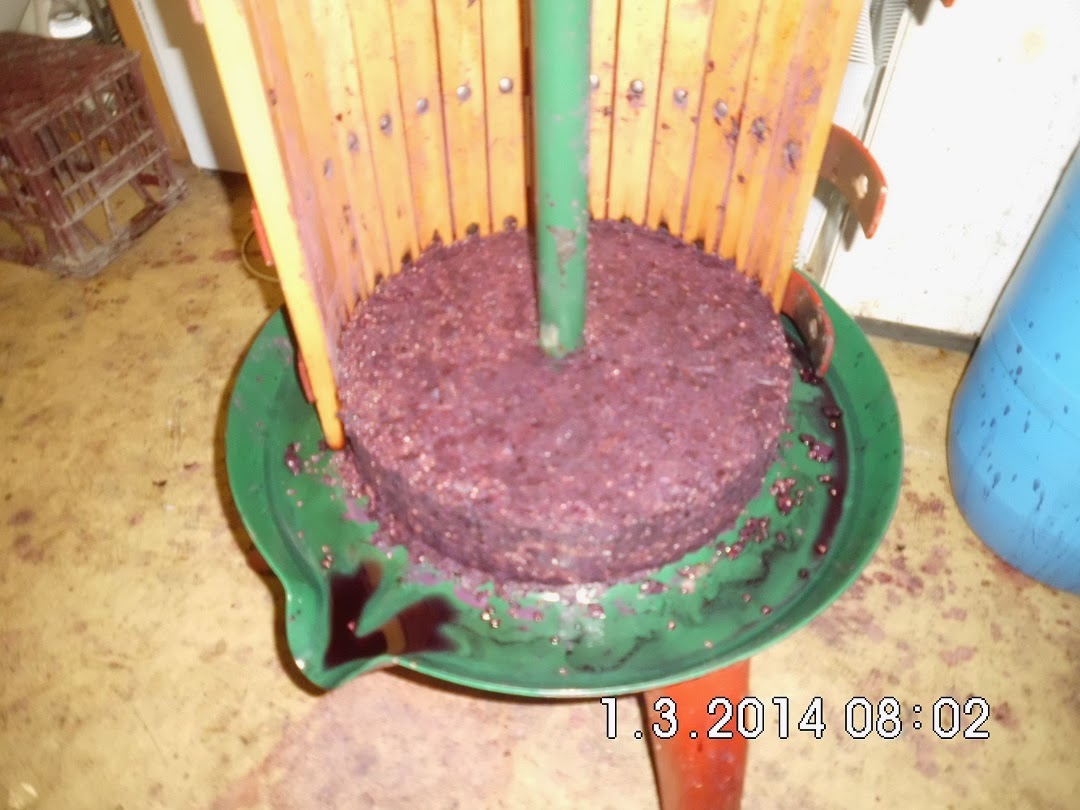
 
After pressing 70 kilograms of grapes there is very little marc remaining
 
In a few days the Tannat will be ready for pressing and just as well it is the last for the vintage as we are getting short on demijohns, especially the smaller 5 litre ones. The problem has been all the experimental batches of white which chewed through our little containers.
 
Our forest of air locked demijohns.
 
Filling demijohns always starts with some calculations to estimate which is the largest sized demijohn that can be easily filled then progressively smaller containers are utilized right down to even a 175 ml bottle which can be used for topping up. The Oak chips that were added eventually absorb water and sink leaving a larger than desired air pocket which needs to be filled as soon as possible to prevent oxidisation of the wine.
 
Pressing is an interesting process. At first you jiggle the ratchet handle just finger tip lightly to allow time for the juice to escape then gradually over a couple or more hours additional pressure is required. It is important not to rush the process otherwise juice may become trapped in pockets. Gradually over time a lot of force is required to increase pressure. Eventually almost no juice results even after letting it sit for a few hours and the pressure gets to point that it cannot be increased.

There are periods where the press can be left alone while juice continues to drain. This is the ideal time to carry on with other cellar tasks such as topping up containers or racking some that have gross lees thick in the base of the demijohn. There is a never ending job of washing out containers and cleaning.

Originally the cleaning was done in the laundry and there was a significant amount of running backwards and forwards dripping water everywhere. Now, having a laundry tub and double sinks in the Cave along with hot and cold rain water is such a great benefit.
 
From about this time forward planning commences for the 2015 vintage. Notes are made as to further experiments or changes to techniques. Once we have had a chance to try the finished wines in a few months further refining of methods will be noted. We also look at our stores of yeasts etc to see if anything needs replenishing.
 
And no we will not purchase any more demijohns otherwise the pressure will be there to make more wine.

Tuesday, February 4, 2014

2014 Vintage Update

Shiraz, Merlot, Tempranillo

After having frozen these three batches to below 0C it was time to defrost them so as to add the yeast. It took all day and night to have the temperature rise into the high teens early twenties. This morning The yeasts were rehydrated in grape juice taken from each batch that had been warmed to 38 C. Then after allowing the fermenting yeasts to cool to within 10 C of the main batches these starter batches were added back.

Two new yeasts are being tried both from Vintners Harvest an American company. The yeasts were sourced from a local home brew shop.

The Shiraz has VR21 which will go up to 15% alcohol the Shiraz has a high Brix reading of 24 and will need this.

Exceptional strain for full fruit red varietal wines with good structure, balance and colour. Excellent strain for red country wines.” Says the manufacturer.

The Merlot and Tempranillo have R56.

Perfect for rich full bodied red wines with exceptional full flavoured complexity

Chardonnay

The Chardonnay was racked after the intial fermentation slowed. Now it rests in airlocked demijohns, occasionally giving off a little CO2 as the last bits of sugar are consumed by the yeast cells. Some of the demijohns wee racked to remove the gross lees and now it was time to try some further experiments. Some of the batches that had good skin contact now had few American Oak chips added. Just to see if there would be any flavour improvement. And yes an un-oaked demijohn was kept of each as a comparison.

Sauvignon Blanc

These batches are in demijohns under refrigeration to keep the fermentation temperature between 12 and 15 C. They are bubbling away slowly. The airlocks aren't bubbling because they don't have water in them. Instead there is a little wad of cotton wool. This was recommended in one technical reference to enable H2SO2 to more readily escape. And it is escaping. There is a distinct rotten egg smell when the doors of the refrigeration units are opened.

Rose

These draining's from the Shiraz, Merlot and Tempranillo batches are all fermenting under airlock also under refrigeration. Once they are nearly finished they will be racked and a little addition of oak chips made just to add another dimension.

Chambourcin

Has pretty much finished its fermentation but some skins are still apparent on the surface. The goal is to have these skins in contact with the wine for a minimum of 22 days before pressing and storing in demijohns with Oak chips to settle and age. There is a plastic sheet covering the container to keep out bugs and every day a little CO2 is squirted over the surface to add some further protection against infection. This is the nervous part of the process. While it was madly fermenting the CO2 gas produced as a by-product protected the wine but now the only protection is the small amount of Potassium metabisulphite that was added at the crush and the daily burst of CO2.

Pinot Noir

The fermentation has slowed but not finished. The skins rise but not much and a once or twice daily plunging occurs. This is also now under plastic protection and also getting a whisp of CO2.

Saturday, February 1, 2014

Shiraz, Merlot and Tempranillo

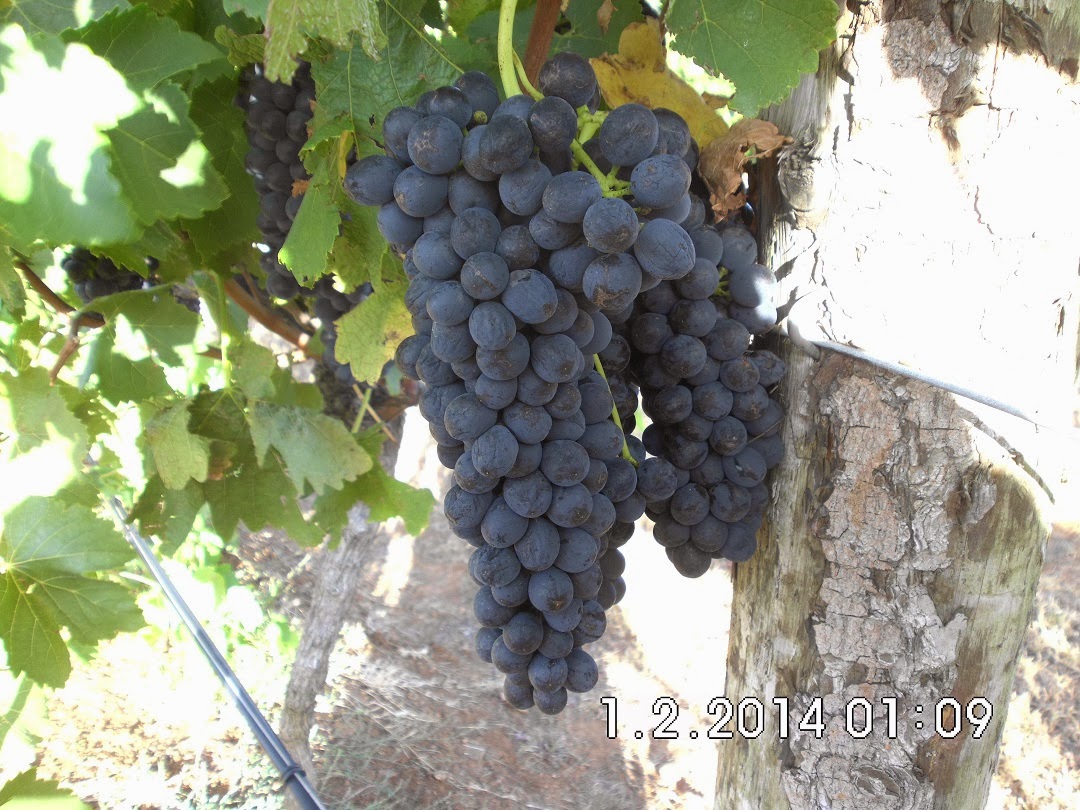
Up at 4 am today to try and get to the vineyard by 6 am. They were picking Shiraz starting at 3 am but that's a bit early for me and they have headlights on their picker whereas I use sunshine.

The vineyard always looks wonderful in the light with the perfect rows and the large expanses of water.


Caught up with the vineyard manager on arrival, he looked tired. We chatted for a while and apart from the Shiraz it was mentioned that the Merlot looked good as did some of the Tempranillo. You might all say "but you were cutting back on varieties this year and  merlot was one of the varieties being let go".


Yes well it was early and the temptation was just too much. But to compensate smaller quantities of each were picked meaning overall the total weight was less. Of course that will probably play havoc with the organisation of demijohns.


This year we've been giving freshly robbed honey as gifts to the vineyard managers. To sweeten the deal for them. It never hurts to be generous with people that take time out of their busy day to speak with you and provide an opportunity to obtain good fruit.


The grapes picked were all in the upper most rows in the vineyard and using the refractometer it was possible to be selective and choose the best quality fruit.


All three of these varieties have big easy to access bunches and picking went very quickly. All done by 8.30 and on the road home.

In the end the result was:

Shiraz, Brix 24, pH 3.73 just a little Tartaric adjustment done to narrow the margin between ideal and ok.

Merlot, Brix 23, pH 3.6 - perfection

Tempranillo, Brix 22, pH 3.6 again perfect.


The usual routine is to arrive home, unload the containers into chilling units and have a cup of tea while going through the accumulated notes on each variety and just make sure everything is clear about which processes will follow. The Vintage book is written up with a page for each variety, a batch number assigned, date picked and weight. The batch number is the year 4 and the sequence number e.g. 05 for Shiraz. That translates to 405 and is written on each container for tracking.


The weight is important as that will be the basis for later payment at the end of picking but also all calculations for additions of Sulphur and Oak is based on weight. In fact it is based on litres and to arrive at litres a yield of 60% is assumed. 100 KG results in 60 litres which is usually pretty close each year.
 
The crushing and de-stemming went quickly with one batch after another processed and put away and everything thoroughly cleaned afterwards.

As usual a Google Scholar search is performed just to see if there is any new research into these varieties and by chance a very interesting article is uncovered. Improved colour and phenolic extraction can be achieved by freezing the grapes before fermentation. The freezing explodes the cells in the skin increasing the extraction by as much as 50%. No time like the present to try this little technique. In addition there will be the 10% Saignee  i.e. bleeding off the juice to make rose and increase the skin to juice ratio. A few days of cold soaking will correspond with the freezing and at the end sitting on skins for a total of 22 days. This should really extract all the goodness and colour to make a powerful wine.

This is an exciting time at HHF with so much going on and the expectation of some wonderful wines in the near future. The opportunity to become immersed in the whole wine making process and the learning opportunity associated with the science of making good wine.

With everything tucked away and chilling it was time for an early night.

Sunday, June 9, 2013

Fermentation

A full days work in the winery. Pressed the Muscat and made three batches. One with American Oak chips, one with French Oak chips and one with no oak chips. All into glass with airlocks. As the pressing progressed the juice became redder and redder. I tried to share the colour with each batch. By last night all batches had commenced bubbling with CRU 56 yeast, the first of three instalments of yeast nutrient added and the refrigeration was set to start after midnight.


 The Shiraz had been carefully picked to exclude bunches with botrytis but just in case it had 80ppm of sulphur added. After an overnight chilling to 10 degrees C about 12% of the liquid was drained off for Rose and BDX yeast added along with some yeast nutrient. Again by late last night fermentation had commenced and a time was set to kick off the refrigeration in the early hours.

The Merlot was in good shape but as it will receive extended time on skins post fermentation, 50ppm sulphur was added. The same process as for the Shiraz was followed.

The sulphur is being added at the vineyard as there is at least an hours drive afterwards to get home after the last batch is picked and the grapes can get quite warm in the drums on the back of the ute.
As of this morning everything was fermenting nicely and the freezers cooling the batches slowly down to the 15-18 degrees.

 The Pinot was two thirds through its sugar and the last instalment of nutrient was added and refrigeration turned off. Hopefully it will peak out at 25 degrees C and all the sugar consumed over the next few days. Weather conditions are quite mild in the 21-25 range.
Everything clean and tidy in the cellar and paperwork up to date. Peace at last – for the moment.
 

The Muscat is Hamburg. Must have had a rush of blood to bother with this but the fruit looked so enticing, large berries like Spanish olives, black skin and in big bunches. Unfortunately all the books recommend this for table grapes or port. Still I'll have a go at something even if it is just for fun. They are crushed and destemmed and have been chilling overnight. I thought a dry rose if some colour can be extracted from the skins. The sugar level is not overly high and the pH pretty good. Might even try some oak in a small batch to see the effect. I've used oak in previous Rose to good effect.

Picking Reds

In one day we picked Tempranillo, Muscat, Shiraz and Merlot. Tempranillo is a great grape for picking. Good large bunches with pronounced stems easy to find and cut. It doesn't take long to fill the bin.

My theory that west side bunches are always riper went out the window until I realised that the wide bitumen surfaced road beside the west end of the roads has probably had a pronounced effect on the ripening, especially during those stinking hot days last month. We are picking a bit early because the heavy rain (180 mm) had caused havoc with botrytis breaking out. We were careful to select only clean bunches. This could be another low harvest year for this vineyard.

The Pinot Noir has been going for 30 days and the skins have still not sunk. Can’t stand it any longer. Pressed 16 litres of dark juice. Using French oak and will add some American oak as it settles. While the press was dirty the Shiraz was pressed as the skins were not rising anymore. The shiraz was on skins for 18 days.

Thursday, November 4, 2010

Tomato Transplants, Seasonal Produce, Mulch Hay, Library, Gleaning Wooden Pallets, Okra, Shiraz Bottling

Tomato Transplants

One of the smallest tomato seedlings that went into the Tomato Bed didn't survive. There were still some spare seedlings remaining in the nursery. The largest was chosen for transplanting. When the original plantings were done the weather was overcast for a number of days making it excellent timing. However the weather this time was quite warm. To reduce the risk of withering from the heat about half the foliage was pulled off once the seedling was in the ground. This has been a successful process in the past and there was no disappointment this time. Had the weather been even hotter it would have required the additional placement of a small pot over the seedling from mid morning to mid afternoon for the first week. This is a useful tip if planting in the hotter months.

Recipes for Seasonal Produce

The garden is producing a good quantity of Peas and Broad Beans. Both these can be transformed into a bruschetta. The Broad Beans steamed until soft have olive oil added with some finely chopped garlic, pepper, salt and some finely grated parmesan cheese, then smeared on toast. A similar process can be followed with the peas, but using only finely sliced leeks or onions which are cooked in olive oil until quite soft.

When on the lookout for alternative uses for seasonal produce it’s quite amazing how often recipes include ingredients which are not grown in that season. This is fine for the city dweller who can attend the nearest supermarket and choose any combination of fruits and vegetables. These recipes are unhelpful to anyone aiming at self sufficiency or buying produce from the local farmers market. The worst aspect is that it encourages vendors to source products from long distances rather than supporting the local growers. It would be more thoughtful if food writers were more aware of these unseasonal combinations.

Both the peas and broad bean plants are getting to the end of production but the timing isn't too bad as the climbing beans are over 2 metres tall now and small flower buds have appeared. If all goes well there should be a beautiful transition in the next month.


Rattlesnake Beans
It doesn't matter how hard we try, its feast or famine with different vegetables. At the moment the self sown Fennel is prolific, the Silver beet ,although nearing the end, is still formidable. Parsley has gone to seed but some self sown plants have popped up elsewhere. Last year we were scratching around to get a meal from the podded peas yet this year it has been full on. Maybe one day we will be like the TV gardeners and have everything orderly, copious and in good health.

Mulch Hay

Hay for mulching is a very sought after product. This Spring has turned out to be a bumper year for availability. Very large quantities went on sale at very attractive prices. We took the opportunity to acquire next year’s requirements as well as this year. Luckily we had plenty of
Mulch Hay
undercover storage. When gluts like these arise its very satisfying to be able to take advantage of them and put in place a little future proofing. After unloading and storing the bales there was a deep sense of wellbeing in the knowledge that we were ahead.

Library

Our local council library works in conjunction with a number of neighbouring council libraries. They have combined forces and share a common catalogue. The catalogue is also available online to any library member. Any books, CDs or DVDs can be requested online and the item will be forwarded to the library branch of your choosing. When finished with it can be dropped at any of the participating branches. If an item is in great demand such as a recently published best seller then the system assigns a number in the queue. You can track your progress in the queue online and you are automatically notified by email or text message when the item is available at your requested collection point. All this is available for just a miniscule fee for each item.

Gleaning Wooden Pallets

With the continual publicity about logging forests it’s surprising to see how much timber goes to waste. Not all timber pallets are reused, most which are used to carry products from overseas are thrown away or burnt. When we were building an over sized pantry to store bulk supplies in our shed we chose to use pallet timber in its construction.

Pallet Wood

The pallets came from a heavy machinery parts importer and a tile importer not all that far away. They were pleased to give them away as an alternative to paying to have them dumped. After collecting a couple of trailer loads it was just a matter of knocking them apart and removing the nails and stacking like sized pieces together. There is some wastage as this isn't first grade cabinet timber and can split. But those broken pieces make excellent starting sticks for next winter’s fire. An ordinary electric planer can be used to remove the roughness. Obviously if you have a planer/thicknessor you can achieve an A grade result. We went for the more rustic look but the design incorporated strengthening to cater for the load the shelving would carry.

Pantry from Pallets

Since then we have collected a number of additional loads of pallets and store the recovered wood for future projects. They have been a real bonus in the workshop for all manner of projects. The only thing to be aware of is to avoid any of the pallets made from chemically treated wood. Fortunately most soft and hardwood pallets from overseas are heat treated for sterilisation.

Okra


Okra Bed
We plant about 10-12 Okra plants every Spring. By Summer they are producing enough every few days to provide a great little nibble with drinks. They are best when small and tender about 50-80 mm in length. From experience Clemsons Spineless are the easiest to grow. The simplest preparation is to fry them in a covered pan with some olive oil until tender then drizzle a little soy sauce or even salad dressing over them then serve. They go well with a beer of wine. The plants will provide an ongoing supply well into Autumn. Last year the plants must have been very well fed as they grew well over 2 metres tall. A few pods left to mature will yield more than enough seeds for the following year.

Shiraz Bottling

Crusher Destemmer & Basket Press
In February this year we were lucky enough to be able to buy and harvest grapes for our own wine making. With the reds no preservative is used. In the case of Shiraz it was destemmed and crushed with 10% of the stems being returned to the fermenter. The stems are a good source of tannins but too many can detract from the flavour; while the pips and skins are a good source of polyphenols. The pH level was adjusted slightly with Tartaric Acid and one third of the required yeast nutrient added. The remaining yeast nutrient would be added in two further instalments as the sugar level dropped. If the pH is too high the wines can taste flabby and be more susceptible to spoilage. Yeast nutrient ensures the yeast gets a good start and reduces the possibility of a stuck fermentation by ensuring there is sufficient Nitrogen for the yeast to reproduce.

Demijohns
The temperature was lowered to 15 degrees C and the must was inoculated with purchased yeast, the yeast having been rehydrated and acclimatised to the low temperature. The lower the temperature the slower the ferment and the longer the skins and pips remain in contact with the juice. The longer the contact the greater the extraction of polyphenolic compounds such as procyanidins which provide the antioxidant health giving benefits. The next morning 5 litres was bled off to make a small quantity of Rose. The temperature was maintained between 10 and 16 degrees for 9 days until two thirds of the sugar had fermented. The temperature is managed by having the fermenter inside an old freezer which is regulated with a timer. The timer being adjusted as needed to accommodate the changing intensity of the fermentation. Over the few weeks of vintage each year our electricity bill skyrockets as we run up to 6 recycled refrigerators and freezers to keep the different batches cool. In addition we run an air conditioner to keep them cool. Well good wine does require some sacrifices.

Because no preservative is used it is important to get the juice under airlock before fermentation finished. Consequently, once two thirds of the sugar is consumed the must is pressed and loaded into demijohns to finish fermenting under airlock. This is also a good time to add oak chips to enhance the flavour profile. As the fermentation eases and finishes the demijohn is topped up as needed to minimise the air pocket. Of late we have avoided racking the wine and therefore any potential oxidisation. The wine is usually bottled within 6 to 9 months. There will be a lot of bottle sediment but that is of no account as it is easily decanted. In the past we have racked between one and three times before bottling but of recent times the move has been to less and less handling and letting the wine develop its own style.

Based on the Specific Gravity measurements, this Shiraz should come in at about 13% alcohol. Only 25 litres was produced as we also had a good quantity of Merlot and Malbec. We put aside one dozen in the cellar to observe how it develops and ages over time; the remainder will be consumed over the next 12 months or shared with friends. As we have still some bottles requiring corks, some is bottled with recycled corks and the remainder under screw top.

We are lucky that the fruit has been of superb quality which makes the wine making a breeze. When the fruit is faultless the winemaking skills can be minimal. It has been said that the worst a winemaker can do in those circumstances is interfere too much and make a hash of the end product.

Only one demijohn remains and it has 34 litres of Malbec which should be bottled next month. Bottling on a descending moon ensures the clarity is much improved, as we've found .

Every year is in itself an experiment, as different ripening conditions take place. In addition, we try a variety of experiments such as wild yeast ferments, varying the temperature at different times during fermentation, quantity of stems in the ferment, timing and quantity of oak chips. Lots of notes are kept with each batch. Apart from failing to make a successful white wine without at least 50 parts per million preservative (compared to anything up to 200 ppm in commercial wine), all the batches have been very good or at worst acceptable. But then, when it is of your own making, there is a greater level of tolerance.