Search This Blog

Showing posts with label Mushrooms. Show all posts

Tuesday, July 29, 2014

Mushroom Growing Experiment - Update

This is the end of July and the experiment started mid May. There is some progress.

Success

And more success


The process for Oyster Mushrooms works i.e. break up an Oyster Mushroom into some used coffee grounds obtained from your espresso machine or from the local coffee shop. Fresh grounds only as they will go mouldy after a few days. Keep the container warm (21 to 26 C) and moist (85%+) and within a few days or so some white threads appear. Boil some straw to sterilise and when cool mix in the coffee grounds. Wrap tightly in a plastic bag so it stays moist and continue to keep warm and moist. This can take 2-3 months. When the mushroom stems appear inside the plastic bag cut lots of small holes (20 cent coin size) in the bag for the shoots to pop out.

The only thing that we did wrong was cut the holes too early which allowed the straw (or in our case hay) to partially dry. It has received another soaking and now the waiting begins. Will the mushrooms shoot from the holes?

To keep the small hothouse warm at the correct temperature there are three lights. To keep the humidity up there is a 9 litre bucket with a small aquarium pump splashing water and it needs topping up daily. Running these must be consuming a lot of electricity compared to the potential yield of mushrooms. Either the volume will need to be ramped up, growing restricted to Spring and Autumn or it will be cheaper to buy mushrooms.

This process works for Oyster Mushrooms. The same process was used (optimistically) on several other mushroom varieties (just to fill the hothouse) with no success which means there is some more research to take place to understand their particular needs.

There are kits available from Bunnings and occasionally from Big W but at $20 there needs to be a harvest much greater than 2 kilograms to justify their acquisition. We have never ever been skilled enough to get more than a few individual mushrooms from a kit. Now that the hothouse is in operation this may change the situation and may be worth a trial.

I suppose the question to answer is whether it is possible to maintain a steady flow and not flood of mushrooms (with or without kits) such as is done in the garden with succession planting. Doing it seasonally and keeping running costs very low may make it a viable operation. Doing it without kits would make it an inexpensive exercise. Much like a vegetable garden there is still a lot to learn in order to get to a set and forget operation.

Thursday, June 26, 2014

Mushrooms - Slippery Jacks

These little gems pop up almost every year just at the top of our driveway beside one of the two Stone Pines. The pines were supposed to produce Pine Nuts, you know those little white seed things that sell for $64/KG. Well so far no Pine Nuts have been seen but the Slippery Jacks are a fine compensation.

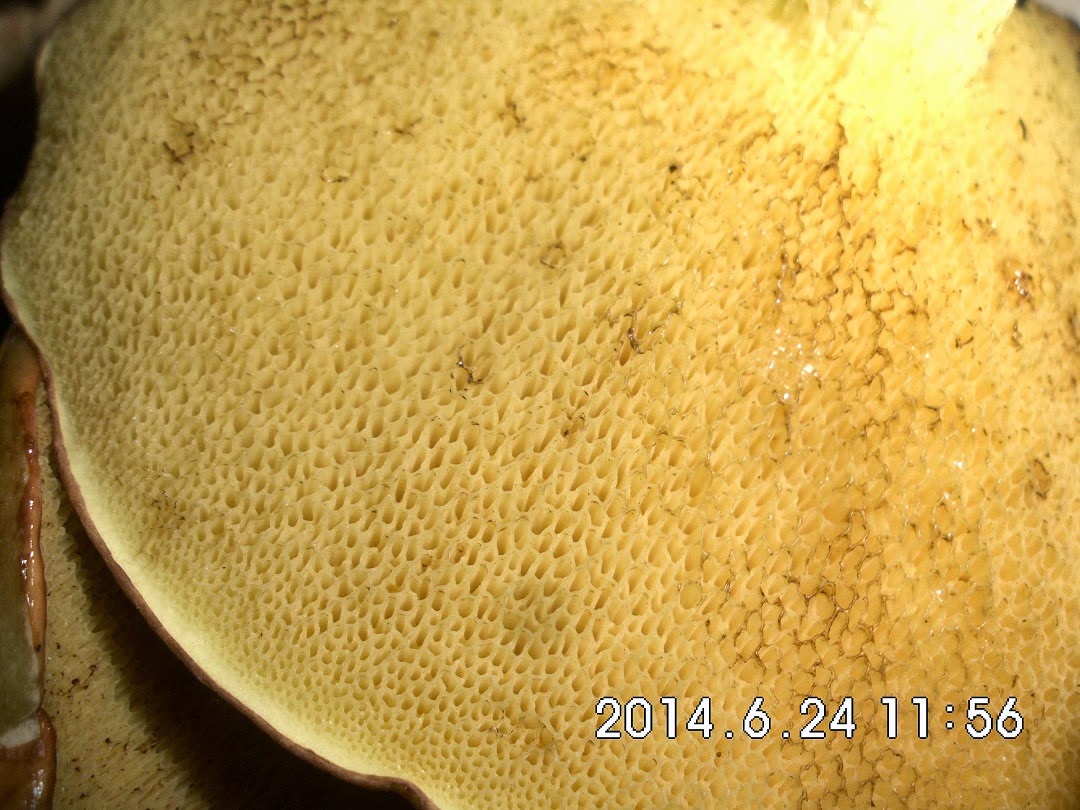
Just in case we made an identification mistake the various guide books were cross referenced. These are strange books, the official name varies from book to book but there is some linkage between the names i.e. Slippery Jacks. Some books don't mention whether these are edible or not. One that does specifies removing the skin and the gills (tubes) which was promptly done.

The recipe suggested is Garlic and Lemon juice. The author then describes the taste of the dish as being "lemon and Garlic". We cooked the Garlic a little more and cooked the sliced mushrooms in half the Lemon juice and then added a little more juice onto the completed dish to preserve the vitamin C.

Served on fresh toast it tasted fine. Mild mushroom flavour, good texture. Slippery Jacks have a particular pleasant flavour of their own. An excellent breakfast choice and no hospital trip afterwards.


Gills or Tubes as they are known

Friday, June 20, 2014

NZ Compost Update, Mushrooms, Chicken Food

Got very close to finishing building the massive 4'6" cubed compost but things kept getting in the way of putting down the last few layers. The lawn is completely mown and the Elderflower, Buddleia and Mulberry are all pruned with pruning's mulched in the compost. Finally this morning the last layers were added.


Steam has been emanating from the central hole for days and too wispy to catch in a photograph but a probe dropped down the hole measured the temperature at 66.8 C. Now that should sterilize any wanton seed.


A few of the Mushroom containers appeared to produce spore and some time was spent sterilising batches of Lucerne to use as a bed. Before adding them to the hothouse.


Oyster Mushroom Spore - I think/hope

Lucerne Hay

And the day is not finished without unloading the ute which carried the 160 KG of mixed grain for the chickens and another 100 KG of Oat grain which will be sprouted for the cattle. Grass is getting scarce and they need to keep up their strength even after gorging themselves on Pumpkin.

Of the last 100 KG of Oats they only got through about half before the rains came and the Autumn grasses took off. The remaining grain went to the chickens.

We don't expect any luxurious growth now until well into September or later. Their diet will be a little sprouted Oats and a small biscuit of Lucerne in addition to what can be picked out of the paddocks.


Wednesday, May 21, 2014

Mushroom Growing Experiment

In the past we have tried mushroom kits with very little success. Probably not the fault of the kit maker but our lack of skill. After several tries we worked out it was cheaper to buy mushrooms as our kit trials yielded one or two mushrooms only. When we did the numbers it cost of about $100/KG.

But being inspired by a podcast on TSP  we decided to try another method. First up was to buy some mushroom samples which we did a few weeks ago. A mushroom or two were broken up and mixed with used coffee grounds and left. The Oyster mushrooms showed some white growth and today we did something with them.

First our spare baby hothouse was to become the mushroom house.


Then we set up some warmth with a lead light (fluorescent).


Some humidity was added using a small pump in a bucket of water to splash the water and increase evaporation.


Then some Lucerne hay was collected as a bed for the mushrooms.


And it was sterilised by boiling in water.


After the water was drained and the hay cooled sufficiently some of the white spored coffee grounds were added and mixed thoroughly.


And finally the hay was wrapped tightly in a plastic recycled shopping bag and some holes cut. The wad was suspended in the hot house near the light.


The small pump is playing up i.e. it is blowing the fuse on the electrical circuit. I've cleaned and sealed a hole near the lead with silicone.

The pump kept tripping the power point even after the repair. There is a slight leak of current still causing grieve. Tomorrow we will pick up a cheap new pump.

The hothouse is monitored by an inexpensive  RF temperature and humidity sensor which we used in our incubator. After sunset as the outside temperature fell the existing light could not emit enough warmth to keep the range between 21 and 27 degrees C. Our solution was a second lead light with a timer attached which comes on after dark. We monitored the temperature manually and found that if we turned on the second light after 8 pm and turns it off at 8am we achieved the desired result.

Now it is just a matter of waiting. We don't expect instant success. This is just the first of a series of trials as we learn more about mushroom growing.

Wednesday, April 23, 2014

Mushrooms, Fitness Update

Luck was with us this week in the Mushroom experiment. We found (in one store) Swiss Brown, Oyster and Portobello mushrooms all in small economical packets. Enough in each container to taste test and to also place a couple in our coffee grounds to see if we could propagate them.


A layer of coffee grounds in the jar, hand shredded pieces of mushroom in a pile in the centre, surround and cover with more grounds. Grounds to be moist but not so they ooze moisture when squeezed. Loose lid to allow breathing. Keep moist.

On the second last day of our manic swimming fitness program at the local pool the manage and my swimming partner made a very stunning statement:

"I was playing with my grand children over Easter and I found I had this amazing amount of energy. I was able to run about with them all day. This last three weeks has really made a difference"

So there you have it, final scientific proof that fitness is good for you.

Of course that didn't take away the pain from the four 30 second laps. Out of curiosity I wore the heart rate monitor today. The chest strap also made a good excuse as to why my lap times were a bit off. After the fourth 30 second lap (just made it) it took a few breaths before I could lift my arm to check the rate. Only 151 bpm. That indicates I still had some fuel left in the tank and was bludging. Oh well, last day tomorrow. Will really give it a hard time. Hopefully won't need an ambulance.

Saturday, April 19, 2014

Camembert, Mushrooms, LED and lots of other things

Gradually we have been reducing the volume of Camembert made at any one sitting to making it more often in order to maintain a reasonably steady supply. This involves less than 10 litres of milk which translates to about 10 small rounds. The other modification to our processing is to make some thin rounds and some thick. This serves to spread out the maturity time. We still end up giving a few cheeses away to friends but now it is in a more manageable quantity.

Large

Small

We now have the coffee grounds needed to start the mushrooms but couldn't get any Oyster mushrooms to start the process. In the interim we will use the standard button mushrooms as a trial.

Aldi had another pile of specials which included LED light globes with a decent number of Lumens. We collected a couple more to replace an outside spotlight which is undercover and doesn't need to be waterproof and one in the workshop we use for short term lighting when making a quick visit which negates turning on a bank of fluorescent tubes.

Cobwebs not included

We have been slowly replacing various types of globes with LED. The trick is to use up the ones we already have rather than turn them into landfill unused but at the same time be economical with power usage.

In preparation for the next fire season we've acquired a fire proof storage box (again from Aldi). It's just large enough to hold various critical documents such as Wills, identification documents and financial papers. The shortfall in our fire plan had been what happens if there is a fire and we are not there to take away bag holding these documents.

Fire and waterproof case

A small fire extinguisher and smoke alarm were purchased for the Cave.


Rather than try and do every thing at once we are slowly addressing small parts of our preparedness plan. This spreads out the cost and makes it all manageable (affordable).

Thursday, April 17, 2014

Dijon Mustard, Dungog Excursion, Mushrooms

Using a recipe from The Compleat Mustard I compounded a Dijon Mustard minus a few things that weren't in the pantry like Tarragon and Chervil. Its been soaking in Verjuice for about 48 hours. Yesterday it had absorbed all the juice and a little more was stirred into the mix.

Today it went into the Kenwood Chef blender. It's pretty thick and a little more verjuice was added to get the mix rolling nicely. It was left in the blender to soak for another 4 hours absorbing more liquid. A little more was added until the rolling pattern returned. After some minutes the texture became smooth although the mustard seed shells make it look like there are tiny seeds. A taste test proved it to be very smooth except for one small problem. It doesn't taste like Dijon. It does taste like a really good English mustard. The recipe now calls for it to be sieved through progressively fine cloths but I'm not going to bother. It's great the way it is.

Dijon

We went to Dungog this morning to see if the Dump Shop had any scissor jacks. Scissor jacks use a screw thread called Acme (Imperial) or Trapezoidal (metric). Our very small wine press is broken because the threaded screw is damaged again after only a few uses since the previous thread was replaced. The beauty of the Acme thread is it is low torque and should take the higher pressure turning. 

The Dump Shop did not yield a scissor jack but it did supply a large Furi knife and an armful of other treasures which put us out of pocket by $10.

The local church hall was having its weekly op shop and again provided some $3 unused cotton t-shirts and heavy duty $9 work pants for me as I've converted a few to workshop rags of recent.

Jean managed a couple of very nice tops and wait for it ... hipster pants. It took some convincing on my part to get her to buy them. Her two reasons for objecting were firstly hipsters are uncomfortable and feel like they are going to fall down. And secondly there was the mutton done up as lamb comment. My arguments were it was a lovely colour, they fitted perfectly and made her look sexy. And she only had to wear them around the house for me if she was that worried.

Not many 58 year old women have the figure to fit a pair of stove pipe legged hipsters - a by-product of our swimming and eating regime.

A day or so ago I was listening to a podcast on mushrooms.  We've bought mushroom kits in the past which produced very few mushroom compared to the cost. This podcast got me inspired. One of the ingredients needed to start is coffee grounds. Picking the largest and busiest coffee shop in Dungog Chillbillies Jean purchased a coffee and made the request for some used grounds. Eureka! Returning a few minutes later with a 20 litre bucket she collected a goodly amount to start our venture. Next step is to purchase some Oyster mushrooms to start the process.

Coffee Grounds

Wednesday, March 9, 2011

Cider and Perry, Last Fruits of Summer, Mushrooms

Apples, Pears, Cider and Perry

December/January is the time that the Tropical Apple is ready for harvest. The fruit was left as long as possible to maximise sugar content and we harvested making cider. As usual timing was poor. We hadn’t tasted last year’s cider before we bagged up this year’s crop to protect it from parrots and fruit fly. The previous year’s cider was great. Now we wished we had gone to the trouble to bag more fruit to make a greater quantity. The cider was not sweet but it was sparkling and very refreshing at the end of a hot day.
Well we still had the pear trees and the Cider Apple trees to harvest later so maybe we would still get a reasonable quantity.
On the Orchard map the harvest months are noted. Well it turns out they are wrong. The dates are for trees in Tasmania not NSW north coast. Our fruit ripens 4-6 weeks earlier. Well luckily we were checking the fruit and discovered it was ready. For some reason some of the apple trees failed to mature any fruit in the bags while others were fine. Still there is enough to make a little more cider. The best tree this year was Stokes Red.
The Buerre Bosc produced a goodly amount of fruit as it always does and we were able to make Perry for the first time. Next year a big effort will go into bagging as much as we can. There are still two more pear trees to harvest a Williams and a Packham. We may not have sufficient cider and Perry to bath in but there will be enough to taste test some more experiments.
The process is fairly simple using our Champion Juicer. The fruit is cut into pieces and juiced. The sugar level is tested. All the batches we did came in at around 15 Brix which is fine. The juice is warm and the yeast starts quickly. We used Chardonnay yeast as an experiment. As opposed to beer yeast which we tried last year.
Fermentation is done in demijohns with an airlock. Once the bubbling stops it is racked into 375 ml bottles and half a teaspoon of sugar added to create the fizz. Then leave it. It will be fizzy in two weeks but a little bottle age is better.
This year there will be four distinct (trial) batches. The trials are on pH, yeast type and sulphur addition (or not). This should give us a good feel on how to proceed next year. Very exciting.

Last fruits of the Tomato Bed

The relocating garden in the paddock that we call the Tomato bed is still producing food. The tomatoes have gone although there make be a second flush in another month. The rockmelons are still going albeit slowly. The bitter melon is coating as is the okra and capsicum. The pumpkins and squash are coming on and some were ready. The Hungarian wax capsicum is still flowering and forming fruit as is the zucchini. The big surprise is a cucumber plant  has germinated and we may get another crop before the cold sets in.

Mushrooms

Sometimes we wish we lived in France so that all the mushrooms could be taken to the local chemist and identified before we poison ourselves. Trying to identify edible ones from a book is damned hard trying to use photographs. Every time some gorgeous looking mushroom forms we find two possible candidates in the book. One is edible and the other is poisonous and we can’t tell the difference.
A recent email to a friend at the nearby university asking if there were any experts about proved fruitful. The friend as it turns out studied mushroom as part of his science course many years ago. All we need is a sample.
Of course by this stage these massive white oyster shaped clusters weighing kilograms had finished their life cycle and nothing remained but a brownish black smudge.
OK we’ll be ready next time.