Search This Blog

Showing posts with label Tomatoes. Show all posts

Sunday, January 12, 2014

Creamed Honey and Seed Saving

Having extracted the honey yesterday the next step was to cream it. Such a surplus means it will be ages before we get through it or give enough away and rather than let it crystallise with age we crystallise it ourselves but into fine crystals that taste terrific. We kept one jar of the previous creamed honey as the seeding material.

A few small jars of natural honey is bottled for gifts and as a comparison to the creamed product. The rest is mixed with the contents of the seed material jar for an hour on the pedestal drill with a squirrel mixer and then bottled predominately into small jam jars kept from when we ate jam.
 
Natural honey kept as samples

We don't eat jam any more preferring to have the fruit and fibre fresh or if desperate for a sweet flavouring either honey or dextrose (in moderation).

The previous batch of creamed honey now out of the fridge

By the time the mixing and filling and cleaning is completed another half day went by.
 
Creamed on the left and natural on the right

This time rather than use the cheese fridge to keep the honey cool while the crystals form we activated the bar fridge someone gave us that has an adjustable thermostat allowing us to keep the honey at 14 C for two weeks.
 
In the refrigerator for setting
 

While I was fiddling around with honey Jean got stuck into seed saving. Samples of various tomatoes we grow have been soaking for a few days and now she washed and sieved and lay the seeds out onto paper to dry.
 
 
One batch of seeds drying with the oyster opening gear in front

The rest of the seeds drying with a sprouting carrot top and some Avocado seeds
 
We also went through our tomato planting plan for next year over morning tea. Too many varieties are being grown. Some were eliminated on taste and others because they didn't do well. Usually we give them a couple of attempts before dropping them but today we were having an aggressive clean out. And still next July when we look at the issue again we may add some back or come across yet another one to try.


Thursday, January 2, 2014

Tomatoes

The Tomatoes are finally coming on. We harvested a good sample of each variety for seed saving today. Something we do each year. The pulp went into the pot along with a whole pile of other tomatoes and we produced another batch of puree. We've run out of jam type jars but have a surplus of 375 ml beer bottles courtesy of a friend who buys not makes. These are a better size for us than the larger 750 ml beer bottles. We bottle some in the larger size just in case but the majority into smaller bottles. It didn't take long to knock out another 15 bottles of puree. We still have plenty from last year but these things keep for a long time and you never know if one year will be totally unproductive.


Interesting how different weather results in different tomatoes doing better than others in that year. For once the Palmwoods are doing really well this year. They are a more meaty variety and ideal for making slow roasted Tomatoes with Garlic and Thyme. Something that can be eaten immediately or left for the next day.

Palmwoods on the left and Roma on the right

The other compulsory Tomato is Roma. It's not one of those that is exceptional eating. It is however robust. It grows and fruits prolifically no matter what the conditions. Seems to avoid fruit fly right to the very last moment and it will work in salads and other dishes. But its real value is in preserving as puree. You always get heaps from just one or two plants.

We are going through a bout of hot weather and no rain yet again. Our routine has been modified to marry with the conditions. Up early and get things done including a trip to the pool then retire to the house to read or do indoor tasks during the worst of the day and then out again to water any withered plants and get a few odd jobs done. We are having a true holiday in one sense as the across the river the boss is in residence and we only have to worry about our own property.

Sunday, December 29, 2013

Weeding, Mozzarella, Tomato Puree

Finally a cool day. A steady breeze blew across the valley and with the humidity it felt like a cool sea breeze. Making the most of the conditions the various bean beds received a weeding. Weeding is something we are not good at performing. Not so much the action but the regularity of the activity. The measure of out laziness was the number of barrows of weeds that went into the compost. At least today we got a start with all the bean beds finished and a good watering afterwards. Hopefully this will provide the inspiration to complete some of the other vegetable beds. The problem is that having taken a few days to relax and read a pile of books it becomes increasingly more difficult to venture out and get stuck into the many outside tasks.

Originally the plan for today was to make the cows milk version of Manchego known as Hispanico. But Jean wanted some Mozzarella for a dish in tonight's meal. It is the last supper for her mum who is catching a late night bus back to Stanthorpe. And so Mozzarella it is. I did cheat and read a few chapters during some of the shorter steps but managed to get other tasks finished or started. The recipe followed was from Neil and Carol Willman's book Home Cheesemaking.
 
A lot of Mozzarella
 
Since we are going to have a lot of Mozzarella it seemed necessary to make up some sour dough pizza base to be used in tomorrow nights meal which surprisingly is going to be pizza. Probably the best time of year for pizza since there is so much fresh produce in the garden which is suitable for the dish.


Pizza base dough mixed and souring overnight
 
Jean and her mum spent a productive hour in the Tomato bed harvesting enough fresh tomatoes for me to puree and bottle. Getting lazier every year. This time the tomatoes were sliced in half to confirm there were no grubs and stuffed into a heavy based pot on low heat. Once there was some semblance of liquid in the bottom a bit more stuffing occurred and then the mix broken up a little more with the stick blender. The entire batch was brought to a slow rolling boil and the stick blender poked about to ensure no oversize pieces that might block the funnel. The bottles for filling were just a collection accumulated from various sources. They have been processed through the dishwasher for sterilisation and the heat from the sauce will now be enough to ensure nothing nasty happens. We still have plenty left over from last year and this years meagre harvest will have little impact on our stores.
 
One of our best acquisitions many years ago is this simmering pot which has a really thick base and nothing ever burns or sticks

A motley collection of jars but they work and more importantly get used more than once before recycling. Always seems a waste to use a new jar only once or buy jars when so many are thrown out.


Wednesday, October 30, 2013

Protecting the crop

The bulk of the day was spent in the vegetable garden. Thanks to the rain the irrigators across the river are off and the only work is moving and feeding cows. Hopefully the rain will result in some grass growth and the hand feeding will cease soon as well. The reduction in outside work has freed up a lot of time.

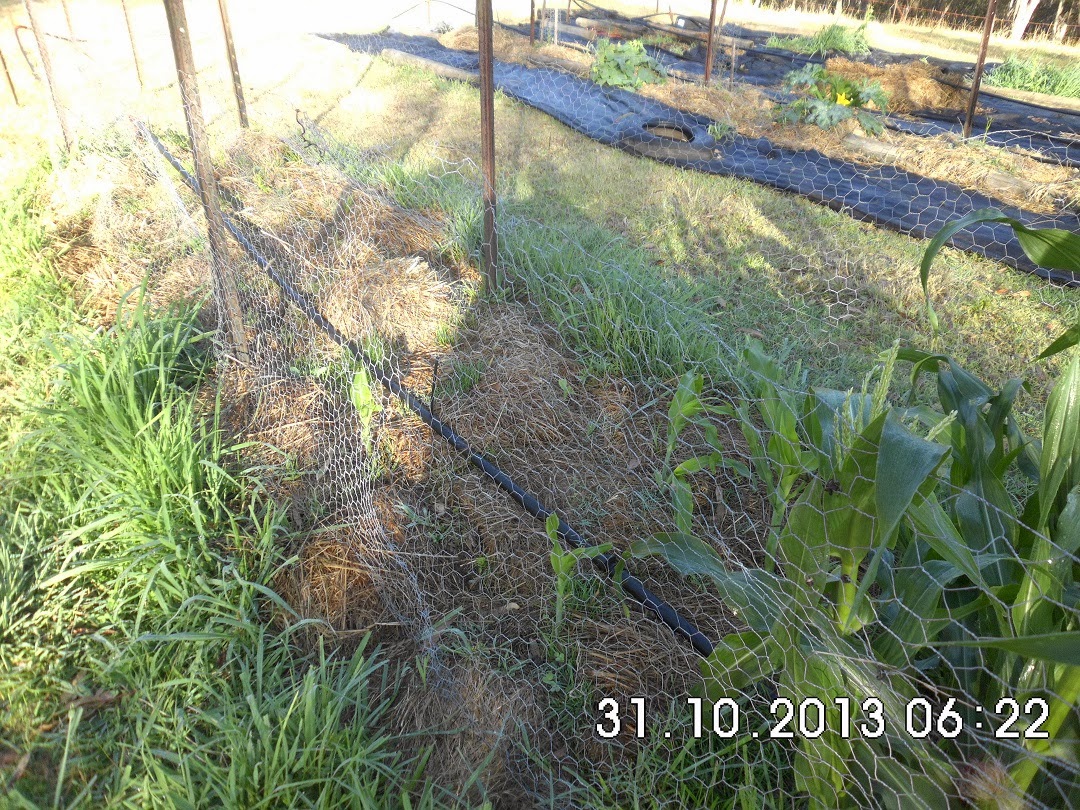
Transplanted some climbing bean seedlings that had germinated. A couple of melon seeds and a Zucchini had also came good and they went out to the unprotected bed on the hill but with some chicken wire barriers. Anything that looked salvageable that had been nibbled also received a protective barrier. Back in the house garden some potatoes went in. Despite the rabbit and wallaby activity the unprotected bed on the hill looks pretty reasonable.


On the right the pumpkins are well advanced but the melons are a bit slow probably because of the cool mornings

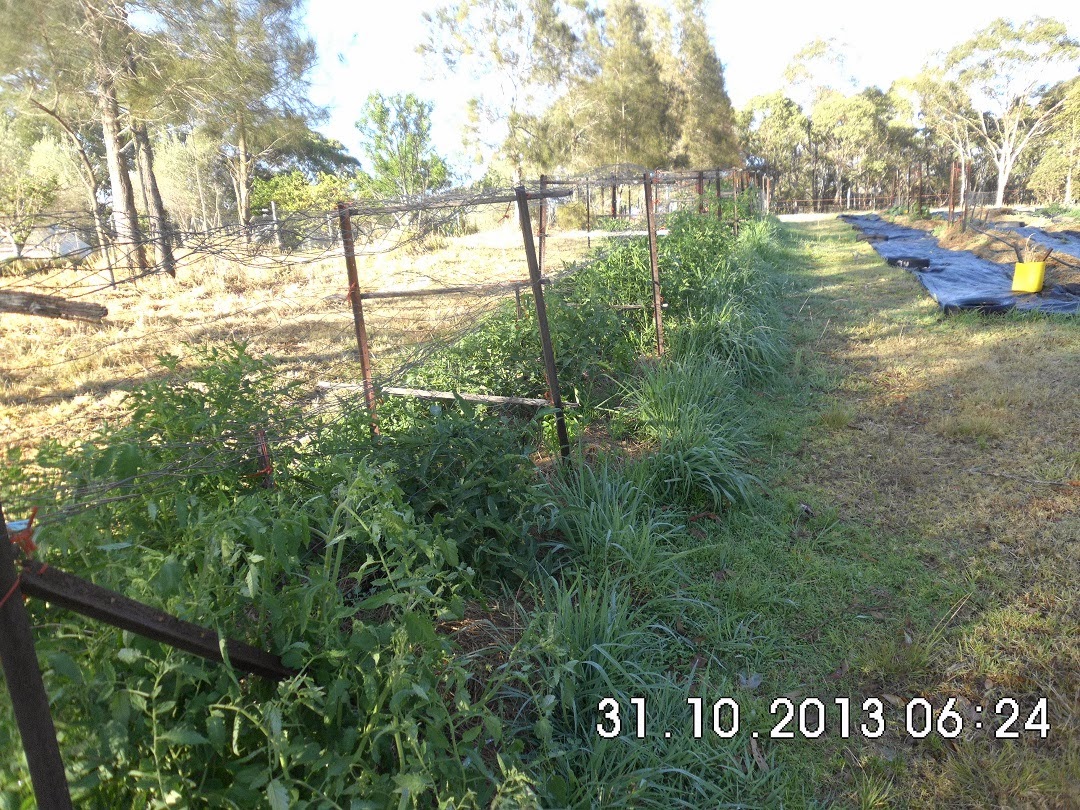
The tomatoes are doing well

The house gardens are a little overgrown as we wait for various things to set seed but there was plenty of choice last night for dinner. Brussels Sprouts, Sweet Potato, Onion, Carrot and lots of salad variety.

The chickens were left locked up until lunchtime to get them to scratch around in the new litter. The cow manure proved the most popular side.

Finally got around to picking up all the bags of manure that had been collected and left in the front paddock. Some will go to the chooks and some to a new bed for the Passionfruit vine bought a couple of weeks ago.

Just a few of the bags of manure from a the cattle after one week in the front paddock

Started using the compost turned a few weeks ago. A bit early but it looks delicious and we needed some for the new plantings.

Brined the Camembert for 90 minutes and put them into their humidicribs for aging. Since I was in the kitchen for a little time also made some chocolate bars with roasted peanuts and toasted coconut shreds. Also made one plain for Jean to use in brownies.

Another one of those productive days where lots of jobs get done and you seem like you might just be catching up and the feeling of being overwhelmed dissipates.

Friday, September 6, 2013

Tomatoes, Pumps, Cattle and things

Our cattle were moved this morning into a fresh cell in what is known as the Big Dam Paddock. They should get about 2-3 days of green pick before needing to be fed with the new Lucerne. They really appreciated the change of cell. Heads down and eating immediately especially the green growth around the water's edge.

Warren and Hector munching on reeds. The two boys are never too far away from each other.
While down at the dam the two pumps were started. All the vegetable beds get a light water every day to maintain moisture. The grapes are in bud burst and flowering and they received their weekly drink. Rain appears to be very far away possibly some decent showers in October but who knows. Honda engines are the most amazing pieces of engineering. The oldest we own is nearly 20 years old and still starts first pull. It does blow a lot of smoke at first but just keeps going. The oil needs topping up most times but that's a minor inconvenience. The wonderful thing about these piston pumps which the engines drive is the reliability, indestructability and ease of maintenance. It takes less than 15 minutes to replace the leather cups which gradually wear out usually one set per pump per year sometimes less.

The 20 year old 5 HP Honda engine

The dynamic duo in operation
The vibrating intake pipes show if the pumps are working ok. That is smoke not mist as the oldest Honda warms up.

An indication of dryness is the falling dam level. It is down just under a metre after the driest few months of the year.

Difficult to see but this is the receding shoreline.
The Tomato bed progresses. The three tiers of mesh have been erected and now its up to the Tomatoes to do their bit. All the vine mounds have their chicken litter piled on as well. A wonderfully productive day.

Trellising Complete
Jean went out to Karuah and picked up some oysters. They didn't have any Sydney Rock ready and we ended up with Pacific. These are fine and easier to open but I can see why everyone raves about the Sydney Rock Oyster. There is a huge difference in flavour and texture. Either way we received a good dose of Zinc, Iron, Iodine and Omega 3. I'm sure there was some health benefit in the half bottle of Home Hill Farm Sparkling Semillon that we shared over the oysters.

Thursday, September 5, 2013

Tomato Planting Day

All bar two of the Tomato seedlings were planted out today a BD Fruit day.

Beefsteak
Health Kick
Roma
Kotlas Purple Cherokee
Palmwoods
Red Fig
Thai Pink Egg
Broad Ripple Currant
Black Russian
Kumato
Amory Orange
Jean Flame
Money Maker
Rouge de Marmande
Black Krim
Tigerella
Cherry

Jean was feeling the heat and being tired commented on the amount of work involved. The only response is "why are we planting so many more Tomatoes than we can possibly eat?" To which I got "well we certainly give it a good shot and I like some variety". Being a promising year we should get an early start to the harvest which will be a month before most people in this area. As usual there will be plenty of give aways  to friends and neighbours.

TIP: After each seedling is planted we pull off about half the foliage. This reduces the transplant shock especially on a warm day. The other alternative is to shade each seedling with an upturned pot to reduce the light during the day for a few days.

1/3 foliage removed to prevent wilting


Also planted were the remainder of the Capsicum seedlings. Some in the Tomato bed and some in mounds. Everything was watered in well with Seasol.

Capsicum on its mound


Progress was made in the completion of this Summer bed. All the planned mounds had composted cow manure added and some which were needed for Capsicums had the chicken litter added and were covered with mulch hay. The full length of the irrigation pipe was installed and tested and more weed mat added. Slowly the entire bed is nearing completion. Only a bit more weed mat to separate the mounds, Chicken litter on the mounds, the three tiered trellis over the Tomatoes and finally the protective electric fence.

Progress on the mounds


There are 30 mounds for vines and other. Sometimes out of laziness we have put more than one vine into a mound but this year we will not as only enough seeds have been planted to match the number of mounds - some discipline at last.

When planning the Tomato season we  planted an extra couple of seeds of each variety just in case there was not 100% germination. Well there was 100% germination and now we are looking for a home for a large number of good sized seedlings. Some neighbours are going to get a surprise.

The first Artichoke of Spring peeping out

Tuesday, September 3, 2013

Tomato Bed - More Progress

Finally getting back to the Tomato Bed. Well really it should be called the Spring/Summer/Autumn bed or the Tomato/Melon/Cucurbit/Corn/Okra bed. I'll just stick to the Tomato Bed.

The next stage is to lay out weed mat. I hate weed mat when it has to be removed or when it gets old and straggly but nothing beats it for keeping the grass down for a few months while the vines from the melons, pumpkins and Cucumbers mature. For a few years we tried a thick layer of mulch hay but just could not make it work successfully. It works on the Tomatoes because by the time the weeds start to pop through the Tomatoes are so thick with foliage they shade out the weeds.

The Tomatoes are ready to plant and Thursday will be the big day according to the Bio Dynamic Calendar. The vines seeds are in seed trays and so we have plenty of time to finish their beds before they are ready. Sometimes we have planted the seeds directly into the mounds but for an early germination the cold frame is best.

In this initial step of the vine beds we pick a non windy day and lay out the really long pieces of weed mat. After the first two long sections were down in went the irrigation pipe. The elevated spray nozzles are put in existing holes at appropriate spacing. This first row will be Zucchini, Cucumber, left over Capsicum plants and some vertical growing vines such as Bitter Melon. The mounds are closer together as they need less space. While still accessible by tractor the first layer of composted Cow manure is put down. The chicken litter will be carried in by hand later because we are not ready to collect it just yet.

The third panel of weed mat is put down and the irrigation pipe installed but the spacing of spray nozzles is further apart as this row will have Rockmelon and Water Melon.

At this stage the weed mat is held down with strategically placed soft wood logs, when we run out of these we will used old tyres. Tyres are ok but they do have the habit of harbouring serpents. The soft wood is treated pine and reasonably light. Not something we would normally have our property but...

These logs are leftover scrap removed from our house when it was modified 15 years ago. Unfortunately our house is made from treated pine logs. It was  an ugly log cabin and the logs are  now entombed inside with Gyprock lining and outside with fibre cement sheeting and cement render.

There is still another row of weed mat and irrigation pipe to go and smaller weed mat offcuts will go in between the mounds, Slowly we are getting there.


Monday, September 2, 2013

Tomato Bed Next step, Spring Plantings

Some people might think that being Fathers Day and our 28th wedding anniversary that it might be a day of rest or celebration but not us. The celebration was held in the evening and although we tried not to rush around too much it proved to be a productive day with a little reading and even a quick nap.
The first one up gets to set up the decorations for the day

The day started extremely well with the water pumps on the dam started before coffee. On the walk back two bales of old Lucerne were put out for our three cattle. Martinique a 7 year old heifer named because she came from a dairy at Glen Martin. Warren and Hector two Friesian Angus cross steers named after the dairy farmer who donated them.

After coffee and blogging, the broken gate valve on the watering system was replaced. Then we both worked on the irrigation system for the Tomato bed. After laying out, securing it to the ground and installing all the spray nozzles a quick test to ensure all is working, a thorough clean of the filter and we were off.
Irrigation pipe installed.

Testing
Jean continued with a few loads of washing and changing the bed then went onto hand watering various pots and beds and incorporating some weeding. My list was all these odd little jobs.  The bees feeder needed refreshing with sugar and water which didn't take long. This is only being done to help increase the brood numbers. Then the following seeds needed to be set out into seed trays for later transplanting to the Tomato Bed i.e. that part set aside for vines or other than Tomatoes. Corn, Cucumber (3 types), Zucchini (2 types), Okra (2 types), Rockmelon (6 types), Watermelon (7 types), Dry Pumpkin and Bitter Melon.

Seed trays

We had an Eggplant which was planted last Summer into a pot. It did really well and also stayed on through Winter and is flowering and setting fruit again. On the strength of that we repeated the trial with another variety and also are trialling some Capsicum done in pots. It maybe the rich compost or the depth of the pot or just the fact that being near the house it didn't experience the cold as much. We shall see. With the two of us on this task it didn't take very long to fill, plant and water five pots. All those big composts we made over Autumn and Winter are coming in very handy.

Last year's Eggplant doing well after Winter

Trialling a new one

One of four Capsicums done in the same way

Last jobs of the day included mulching the various Onion plantings with fine Lucerne hay that had been processed through the mulcher. This little job had been sitting around for two weeks. Any longer and we would have had to weed the beds again. The bed (in the house that is) was re-made and vegetables picked from the garden for dinner. A quick shower and Champagne was opened at 6 pm and washed down a selection of home made cheeses. Happy Anniversary!


Sunday, September 1, 2013

Slowly Making Some Progress...

Being Saturday and the last day of August means that the Raymond Terrace Aldi store will open at 8.30 am with a broad selection of vegetable seedlings which are both well priced and well advanced. Having built up their reputation for supplying good seedlings it is important to arrive early to fight off the crowd of enthusiastic customers before all the goodies disappear. So we did arrive early and collected the few items that we have trouble germinating ourselves such as Eggplant and Capsicum and just because they looked so good picked up a few other things such as Dill, Basil and Lettuce and a couple of Tomatoes that weren't in our collection. There was a good crowd and lots of bustling to get to the Saturday specials but stocks were plentiful and no one disappointed.

Aldi Seedlings

This year the seedlings were very advanced which is OK for Tomatoes, Eggplant and Capsicum but makes things like Dill and basil a bit straggly. Still, all good fun.

This year our own seedling have been the best ever in terms of health and size. Could be the weather and possibly because they were potted up very early?

Our seedlings

The cosmic forces that govern the building of Tomato beds are obviously in a playful mood. Todays first disaster was the box trailer. It needs to be ready to haul some more silage and hay this coming week and it was noticed yesterday that the lights were inoperable. First eliminated the vehicle as the cause then dismantled the light fittings and cleaned all the connections - one loose bulb and one broken wire. Half the lights now working. Checked all the other fittings. This is all very difficult as the trailer lights are out of sight when working behind the vehicle. Mounted a vanity mirror on the ground. Aha the lights flicker when playing with the main connector. Stripped that down checked it all over and adjusted the connection points. Finally after an hour and a half all is functioning.

Now back to the planned job of the day i.e. Tomato bed. Spread a goodly amount of Dolomite to sweeten the bed and covered with a thick layer of mulch Hay - very thick. Hay bales come apart in different sized biscuits depending on the grass type and in this case woody long grasses resulted in biscuits well over 100mm thick. Fine that should keep weeds at bay for longer. The mulch hay was a special deal last year about a 120 bales at cost of production price of $2 from a friendly farmer. Enough to keep us in mulch hay for a  few years and at a price that means we can be generous with the application.

The next step 19 bales of mulch hay over 25 metres. The last 5 metres will be held back for succession planting.
This is what is left of a junior Red Belly Black snake near the old Tomato bed after a little slashing recently. Only just noticed it.
The mock Roquefort made most recently was done in two different ways. One lot received no pressing, was brine salted and not wrapped in foil. It came out creamy and soft after only a few weeks. The other had been pressed lightly and was rubbed with salt in two stages with the salt calculated on the current weight of each round. The rounds were pierced after the salt was absorbed and wrapped in special cheese foil. This has taken longer to mature. Although creamy it is firmer and closer to the mouth feel of real Roquefort but not that airy, granular look. But progress is being made.

Just before dark we noticed the Viburnum hedge looking a bit sad. Just a simple matter of turning on the automatic watering system? No such luck, no water coming through. After a quick investigation the culprit was the gate valve back at the pump. There are three valves splitting the watering system into three sections to simplify leak tracking. This one has broken in the off position. Fortunately we were able to patch in a hose from a working section to the Viburnum system and provide them with a  drink. The valve replacement can be tomorrows emergency repair.

The shut off valves have proven a worthwhile addition to the watering system


Thursday, August 29, 2013

Getting Ready for Spring Part 3

At the current rate of progress "Getting Ready for Spring" will go to "Part 10". Has everyone experienced one of those days where everything seems to go wrong? A little mistake and the day becomes lost to recovery jobs.

It all started over the river early in the morning.  Down on the flats amongst the poplars the RTV is being used to drag the 100 metre long irrigation hose into its new location. Just squeezing past a poplar at a very slow speed and BANG! Stopped to look behind and there is the whipper snipper with a bend in the non flexible shaft. It looks like a deformed banana. The whipper snipper was sitting in the tray of the farm's RTV leftover from being used the day before. Couldn't be bothered to take it out. Finished setting up the irrigator and popped over to see the local machinery repair man. Can't be straightened, go buy a new shaft. Telephoned dealer, $200 for the bottom half of the shaft and another $150 if you need to replace the top half. New whipper snipper $600.

Down to the workshop. The top half is only slightly bent. Start there. Pull out the inner drive shaft it is  OK. Slowly manipulate the hollow tube outer shaft using a pipe jig and it looks OK. So now the damage is only going to be $200. Well why not give it a go. Carefully bring the lower section into a smaller arc, just enough to be able to remove the inner drive shaft. 30 minutes later the lower tube is reasonably straight. Not great but probably good enough. The inner drive shaft receives some panel beating and it is close to straight. Reassemble everything and test. Works! A little bit of heat being generated by the friction of the not so perfectly straight components but may work long enough for some else (i.e. The Boss) to blow up the engine and negate having to fork out $200 for own stupidity. Will let him know there is money set aside for repairs should this patch up job fail the longevity test.

Just loading the whole thing back into the farm ute and notice a slight arc in the assembled shaft. Mmmmmh I'll just put it on the ground upside down and gently put my weight in the centre and force the arc out. Might reduce the friction. SNAP! the plastic handle disintegrates.

Fortunately there is an identical  handle in the shed from a long dead whipper snipper. Saved.

And then it's onto working on the Tomato bed. Its only 1.30pm.

Cleaned out one side of the chook pen resulting in a trailer load of sawdusty chicken litter. Just enough to put a decent layer over the cow manure. By 4.30 have brought up 20 bales of mulch hay ready to cover the bed. Well progress not too bad, not as good as hoped but it'll do. Off to move the irrigator for its night run.

A little tip: If you look closely at the photograph the trailer is connected to the slasher by having a tow bar on the slasher. This is a bit like a road train and needs plenty of room to turn but it's a quick way of moving the trailer about without continually taking off the slasher. Just a note of caution: if the trailer is fully loaded with heavy material it exerts a lot of push on the small tractor when moving down hill and can push the back of the tractor side ways.

Chicken Litter

Wednesday, August 28, 2013

Getting Ready for Spring Part 2

Making great progress on the Tomato bed. All the irrigation pipework has been dismantled and put to one side. The weed mat has been pulled up. A difficult job with so much grass growing through any available hole. The weed mat is getting quite old and each year more holes appear. About half of the sections of weed mat has been cleaned of vegetation. It is a slow, difficult but necessary task to be completed before it can be laid down again in its new location.

The new section of paddock has been slashed and after some careful measuring the steel posts have been hammered in. The posts are 2.5 metres apart and will hold up the netting which will support the tomato plants. 2.5 metres is the furthest apart that will minimise sagging. A little closer may be better but requires more work on our 30 meter row. If the aging netting shows any sagging it can be propped up with a strategically placed stick. The row is 90 mm apart which is the width of the netting.

Also completed was the moving of the cow manure compost into the row. The manure was well broken down and is rich and fluffy.
The concrete block compost bin

Composted cow manure

The task is made so much easier with the tractor. The scoop on the front end loader holds exactly the right amount for each 2.5 metre panel. A coincidence which means no shovelling is required. Once all the scoops were deposited the compost was spread out evenly between the steel posts.

An invaluable tool for the small acreage

The 30 metre Tomato bed

Tuesday, August 27, 2013

Getting ready for Spring

Moving into the last week of Winter means it's time to get ready for planting the Spring vegetables in the temporary Spring/Summer bed. Mainly this is Tomato but also includes Eggplant, Capsicum, Corn, Okra, Rockmelon, Watermelon, Pumpkins, Bitter melon and Cucumber.

This temporary bed is built in the paddock on the hill and enclosed in an electric fence. The cow manure collected and stockpiled in a concrete block compost bin near the hayshed will be the first layer and then covered in broken down chicken litter and sawdust from the chook pen.

The cow manure was collected from the paddocks each week and dumped in the bin until it was full a couple of months ago. It has now been broken down by the compost worms and will provide a sweet layer for the plants in our rocky hill.

The sawdust in the chook pen was put in a year ago. It was back then about 150-200 mm thick but has now compacted to much less. During the year the chooks have turned it over many times and occasionally if it formed a crust we would turn it manually with a garden fork. The material under the roosts is particularly rich in droppings and it is mixed with the less nutrient rich material from the run.

The final layer will be mulch hay biscuits in a thick layer that will keep weeds at bay until we finish with the bed in May - life span of 9 months. Depending on weather and luck we will start harvesting produce from late November or early December through to May. For the effort of about 3 days needed to build the bed which includes dismantling last years bed we will be rewarded with a harvest spanning 6 months.

Last years bed

This is a low maintenance bed with the only ongoing work being mowing around the outer edge to maintain access. The mulch is usually good enough to keep weeds down until the plants have matured and then they shade out any regrowth.

This section of the hill has been in use for three years with the beds being moved east to west each year onto a fresh piece of ground. This year the bed will be moved north to south 30 metres onto a fresh section. It takes about 12- 15 years to traverse the hill and so this is only the second time this patch of ground has been used for vegetables. In the intervening years the pasture is allowed to grow and the cattle have access to it in their cell grazing cycle.

Once the harvest is finished in May the electric fence is removed and the cattle clean up the vegetation. Because the bed is well water the growth is substantial. The by product of this method is that the top of our hill gets a good feed gradually which has greatly improved the pasture.

Today's job was to remove the tomato trellis and all the timber and tyres that were holding down the weed matting. The weed matting was laid in a grid leaving 500-600 mm gaps for the melon/pumpkin/cucumber mounds. The irrigation pipe was pegged with short pieces of star pickets and all these were lifted and put aside. All the material is reused in the subsequent year. The only tricky bit today was to make sure none of the tyres held any snakes. They seems to love over wintering in the warm tyres. Phew, all clear this year.

Rather than stake the tomatoes we use pig/dog netting with 100 mm openings laid horizontally to support the tomato plants as they grow. The netting is in three tiers about 300-400 mm layers. This greatly reduces the work load and only the tomato foliage that grows outside the 900 mm wide panels needs to be tucked in every now and then. Because we struggle to reduce the number of tomato varieties we grow the tomato section of the bed is about 20 metres long. The last section of this strip is 10 metres long and will be planted to Corn, Okra and Capsicum.

Tuesday, July 23, 2013

Compost Bin, Tomatoes

Finally finished mulching all the Elderflower pruning's and layering the most recent NZ Compost bin. There wasn't quite enough material to finish off but the lawn mower and catcher provided another layer topped with mulch hay and some cow manure. All is watered in well and heating away for the next 6 weeks at which time it will be turned into the bin next to it. If that bin isn't free it'll just stay where it is for 12 weeks.

The layers were:

Fresh green mulch and chipped material
Dusting of fireplace cleanings (ash and charcoal)
Very thin layer of dirt from pots that have been re-done
A dusting of blood and bone every few layers

Another bin of compost completed with an older bin in the background warning the cold frame.


Most of the tomato seeds we planted last week and kept in the cold frame are already up thanks to the heat from an earlier compost bin. If left in the cold frame they seem to get long stemmed and straggly. All those that had come up and had the first leaves fully formed were transplanted into a larger pot and moved out of the cold frame but left on the compost bin. If all goes well now the seedlings should be a decent size to plant by the end of August.

Germinated Tomato seedlings potted up

Sunday, July 14, 2013

Sunday can be the Busiest of Days

Couldn't sleep after waking at 4 am. Got out of bed at 4.30, may as well make the most of it. Stirred up the fire, had coffee, did the emails and wrote the blog. Got the yoghurt (that we made a few days ago) draining.


Draining and Tubbing the Yoghurt


By then it was light enough (although very misty) to check the neighbours cattle. Still no babies on the river. One or two look promising and will need to be checked again this evening. Took the trailer full of rocks (ex Nuttery) down to the spot near the hayshed that we are filling to extend the flat ground. Emptied the trailer (by hand) and brought back a load of firewood that had been drying (never waste a trip). The extended area is getting quite large and should give us a better storage area for firewood. Living on a ridge makes flat land very valuable.


The rock platform growing

Over morning tea of coffee and scones we went through the Tomato planting list. July is the time we put our seeds down ready for Spring. The seed trays will sit on one of the hot composts to germinate. and then be planted up to larger pots as needed. Despite every attempt to keep the numbers down we still managed to pass the 20 mark. There are just too many favourites. Some are chosen for colour, others for texture and flavour, a couple are really early ripening, a couple are really late ripening, some are better for bottling and a couple are just good standby fruit in bad years when the others struggle. We look at what we grew last year and take out any we didn't like and go through the catalogue to see if there interesting additions. The first column is last years planting, the second is the proposed 2013 planting and the third is how many seeds need planting. We like to have a couple spare of each variety.

The Tomato List 2013

Tomatoes in trays in the cold frame


Put the tractor away in the hayshed, taking a load of rocks back in the scoop then went onto putting all the grape vine pruning's through the mulcher and start the next hot compost. Got down two layers. This will take a while to fill as we will be pruning the fruit trees as we go.

The beginnings of a compost with central hole


Last job of the day was to check the springers on the neighbours hill and on the river. The girls on the hill can be easy as the hill is in view from the house but not today, it needed a walk which the dogs enjoyed. Success a new calf born only a couple of hours earlier. On the river there was more productivity. A new calf just born, mum was still cleaning up as I arrived.

Only minutes old