Search This Blog

Showing posts with label Tempranillo. Show all posts

Friday, February 28, 2014

Shiraz, Merlot and Tempranillo

Today was a big day for pressing grapes. Three varieties have been sitting on skins for 23 days soaking and breaking down to maximise the extraction of all the goodness possible.


Shiraz went first. Barely 35 kilograms producing a little over 19 litres after 4 litres was drained for Rose before fermentation. The demijohns had both American Oak and French Oak added in a 50/50 mix equaling 6 grams per litre.

Leaving the Shiraz pressing in place the Merlot was tipped in over the top. Starting with only 30 kilograms and having already taken out two litres the result was just over 17 litres. It received the same Oak treatment as the Shiraz.

Finally the Tempranillo. Only 21 kilograms yielded just over 12 litres after the earlier 2 litre Rose siphoning. Identical Oak treatment for it as well.

The Merlot was a much juicier grape providing a better yield while the Tempranillo benefited from being the last variety pressed. Just before it was added the previous grape Marc was broken up which would have added a little more liquid and of course being the last pressing of the day it received a very solid pressing.
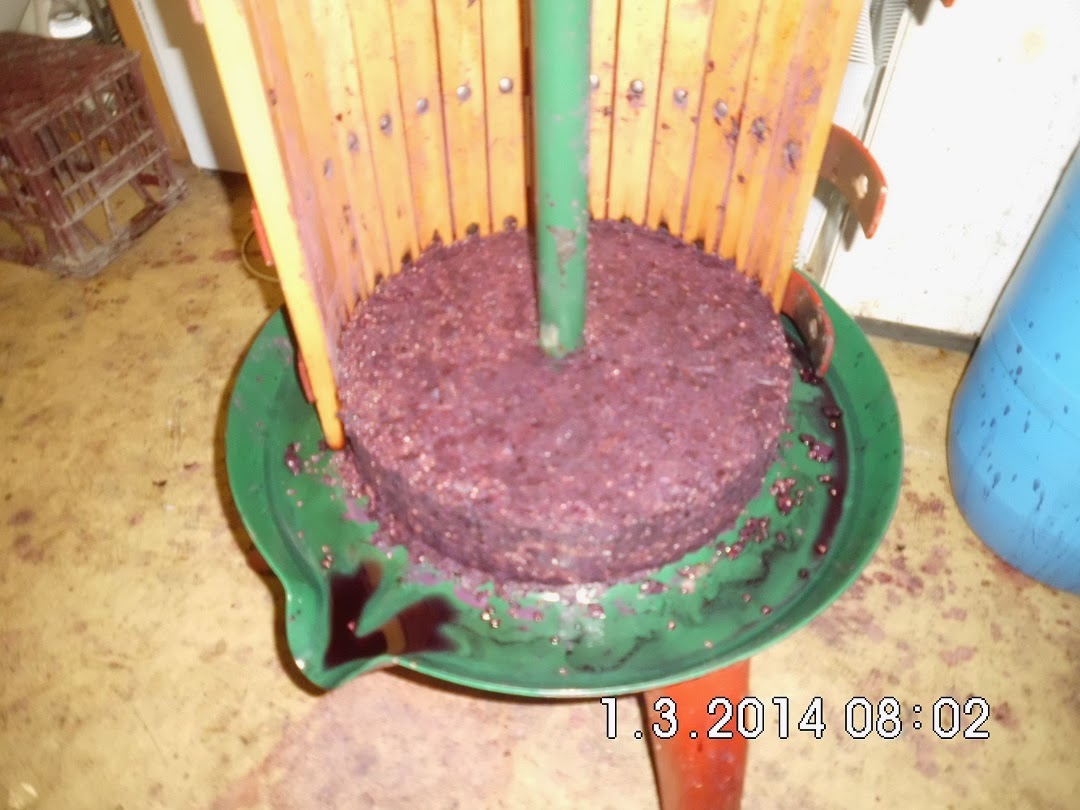
 
After pressing 70 kilograms of grapes there is very little marc remaining
 
In a few days the Tannat will be ready for pressing and just as well it is the last for the vintage as we are getting short on demijohns, especially the smaller 5 litre ones. The problem has been all the experimental batches of white which chewed through our little containers.
 
Our forest of air locked demijohns.
 
Filling demijohns always starts with some calculations to estimate which is the largest sized demijohn that can be easily filled then progressively smaller containers are utilized right down to even a 175 ml bottle which can be used for topping up. The Oak chips that were added eventually absorb water and sink leaving a larger than desired air pocket which needs to be filled as soon as possible to prevent oxidisation of the wine.
 
Pressing is an interesting process. At first you jiggle the ratchet handle just finger tip lightly to allow time for the juice to escape then gradually over a couple or more hours additional pressure is required. It is important not to rush the process otherwise juice may become trapped in pockets. Gradually over time a lot of force is required to increase pressure. Eventually almost no juice results even after letting it sit for a few hours and the pressure gets to point that it cannot be increased.

There are periods where the press can be left alone while juice continues to drain. This is the ideal time to carry on with other cellar tasks such as topping up containers or racking some that have gross lees thick in the base of the demijohn. There is a never ending job of washing out containers and cleaning.

Originally the cleaning was done in the laundry and there was a significant amount of running backwards and forwards dripping water everywhere. Now, having a laundry tub and double sinks in the Cave along with hot and cold rain water is such a great benefit.
 
From about this time forward planning commences for the 2015 vintage. Notes are made as to further experiments or changes to techniques. Once we have had a chance to try the finished wines in a few months further refining of methods will be noted. We also look at our stores of yeasts etc to see if anything needs replenishing.
 
And no we will not purchase any more demijohns otherwise the pressure will be there to make more wine.

Tuesday, February 4, 2014

2014 Vintage Update

Shiraz, Merlot, Tempranillo

After having frozen these three batches to below 0C it was time to defrost them so as to add the yeast. It took all day and night to have the temperature rise into the high teens early twenties. This morning The yeasts were rehydrated in grape juice taken from each batch that had been warmed to 38 C. Then after allowing the fermenting yeasts to cool to within 10 C of the main batches these starter batches were added back.

Two new yeasts are being tried both from Vintners Harvest an American company. The yeasts were sourced from a local home brew shop.

The Shiraz has VR21 which will go up to 15% alcohol the Shiraz has a high Brix reading of 24 and will need this.

Exceptional strain for full fruit red varietal wines with good structure, balance and colour. Excellent strain for red country wines.” Says the manufacturer.

The Merlot and Tempranillo have R56.

Perfect for rich full bodied red wines with exceptional full flavoured complexity

Chardonnay

The Chardonnay was racked after the intial fermentation slowed. Now it rests in airlocked demijohns, occasionally giving off a little CO2 as the last bits of sugar are consumed by the yeast cells. Some of the demijohns wee racked to remove the gross lees and now it was time to try some further experiments. Some of the batches that had good skin contact now had few American Oak chips added. Just to see if there would be any flavour improvement. And yes an un-oaked demijohn was kept of each as a comparison.

Sauvignon Blanc

These batches are in demijohns under refrigeration to keep the fermentation temperature between 12 and 15 C. They are bubbling away slowly. The airlocks aren't bubbling because they don't have water in them. Instead there is a little wad of cotton wool. This was recommended in one technical reference to enable H2SO2 to more readily escape. And it is escaping. There is a distinct rotten egg smell when the doors of the refrigeration units are opened.

Rose

These draining's from the Shiraz, Merlot and Tempranillo batches are all fermenting under airlock also under refrigeration. Once they are nearly finished they will be racked and a little addition of oak chips made just to add another dimension.

Chambourcin

Has pretty much finished its fermentation but some skins are still apparent on the surface. The goal is to have these skins in contact with the wine for a minimum of 22 days before pressing and storing in demijohns with Oak chips to settle and age. There is a plastic sheet covering the container to keep out bugs and every day a little CO2 is squirted over the surface to add some further protection against infection. This is the nervous part of the process. While it was madly fermenting the CO2 gas produced as a by-product protected the wine but now the only protection is the small amount of Potassium metabisulphite that was added at the crush and the daily burst of CO2.

Pinot Noir

The fermentation has slowed but not finished. The skins rise but not much and a once or twice daily plunging occurs. This is also now under plastic protection and also getting a whisp of CO2.

Saturday, February 1, 2014

Shiraz, Merlot and Tempranillo

Up at 4 am today to try and get to the vineyard by 6 am. They were picking Shiraz starting at 3 am but that's a bit early for me and they have headlights on their picker whereas I use sunshine.

The vineyard always looks wonderful in the light with the perfect rows and the large expanses of water.


Caught up with the vineyard manager on arrival, he looked tired. We chatted for a while and apart from the Shiraz it was mentioned that the Merlot looked good as did some of the Tempranillo. You might all say "but you were cutting back on varieties this year and  merlot was one of the varieties being let go".


Yes well it was early and the temptation was just too much. But to compensate smaller quantities of each were picked meaning overall the total weight was less. Of course that will probably play havoc with the organisation of demijohns.


This year we've been giving freshly robbed honey as gifts to the vineyard managers. To sweeten the deal for them. It never hurts to be generous with people that take time out of their busy day to speak with you and provide an opportunity to obtain good fruit.


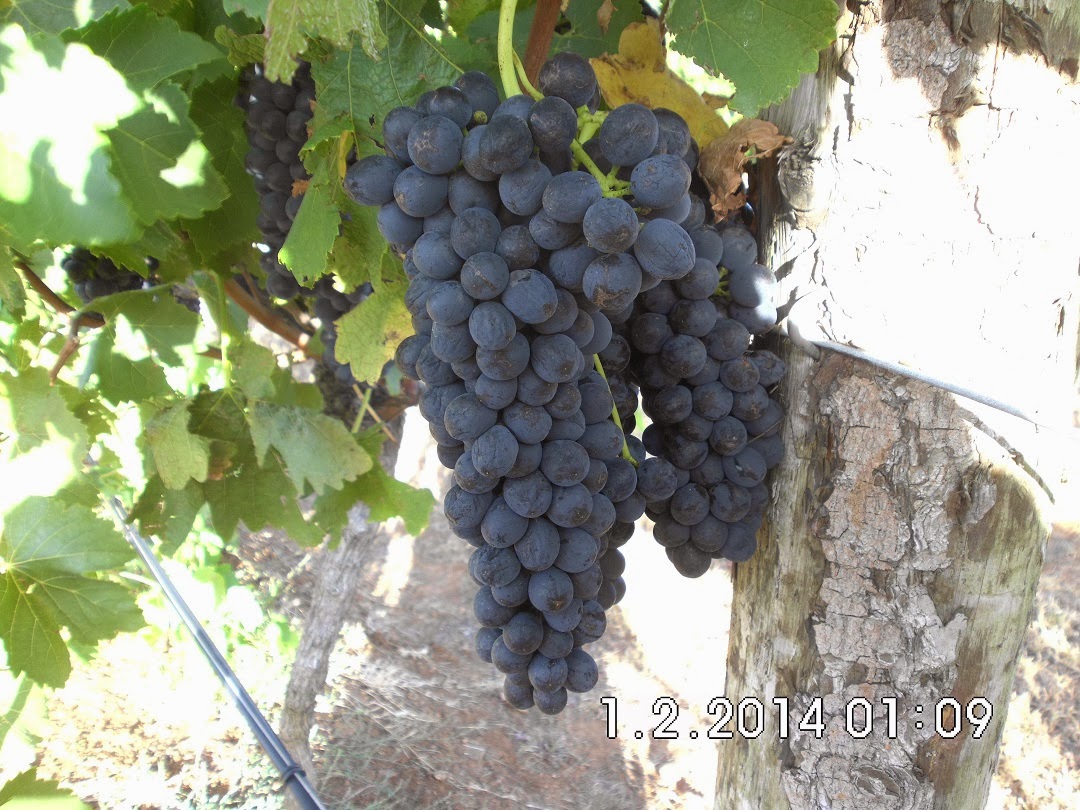
The grapes picked were all in the upper most rows in the vineyard and using the refractometer it was possible to be selective and choose the best quality fruit.


All three of these varieties have big easy to access bunches and picking went very quickly. All done by 8.30 and on the road home.

In the end the result was:

Shiraz, Brix 24, pH 3.73 just a little Tartaric adjustment done to narrow the margin between ideal and ok.

Merlot, Brix 23, pH 3.6 - perfection

Tempranillo, Brix 22, pH 3.6 again perfect.


The usual routine is to arrive home, unload the containers into chilling units and have a cup of tea while going through the accumulated notes on each variety and just make sure everything is clear about which processes will follow. The Vintage book is written up with a page for each variety, a batch number assigned, date picked and weight. The batch number is the year 4 and the sequence number e.g. 05 for Shiraz. That translates to 405 and is written on each container for tracking.


The weight is important as that will be the basis for later payment at the end of picking but also all calculations for additions of Sulphur and Oak is based on weight. In fact it is based on litres and to arrive at litres a yield of 60% is assumed. 100 KG results in 60 litres which is usually pretty close each year.
 
The crushing and de-stemming went quickly with one batch after another processed and put away and everything thoroughly cleaned afterwards.

As usual a Google Scholar search is performed just to see if there is any new research into these varieties and by chance a very interesting article is uncovered. Improved colour and phenolic extraction can be achieved by freezing the grapes before fermentation. The freezing explodes the cells in the skin increasing the extraction by as much as 50%. No time like the present to try this little technique. In addition there will be the 10% Saignee  i.e. bleeding off the juice to make rose and increase the skin to juice ratio. A few days of cold soaking will correspond with the freezing and at the end sitting on skins for a total of 22 days. This should really extract all the goodness and colour to make a powerful wine.

This is an exciting time at HHF with so much going on and the expectation of some wonderful wines in the near future. The opportunity to become immersed in the whole wine making process and the learning opportunity associated with the science of making good wine.

With everything tucked away and chilling it was time for an early night.

Sunday, June 9, 2013

Tempranillo and Chambourcin, Petit Verdot

The Tempranillo was 11.4 Baume and pH of 3.63. About 10% good quality whole bunches were left at the bottom of the fermenter and the rest run through the crusher destemmer. Overnight the temperature was lowered to 10 degrees C. This morning approximately 5 litres of juice was drained off to make rose and increase the skin to juice ratio.

Have been trying to leave the Chambourcin to the last minute to maximise sugar and skin colour. The weather has been cool in the Hunter and ripening has been slow. The weather beat me though as heavy rain was forecast for the weekend. Picked on Thursday and got 40 kilograms. Was expecting 50-60. Last year there was 120 but this year I pinched out the second flower on each spur hoping for better maturity. Well the sugar level was 23.5 Baume and pH was 3.5. Couldn’t have asked for a better result. After 24 hours the juice is almost black. Started fermentation immediately with BDX yeast and some nutrient. Once it was all going I bled off a couple of litres for Rose and put the lot into the freezer to bring down to 21-24 C range. This is very exciting.

Up at 4 am to pick some Shiraz from a vineyard an hour away. About an acre of vines was being left because of bird pick and botrytis but there were plenty of good bunches to selectively pick. Took off 65 kilograms and was then told that there was a suspicion that this was not Shiraz but could well be Petit Verdot. It was being DNA tested at the moment. What great news if it is Petit Verdot, yet another variety to play with. Got it fermenting with BDX yeast and the next morning bled off 5 litres for Rose and started chilling it.

Wine Making

Everything is progressing well. The Sauvignon Blanc ferment came to halt which allowed me to rack it into clean demijohns and it is now aging and settling. 

 The Pinot is still bubbling away but now under airlock. The header boards mean that the juice at the top isn’t representative of the entire batch in terms of sugar levels. Once each day I take out the header boards and give the barrel a good stir.

 The Shiraz, Muscat and Tempranillo are about two thirds through the fermentation process and are out of the their chiller units and finishing off at the ambient temperature. Only the Merlot is under refrigeration. The electricity bill will be phenomenal .

 The Chambourcin in our own vineyard is in the low 20s (Brix). I’d like to get it up to 24 if possible. This week is cloudy but hopefully not a lot of rain. Could be another week or two before harvest.
The Tannat which we are buying is in a similar position to the Chambourcin.

 An interesting observation was the effect of hot days on pH. The Pinot was harvested following a 40 plus day. The pH was 4.1. The other reds were harvested later after a week of rain and cloud and the pH was 3.6. Had it been our Pinot instead of an hours drive away I would have waited and harvested at a more optimal time. Anyway there is nothing that Tartaric can’t fix.

 I’ve been able to taste some samples of the whites as they were being racked and they show a lot of potential. Good nose, a little bite but that should settle out.
From left to right 1) pH Tester, 2) Small digital scales for measuring from 0.01 grams to 20 grams, 3) Digital scales for up to 5KG.
 

Picking Reds

In one day we picked Tempranillo, Muscat, Shiraz and Merlot. Tempranillo is a great grape for picking. Good large bunches with pronounced stems easy to find and cut. It doesn't take long to fill the bin.

My theory that west side bunches are always riper went out the window until I realised that the wide bitumen surfaced road beside the west end of the roads has probably had a pronounced effect on the ripening, especially during those stinking hot days last month. We are picking a bit early because the heavy rain (180 mm) had caused havoc with botrytis breaking out. We were careful to select only clean bunches. This could be another low harvest year for this vineyard.

The Pinot Noir has been going for 30 days and the skins have still not sunk. Can’t stand it any longer. Pressed 16 litres of dark juice. Using French oak and will add some American oak as it settles. While the press was dirty the Shiraz was pressed as the skins were not rising anymore. The shiraz was on skins for 18 days.