Search This Blog

Showing posts with label Wine Bottles. Show all posts

Saturday, August 17, 2013

Tannat Wine, Cleaning Wine Bottles, The Project is finished

We opened two bottles of wine yesterday. Both were the 2012 Tannat  (red) which had extended fermentation. T1 had been fermented on skins for 15 days and French Oak Medium toasted chips were added after the main fermentation was complete. It is beautiful. Very drinkable with a dark almost black colour and good fruit nose and palate. T2 had not only been fermented for 21 days but had the pressed skins from T1 added to it at day 15. Same oak addition. The whole idea was to extract as much of the goodness out of the skins as possible. T2 was harsher more tannic but will soften in time.

The conundrum is that T2 is at its peak in goodness and should really be the one to drink now. Our compromise was to mix the two 50/50.

Can't wait to try some of the 2013 reds as they were fermented on skins for an additional week to really push the boundaries of extraction.

One of the podcasts recently listed to was from Cellar Dwellers in the USA. Very entertaining coverage of wine making with the motto "the more you drink the better we sound". Some wrong information occasionally but always some new concepts and ideas to try. What was highlighted in one podcast was the problem a lot of people have with cleaning bottles. Getting the label off seems to be one area they struggle with. Some labels come of easily as the glue is water soluble. Others can be taken off if the bottle is filled with hot water and then soaked in hot water.

What a waste of effort. A sharp kitchen knife (not longer used in the kitchen) will scrape off the labels and the residue scrubbed off with coarse steel wool. This steel wool is kept aside just for this job as it becomes clogged with paper fragments. A few types of labels have a glue which needs to be rubbed off with paint thinners but this type is a reasonably  small percentage.

The final step is putting them through the dishwasher. They come out squeaky clean and sterile ready for wine bottling. The podcast was saying it takes about an hour to do 12-15 bottles and so they were moving away from recycling to purchasing new bottles. What a waste. The method outlined above takes no more than 10-15 minutes for 12-15 bottles.

The Project aka Egg Incubator aka Chickabator is finished. Today the bottom mesh was installed and while a full scale temperature and humidity test was underway a sliding frame was assembled to hold the eggs and allow them to be rolled easily without removing the lid.

Temperature and humidity test underway

Also tested was whether air was circulating. A small tray with smoking sawdust placed inside demonstrated that air was indeed leaving the box.

Humidity device, The cloths stop the slopping when the bator is moved. More trays = more humidity. Notice the protruding handle used to roll the eggs.

The last test will be a 24 hour min max temperature test.

The primitive egg roller installed and the wireless temperature and humidity transmitter secured to the wall.

Saturday, July 27, 2013

Recycling Wine Bottles and Sinks

As usual there was the quick whip around all the herds. A new strip of grass for the cows and calves next door and another birth up on the hill.

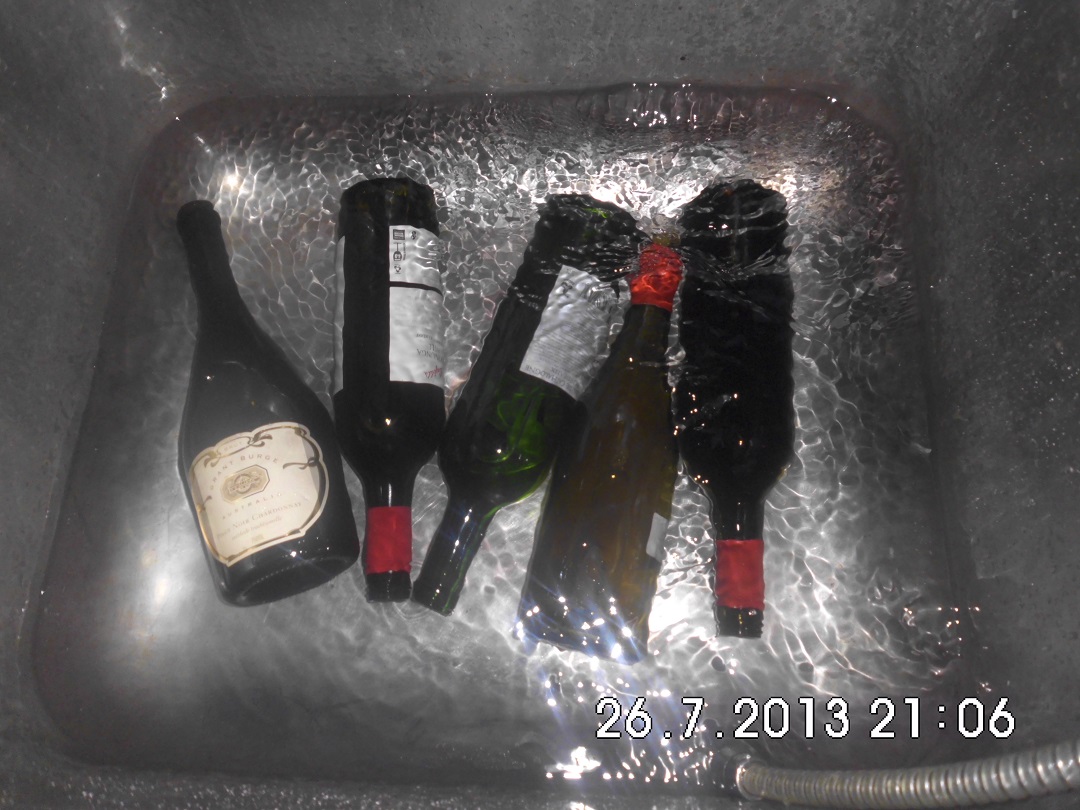
Bottling wine requires that empty wine bottles. This is achieved by recycling both our own wine bottles and if needed some from friends. The empties are soaked in batches in the laundry sized tub in the cave for 24 hours to soften the labels and using a sharp knife they are scrapped off and a piece of steel wool is scrubbed over the surface to remove any traces of glue and paper. Sometimes the glue is of a type that needs dissolving using Turpentine or other thinners and an old cloth. Both screw top (Stelvin) and standard cork seal bottles are kept. If the corks have not been pierced all the way through they can be reused in most cases depending on thickness and other damage.

The bottles are then included in a run of the kitchen dishwasher just to perform a final clean and sterilization. Stored in wine cartons with the open top pointing down they are ready for immediate use when needed. Our whites were bottled in Autumn. The reds will sit tight until warmer weather in mid to late spring just in case there is any final fermentation of residual sugars or a Malolactic fermentation.


Having good washing up facilities is a real time saver. Originally all the cleaning during wine making was done in the laundry. Traipsing in and out of the house opening and closing doors and then cleaning up the mess afterwards.

Well not any more. A double sink and a laundry sink in the cave has changed all that. Shoes do not have to be removed in the cave unless caked in mud. The large cheese making pots are scrubbed in the cave after use and allowed to drain dry. To facilitate all this there is both hot and cold water. In addition one set of taps was installed with a flexible extension hose to make cleaning larger vessels all that much easier. Almost all our taps have usage reduction nozzles fitted except the odd like this extension nozzle. This makes for rapid filling of the tub or when a volume of water is required.

Large and small tubs and plenty of draining area.
This may seem like an extravagance but it has proved a real bonus. Since the plumbing for the cave was a necessity it seemed sensible to install another double sink on the outside wall and combine all the plumbing work. Now there is both hot and cold potable water on the outside which means if one is too grubby to go into the cave then cleaning operations can be performed outside. This is particularly useful for cleaning vegetables. The sink is also located right next to our potting station and seedling raising bench. The drainage is fed out into the Orchard benefitting a whole host of trees.


Most of today was spent continuing the rock picking in the Nuttery. Another trailer load was completed and a rough estimate indicates that one more trailer load will finish the job - well maybe two.