Search This Blog

Showing posts with label Grapes. Show all posts

Wednesday, July 30, 2014

What it means to have a small Holding

Here's the theory for July: It's cold or at least cool, it could be misty in the morning and even drizzly rain, the fireplace is ticking over with hot coals or a fresh piece of wood flaring, a bit of a wind gusting outside and the sky is grey. Time to spreadeagle on the lounge with a one of the many books backlogged in the pile and relax.

Now here is the reality: The sun is shining, the wind has gone for the moment, the grapes need pruning and weeding, tomato varieties need selection and potting under heat to be ready for a September planting, there is a pile of other fresh pruning's that need a run through the mulcher and there will be a need for lots of compost in spring so make use of all the green material you have.
 
The book goes back on the pile and work begins. All the grapes get pruned, a little layering or transplanting of last year's cuttings to fill a spare spot. Tying up any rogue shoots, a quick weed around the trunk and on goes a huge pile of cow rejected silage which stinks but the wind is blowing that scent across to the neighbours and away from us. Oh well, the smell will only last a few weeks. It is just part of nature in the country. Probably means moving a bottle or two of last vintage from our side of the cellar to the neighbours side of the cellar.

Table grapes pruned

Ready for chipping and mulching


A lot of work and tons of silage but will pay dividends

Using the freshly made compost to start seedlings
 
July can really be one of the busiest months of the year. At least in August it will only be the last week when the Tomato bed needs building that life will become a little hectic. Then of course with September becomes the planting out of the warm month vegetables. Always too many for two but there are always many happy recipients elsewhere in the village. There is the anticipation of the first fresh tomato and first young cucumber. Yes it is possible to use a hothouse and grow the most delicious produce all year round but then the mouth watering wait and abstinence is missing and life lacks those peaks and troughs that provide contrast and highs of long awaited pleasure.

As the weather warms up and if the rains come the following 6 months become a blur of weeding, watering, planting and harvesting until the blessed cool arrives with a sigh of relief tools go down and relation comes in the form of wine and cheese in the mildly warm garden.

The steady rhythm of seasonal demands and rewards. With each bringing the expectation and desire of the next stage. Maybe some find this repetitiveness boring. But there is a pleasure which can't be felt from any other form of activity. Contact with the soil, plants and animals seems to be a desire that comes from deep inside.

For some it's the travel, the sport, the toys for us it's being at home on our own plot, digging and weeding, having successes and having failures, plopping down in the evening with fresh home made produce and resting for tomorrow.

Tuesday, March 4, 2014

Uses for Grape Marc

A final clean up of the Cave today as part of the end of vintage. The last job was to break down the basket press and perform a thorough clean. There are still some pears and apples maturing in the orchard and the press will receive additional work between now and the end of April. After that it gets a coat of non toxic paint to the base plate and is put aside for another year.

Just as the grape marc was about to be tossed into the compost there was a pause and some light globes (LED) went off. There was the faint memory of a cheese we had seen at Simon Johnson's shop more than a decade ago. It was a cheese that had been stored in grape marc. We obviously tried a piece and found it interesting.

Grape Marc

After a quick check on the web a few options were uncovered.

Grape Marc Aged Tomme

here was a Havarti in the cheese fridge from last October that we felt was a bit dry. It went into a container shrouded in marc with a bit of freshly pressed wine. And as a proper test a nicer cheddar like cheese was also covered in marc and stored. These will stay like that for 2-3 months.


In Europe cheeses like this are made and stored for a period of months then coinciding with the end of vintage they are brought out and shrouded in grape marc for 3-4 months before consumption.

Just in case any of these cheeses turn out fabulous a few jars of marc were frozen. No need to wait until next vintage for the ingredients.


We finally caught up with a nearby farmer who had a stack of mulch silage round bales for sale at $30/~ton. We met up with him at 2.30 and loaded the ute and trailer as a bonus he chucked on a third bale as a bit of compensation for having to wait so long (at no extra cost). By good fortune we'd brought along a jar of our creamed honey as gift. Good swap. It always pays to sweeten a deal whenever possible.

Friday, November 1, 2013

Bio Dynamic Practice with Birds and Bees and some other stuff

Each year after veraison the vineyard starts to receive attention from the bird population. Mainly from one particular species. We invested a large amount of money in netting to protect the crop and at first this seemed to work. But these pests are particularly aggressive and would stand on the netting and peck at the bunches underneath creating extensive damage.

Last year in a BD newsletter received at the time there was a very good article on making insect and animal peppers. As the timing was right we followed the instruction carefully and made some peppers from a few of the birds and applied the peppers in the prescribed manner as well as netting.

Right through December and into January no birds invaded. Then there was a period of solid rain and afterward the pests arrived. When things dried out again we re-applied the peppers with good results. Last year overall there was very little bird damage. This is not a conclusive trial but it looks very positive and we will try again.

So to the bees.
An examination of the hive today showed a healthy hive. Food stores look good, lots of activity, a few bees bringing in pollen and a few drones walking about. Can't say I was happy with the amount of brood but the smoker died part of the way through the inspection and not all the frames were examined. Will re-examine the hive in a couple of days time.

The SHB (Small Hive Beetle) population was quite small. Is this an indication of a strong hive or just dry weather not being conducive to their breeding? The opening of the hive drives the SHB to the bottom board where there are some small slots leading to a trap filled with Diatomaceous Earth. After each hive opening the trap always has a dozen or two SHB floundering about in the earth. I make sure they get a good coating.

The slide out bottom board SHB trap

We made some SHB peppers last year again at the correct time and today I applied the peppers around the hive in a series of concentric circles. This will be an interesting test. Having used up all the peppers I harvested the dead and struggling beetles from the hive trap and added them to my collection which is kept frozen. As soon as the time is right we will make some additional peppers.

Frozen SHB

When making chocolate the other day I made a large chocolate block with no nuts or shredded coconut for Jean to use in making  a dextrose sweetened chocolate fudge for morning tea which she did today. It was perfect. Moist, a hint of sweetness and very chocolaty.

It broke in two when picked up

Across the river at the workplace things proceeded quickly now that no irrigation is required. The cows had demolished the freshly made Ryegrass silage put out yesterday. They had almost licked the ground clean of any that fell out of the feeder. The last of the old Lucerne was fed to the weaners with the exception of three bales which I was forced to leave in place. In a bowl like cavity chewed into one bale was a nest with 4 or 5 little rabbits huddled together sleeping and making sighing noises. I gently partially covered the nest with a bale for protection and left them alone.

Back home the NZ compost made 5 or 6 weeks ago was due for turning which didn't take long as there was a spare compost box right bedside the it.


And then (finally) got back to repairing the box trailer. We are still two bushes short to complete the task but the newly painted axle and rust proofed springs went in and all but two of the bolts. New bearings and seals and lots of grease completed the wheel assembly. Only five minutes work remains once we get the two new bushes.

Tuesday, September 24, 2013

Feeding Grapevines, planting out more Spring seedlings and not getting it right every time

Now that all the grapevines have flowered and set fruit it was a good time to give them a light feed of fish emulsion. We had picked up a few 5 litre containers of the emulsion at the last Tocal Field Days event at a good price. Not wanting to overdo it only one container was poured into the holding tank which contained 3-5000 litres. One pump was started on the dam to get the water splashing into the tank and mix the emulsion then the drip irrigation system was started for the 150 vines. There has been no rain for two weeks and the vines have not been watered for three weeks. The idea is to add some nutrients into the soil for the vines but to over stimulate the growth and possibly get a crop of grapes that that do not have sufficient intensity of flavour. Grape vines seem to produce their best wine fruit when under a little bit of stress and working hard. By watering heavily today it is hoped the moisture and nutrients  will spread deeply into the rocky underlay and encourage the roots deeper.

The timing worked out perfectly. returned from over the river after two hours to find the water was just running out and the vines could be turned off. Topped the fuel in the pumps and started both to fill the tank overnight.

Had a good strike of corn seedlings for a second planting. Out went some Cucurbits and a Watermelon seedling that friends have left us as well as another Okra. Still outstanding is the Bitter Melon a great addition to stir fry, Zucchini, more beans and some other varieties of Rockmelon and Watermelon. Well maybe this can be classed as succession planting rather than germination failure.

One particular podcast Episode 1210 from http://www.thesurvivalpodcast.com/ was playing as work progressed during the morning. Worth listening to for all those attempting a self sufficient lifestyle. All does not go according to plan every time. Conditions change (we are dealing with nature after all) and sometimes you need to step back and review what is being done. A lot of things we do are automatic based on prior experience and occasionally we get a surprise when it doesn't work.

Rarely to we talk about our failures. Do we believe people don't want to hear about our failures? Are they only interested in out successes so that they can replicate them?  Should we also mention our disasters and demonstrate out fallibility? Use the failures to demonstrate how to recover from a problem?

Having presided over more disasters than you can poke a stick at we could flood the ether with our stories.

Wednesday, September 18, 2013

Cutting the trees down was the easy part

The clean up that follows downing some trees is the time consuming part of the program. Already the trees had been cut up into various lengths. This morning foliage was stacked ready for mulching and chipping and the firewood sized pieces carried up to the wood pile and stacked. The trees downed behind the water tanks were just too far away from the wood pile to do entirely by hand but have had the foliage stacked and tomorrow the firewood will be brought up with the tractor and trailer.

A view from the south of the water storage facility. 4 concrete tanks totalling 100,000 litres.
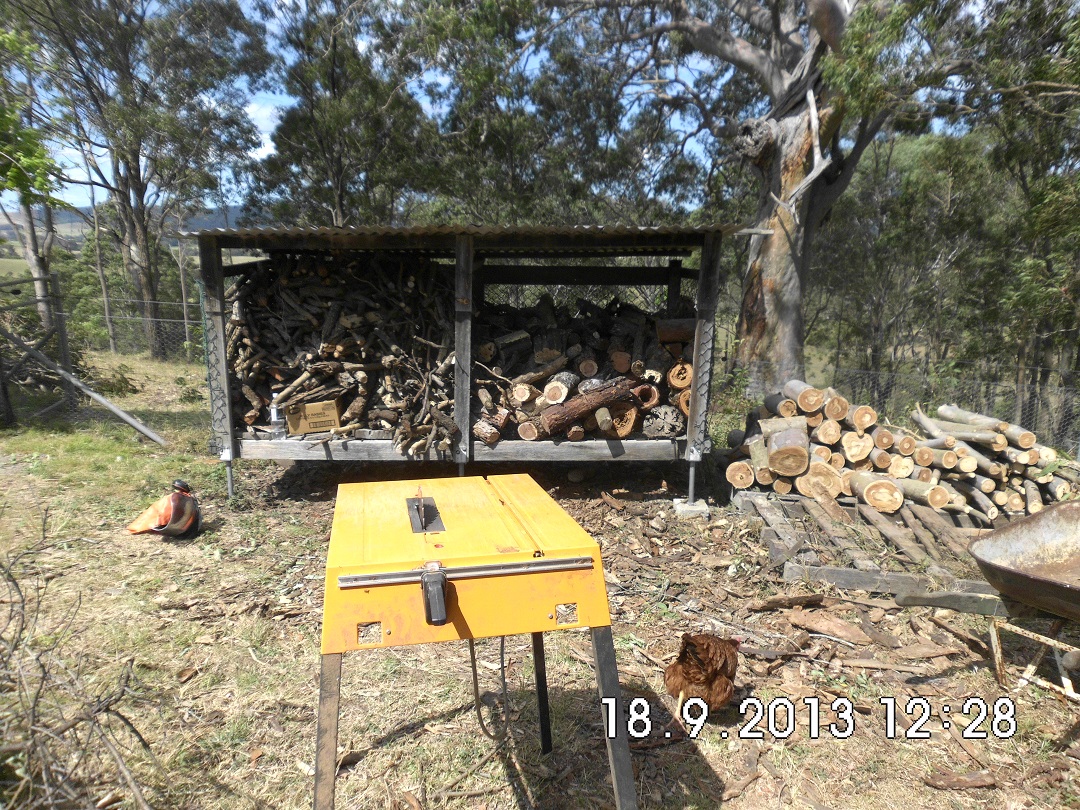
To make room for storing the new firewood the previous seasons wood had to be removed. The larger pieces had already been cut to size with the chainsaw but the rest had to be processed before it was stored in the firewood shelter. The quickest and easiest way was to carry the light weight saw bench up to the wood pile and suitably dressed in protective clothing cut each to length.

Triton saw bench
As soon as a chain saw or saw bench is started the chooks run over. They love scratching about for what ever falls out of the bark form the aged pieces of wood.

It is always satisfying to think that nothing was wasted from the tree felling operation. Wood for the fire and mulch for the garden which will in turn reduce our watering requirement.

After a few hours paid work across the river harrowing paddocks and trying to finish off a piece of fencing that has been started but constantly put to one side as other priorities intervene.

It was after 4 before we arrived back home and commenced the afternoon chores. I made a quick pass through the vineyard to inspect the vines progress. They are still bud bursting and setting flower but the bulk have finished and there were very little pruning of excess bunches needed on this pass. It was surprising to see how quickly the bunches which flowered earlier have grown.


One of the early bunches with a rose in the background. Despite what is generally said the roses are only there for show.


Saturday, September 7, 2013

Spring in Earnest

Vegetables

Rockmelon, Snake Bean, Corn and Okra seeds planted have begun to germinate in the Cold Frame. This is much faster than we expected but with the weather as warm as it has been it shouldn't be surprising. Planting out will be early this year but it's a bit soon to get too excited. Once out of the Cold Frame if the weather cools the seedlings will sit there doing nothing for a while. Its one of the problems with succession planting of Rockmelon and Watermelon. The early plantings are slow to progress and the later plantings take off and start to catch up. In the end the two harvests merge and the glut still occurs. This year there will be no succession planting of melons.

Okra and Corn

Snake Bean

Rockmelon
Vineyard

Out in the vineyard bud burst has been under way for some time. Flowering is occurring as well. Because the Chambourcin is such a prolific flowerer and our ground is so poor the grapes will struggle to ripen if left alone. Every couple of mornings there is the stroll amongst the vines pinching out excess flowers. One bunch per shoot instead of the two or three.

Vineyard greening up

Chambourcin

Isabella

Isabella


Preparedness

Having spoken about Honda engines and reliability recently it needs mentioning that our backup power source is a Honda engine driving a generator. It always starts on the first pull. We mounted ours on wheels so it can be moved quickly into position for exhaust fumes to dissipate. It's all fuelled and ready to go. In past years power reliability was an issue, not so much these days but we still get that inconvenient outage just on dusk. Outages are either just a brief flicker or last 2-3 hours while repair crews find the source of the problem. With Summer coming no doubt there will be a few issues either because of high winds, overload or fires.

The generator is only one part of the solution. A good selection of power leads and multiple outlet power boards are always kept nearby for easy access. Setting up the house with lights, TV etc. takes about 15 minutes. Rather than sit around waiting its easier to perform the setup at the first sign of trouble and then put everything away in the morning.

Generator

Extension leads and powerboards


Saturday, June 22, 2013

Vineyard Pruning


That time of year again. Started pruning in the Vineyard as all the leaves have dropped. The table grape vines around the house are still covered in leaves probably because of the heat generated around the house. Only a few of the orchard trees have dropped which means we can prune a few things at a time spinning out the workload.

After pruning the vineyard we will try grafting (again). There are some Isabella vines which are unsuitable for wine making and every year an attempt has been made to graft Chambourcin to Isabella rootstock. Having tried two grafting methods both have had a success rate of about 1%. So there is a technique here that we have definitely not mastered.

During vintage we noticed at a commercial vineyard that whole sections had been grafted successfully. Some inquiries added some additional knowledge which will be incorporated into our technique. The main piece of knowledge was when bud grafting leave some original buds which will burst and provide life to the vine until the new graft has taken. The original buds need to be trimmed so they don't get out of hand. We'll see how we go. We haven’t try top grafting before so maybe that is another experiment. The few successful grafts are very vigorous.

Our vineyard has a rock platform about 600 mm bellow the ground and the roots grow sideways not down. They say to make good wine you need to stress grape vines, well these get really stressed especially if there is a dry spell. Fortunately we have access to plenty of dam water.


Saturday, June 8, 2013

Vineyard


A couple of years ago the old vineyard trellising was feeling its age. Because of the shallow soil metal end strainers were the only viable solution unfortunately the cost was going to be between $500 and $1000 to buy enough galvanised steel pipe to complete the project. The idea was shelved until we stumbled across a large quantity of short off cuts at the local garbage dump shop. At the cost of $1 each we took the lot. By the time the entire vineyard was re-trellised a great deal of skill was acquired welding pipe together to achieve a suitable length. In the end not only was the trellising completed but there were enough off-cuts to complete other fencing as well as a few odd jobs and all that for $60.

The rag tag vineyard which originally had patchy trellis put in as a temporary measure to see if grapes would survive now has a pleasant symmetry about it. The wire stays on the slanted strainers were use to avoid having to put in diagonal pipe stays. The strainers are filled with cement as they would otherwise bend as the wires were tensioned. Each strainer is concreted to bedrock and each wire stay is attached to a piece of pipe also concreted to bedrock. To achieve the same angle we built a portable wooden jig to support the strainer until the concrete had set, Small nuts are welded to the strainer to stop the wires from slipping.

Each of the uprights in the row has a netting spreader installed to keep the netting away from the fruit as the birds sit on the net and try to reach the fruit.

Once the trellising was completed a new drip irrigation system was installed to increase the water capacity. Most recently the weed mat was removed and guards installed around each vine. The weed mat had helped reduce the weed competition while the vines gained some maturity but was now too overgrown.

The end result has been positive for the fruit. Yields have increased and there is less disease as a result of the additional height and the better netting.