Search This Blog

Showing posts with label Fruit Trees. Show all posts

Saturday, June 14, 2014

Bunya Nut

On the way back from the Hay come Tractor shed the path leads past the  Bunya Nut which was planted a decade or so ago. It's doing well and to prevent loneliness a mate was planted about 20 or 30 metres away. Eventually these Jurassic fossils will reach 40-50 metres. The first one was a gift from someone as was its mate. There is something primitive about its leaf profile and it emanates a special feeling as you pass by.

The good thing is its fruit which we are anticipating. We made sure they are planted well away from anything the 5KG fruit will damage as it descends to earth.


Thursday, June 5, 2014

Blueberry Plant Arrives

Over the last few years we have grown (or tried to grow) a number of Blueberry plants. The first few attempts for complete failures. For a start we had them with the wrong aspect i.e. too much Sun. Just to make it impossible for them to thrive we also planted them in the wrong soil i.e. they like a bit of acidity.

After a few failures I was listening to a local radio station 1233 and the announcer Carol Duncan mentioned she had Blueberries in pots in her back yard. That sounded like a good idea. We loaded the pots with a Rose/Gardenia/ Azalea mix and planted again but put the pots around on the eastern side of the house and had great success.


The next problem was Jean investigating Blueberries in various books and journals only to discover the varieties we had planted were really ornamental and the fruit we harvested was mediocre in flavour compared to the real thing. But they survived in our climate.

Sunshine Blue, Edible but really ornamental


Jean assembled a list of desired low chill varieties and approached Country Elegance Gardens and Gifts in Dungog. They have done a superb job and the first plant arrived this week via a circuitous route. The grower took it to Sydney and nursery owner's husband collected it in person. Now that is service. The next variety will arrive in July.

Misty, the real deal. 250-450 chill hours with large full flavoured fruit

Just so we didn't waste the trip to Dungog we performed a few additional tasks to make an afternoon's fun. Dropped off some books and DVDs at the library and filled the company ute with fuel.

The vehicle in use this week is a V8 Landcruiser with two 100 litre tanks which we are temporarily driving while the boss uses the much smaller Colarado duel cab, our normal company vehicle. The Landcruiser should warm the globe on its own. Apparently it is the choice of middle east armed insurgents for mounted cannon. I don't know how they can afford the fuel. And it barely fits two in the front which is probably why you see so many masked men hanging off the tray in those news reels. The masks must be to keep the sand out of the mouth.

The highlight of the trip was the visit to the dump where we collected a whole host of useful objects such as a couple more heavy gauge galvanised pipes for fencing, a three metres of thick conveyor belting for the future cattle yards and a few kilograms of unused Tek screws of which my workshop consumes in vast amounts. Additionally there were various hand tools, bits, bobs nuts and bolts. The screws alone would be worth over $100 but our entire haul cost $30.

Belting and pipes
Small Hand Drill and hinges

Axe, chisels, Crown Seal Capper, Scissor Jack, Carpenters Pincers

Miscellaneous  Tek Screws

More Tek Screws

Yet more Tek Screws

Monday, April 28, 2014

Fresh Fruit All Year Round

Our goal at HHF when we first arrived was to have fresh fruit available all year round. We chose the Orchard trees based on their documented fruit maturity month. For example we have lots of Citrus trees which grow well in our area. The first Mandarin is ready for eating in May and the last Mandarin in October with a few Oranges holding on until November. Mulberry comes on after the Mandarin followed by Peaches and Nectarines, then Plums. Grapes and melons are followed by Apples and Pears. Dragon Fruit fills any gaps about this time. Occasionally we get some Bananas and the occasional Pineapple. All a welcome diversity.

The transition period of April/May is covered by our Cherry Guava (Botanical Name: Psidium cattleianum Plant Family: Myrtaceae). This provides a high vitamin C fruit for our nightly yogurt from April through to July.


Our tree is planted beside the chicken run and benefits from the proximity to lots of fresh nutrient while provide some shade for the chickens and a they return the compliment by cleaning up the fruit fall.


There is this steady progression of fresh vitamins and minerals in our diet. We don't juice our fruit except to make wine from excess fruit. The fibre is just as important as the  juice. Juicing just increase the amount of sugar consumed without making the gut work.

An attraction of Cherry Guava is that the fruit matures gradually not all at once
The sugar content of Cherry Guava is quite low and it would be unsuitable for wine making without adding sugar. Like lots of small fruits it probably would freeze although we haven't tried this. By having such a variety of fruiting plants we are able to save energy by not having to freeze or preserve fruits. The only short coming of our plan would be if we have a bad harvest and a gap opens in our plan. Backup plan is homemade ported prunes.

Wednesday, December 11, 2013

Fruit and Vegetables

Just wanted to show a few items that are doing well in the garden at the moment.
 
This is Dragon Fruit. The plant is quite large and the mounting post up which it grows fell over a couple of months back. It is fine now and is preparing to flower. We have found at least 4 flowers forming although there could be more as the season progresses. Easy to grow plant and the fruit is fantastic. Very hardy.

This is a flower from a different angle.

Hungarian Yellow Wax Capsicum. This is the sweet variety. These little plants are prolific. Two or three plants will keep you in capsicums all Summer. Usually we just fry them until soft in a pan and then dress with salad dressing or soy sauce. Good nibble.


The Williams pear tree and the Packham pear are covered in fruit and consequently exclusion bags to prevent fruit fly. We will eat some of the fruit fresh but the bulk will go to making Perry. The exposed fruit will start to go off because of the fruit fly but the cattle love them. We will pull off the exposed fruit and toss them over the fence to be eaten before they break down too much.

One of the four Mango trees. The dry Spring was ideal for fruit set. The first time we have had fruit mature this far in many years. Hopefully it will keep going and ripen. There is so much fruit we are looking forward to eating and preserving. Probably freezing pieces will suit our need for fruit with fresh yogurt.

This is a sample of the Gresford Dry Pumpkin. It is small hard and keeps forever and tastes wonderful. It's call Gresford Dry because of where we purchased the first one and harvested the seed.

The Winter Squash also keeps well, tastes great and is spectacular in colour. Makes the cucurbit bed look pretty. Matures early.

A banana flower just starting

A good sized bunch of bananas. By thinning out the number of trunks in the bed we were able to increase the size of the fruit.

Tuesday, October 29, 2013

Washing Chooks and the results of dry weather

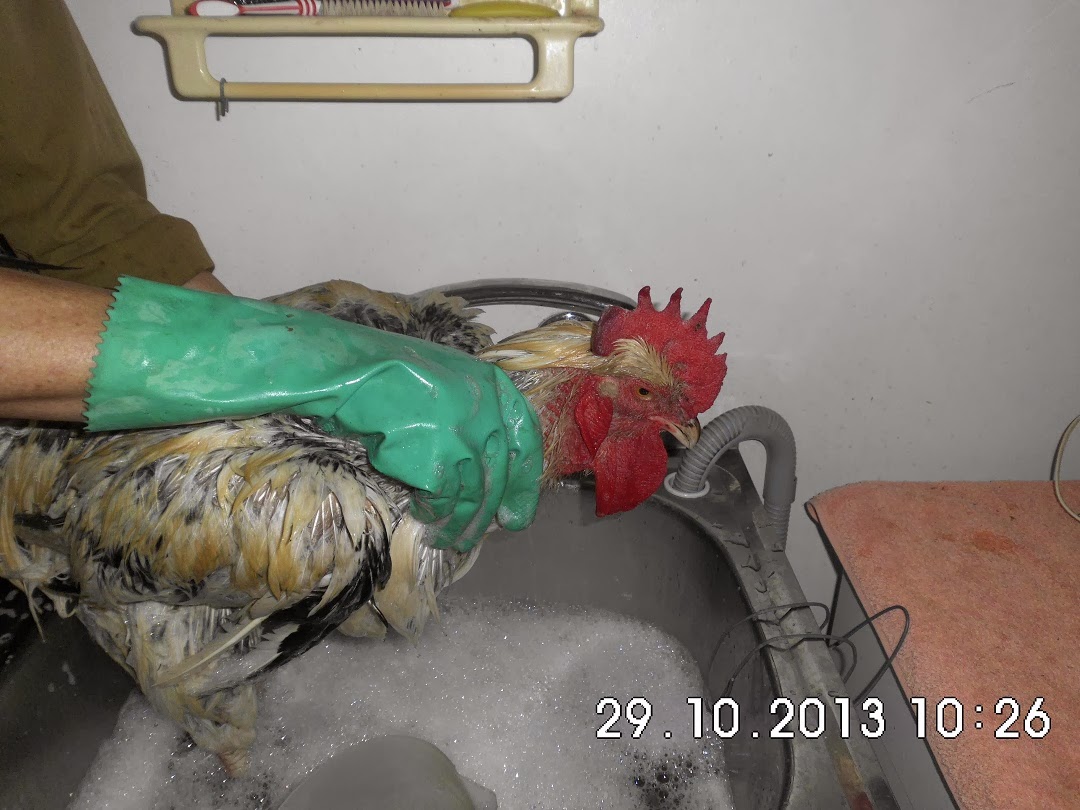
Jean has commenced a program of washing the worst of the chooks. This is our oldest rooster who will be put in the isolation pen with Light Lomi for a few days.

Light Sussex rooster in an embarrassing position

A better angle

And finishing off

The dry weather has been great for fruit set and we were looking forward to a bumper year. But as it happens other things come to pass. Fruit Bats have been visiting at night and ripping open the paper exclusion bags. So next year it will have to be Cotton bags on these.


Fruit Bat damaged exclusion bags on the Tropical Nectarine

Out in the paddock Summer bed the dry weather has meant there is little feed for Wallabies and Rabbits. And that makes our cultivated plants very attractive. All bar one Capsicum has been eaten, The Dill was popular and the Okra. Very young Corn is a target although after it gets past a certain stage it is not attractive to predators.

So that is nature two steps forward and one step back. The next planting out will have a cage around it.

Wallaby damaged Corn


Damaged Capsicum - Rabbits or Wallabies


Okra


Saturday, October 12, 2013

Broody Chook Pen, Fruit Set 2013, Cuisine Night

Finally finished fiddling with the broody chook pen which was blocking the doorway of the workshop. We managed to slowly carry it out into position at the side of the workshop close to the chicken run. After getting it level a star picket was hammered in at its rear and a couple of metal straps attached to make sure it didn't get bowled over in a strong southerly. A job well done - free to good home item + a couple of hours labour and good as new ready for action.


Spent a couple of hours putting fruit fly exclusion bags on the apples and pears. There is so much fruit this year. I wonder if it is because of the dry weather that the prolific flowering has set fruit much better or is the serious pruning two years ago? The pears have these great bunches of baby fruit and the tropical apple is so prolific the tree is nearly completely covered with cotton exclusion bags.

It will be interesting to see how the season matures.


One of the two compost bins in progress was due for its first and only turning. It was well broken down and cool. This turning should stir it up again. Before shovelling it into its new bin all the fallen citrus was collected from the orchard and put in the bottom. There were also a small pile of pruning's that needed mulching and these were also tossed in. This should all be ready in 5-6 weeks for use in the vegetable garden and as potting mix. I'm excited by the speed at which a bin can be assembled from scratch and that it only needs a single turning. The high temperatures really do kill off any seeds and diseases in the pruning's. No need to burn anything - all recycled.

The base of this compost was some citrus windfall and mulched pruning's from a diseased Orange tree.


We were recently invited to a culinary event in the local area. The format is a brief meeting a couple of weeks before the event where a cuisine is chosen from around the world, dishes are planned and shared out to the participants. On the night we all bring our prepared and themed  dishes to one location and enjoy the result with the appropriate liquids.

This theme was Shanghai and so lots of interesting dishes pertaining to that area of China were on show and some Chinese beer along with various wines (Australian). After much eating and chatting we adjourn to the lounge (with drink glasses) and watch  a brief DVD on Shanghai, the region, it culture and food. The DVD cover has a booklet with various multiple choice questions on the DVD. What ensued was a Len Evans Options like game seeking answers.

The food and drinks were excellent and the DVD and follow on questions amusing. A good and interesting event and an opportunity to meet people.

Friday, June 7, 2013

Weed Mat and Chickens


Winter has started and while working in the vineyard this week removing the last of the weed mat and rocks originally put there to hold it down the chooks joined in scratching around the vine stems cleaning up grubs. They are good company and will work right alongside to make sure they don't miss out. Not using a chicken tractor has its downside i.e. the girls frequently dig cavities in the grass to get to soil for their dirt bath. There is the occasional lurch you step into a deep hole but it doesn't seem fair to confine them as they love ranging over the Vineyard, Orchard and Nuttery. The freedom does mean they can get close to every tree and into every corner. The trees have benefited now for over 20 years of droppings spread widely. The grass is also lush which is not such a wonderful benefit but then mowing from time to time adds mulch. Sir Albert Howard was not an advocate of having grass grow under trees and his trials showed a distinct advantage for tree with bare soil under their drip line. The weed mat originally provided that clear ground as well as stopped the chooks scratching away the copious amounts of cow manure that was deposited under the trees in their youth. But eventually the wee mat became over grown and slowed the penetration of water. Last Winter with a supreme effort all the weed mat and accompanying rocks were removed. So for now the mature trees will have to learn to live with the grass at their feet.
Weed mat overgrown


After removal of wed mat

Wednesday, March 9, 2011

Mosquitoes, Peanut Butter, Farm Activity, Dogs and Beaches, Oven Baked Tomatoes, Haloumi and Tomatoes, Chillies

Mosquitoes

The trial continues with two dark blue containers on the southern side with water to see if we can break the mosquito breeding cycle. Unfortunately, with the regular rain, the water has pooled in all sorts of places and the mozzies are spoilt for choice.
In the mean time we have tried some short term remedies to prevent night time attacks while we slumber.
Three different types of citronella candles have failed to secure a full night’s rest. The overhead fan on full speed appears to provide an unattractive environment but its use is limited to warmer nights. The most reliable product is the old mosquito coil with the active ingredients being D-Allerthrin and Citronella oil. Hopefully, these aren’t the products used in gas chambers. Rather than sleep with the coil, it is started and waved around the room then left in the bathroom across the hall. Sufficient odour mingles through the house and we rest peacefully.

Peanut Butter

We have a Champion Juicer which can also grind peanuts. The peanuts come from our local wholesaler at a reasonable price in one kilo packs. The first attempt involved roasting them in the oven on trays until the colour looked about right i.e. a light brown. It does need a little stirring for an even roast. The outer edge of the tray cooks first. Just mix the cooked with the uncooked. Unfortunately, the output was a dry crumble which tasted fine although un-spreadable.  The successful method was to mix the nuts with a little olive oil before roasting. This produces an absolutely delightful paste with excellent keeping and spreading qualities. Producing about 2 kgs at a time seems to be a good quantity to justify the use of the oven and the cleaning of the juicer.

Activity on the Farm

Well the peaches are finished. The old style peach, a Cardinal, was the best. The wet conditions produced large fruit although not all that sweet but still very tasty. The tropical peach produces lots of small fruit but not of any quality. Probably wouldn’t bother with it in future. The plums followed on nicely. As always the Pawpaw weathered winter with some loss of leaves but the fruit stayed on and is now ripening regularly.
With Christmas approaching we made a big effort to get the lawns all done and trim around the edges and the trees in the orchard. The place looks magnificent. A lot of work but nice to see it looking so good occasionally.
The chooks are hard at work. One rooster was standing on a large rock and stretching up to pick low hanging grapes. These he dropped onto the ground for his small group of girlfriends. What a selfless male! Another is seen jumping several times at a small fruit tree until he finally managed to reach a spider in the leaves which he dropped to the ground and called his girls. Poor spider, lucky girls.
The Olives may not like all this moisture but the grapevines are groaning with fruit. The two hybrids, Chambourcin and Isabella, tolerate the humidity. The fruit hasn’t changed colour yet, leading us to think it will be a late harvest this year after three years of progressively earlier harvests.

Dogs and Beaches

We are fortunate to live near the coast. About 40 minutes drive away is our favourite beach. Most of the year i.e. outside school holidays and weekends the beach is unoccupied, the sand stretches for kilometres and the water is clear. On the hottest days the breeze is cooling.
Our dogs love the beach. Even when we are still kilometres away they can smell the ocean. They become excited in the car and their heads protrude from the windows with noses sniffing vigorously. The torrent of air passing the car forces their eyelids into slits and they inhale the numerous scents of the no so distant sea. You can almost imagine them singing to each other
 We’re going to the beach, we’re going to the beach
Hi ho the derry o we’re going to the beach”
We park the car and they tumble out all excited running from here to there with heads down smelling the remains of past visitors to the car park. The narrow track winds through scrubby land and sand hills to the beach. They run back and forth urging us to hurry. Always staying within sight.  At the last sand hill, they disappear then reappear racing towards us all wet and stuccoed with sand, mouths wide open almost shouting “we’re at the beach, yippee”.
Over the next couple of hours they run back and forth, back and forth every now and then launching into the water to cool off before running on again. They love it! The salt water cleanses their skins and they exhaust themselves. What a great experience for them. We also occupy ourselves with a swim to cool off and always carrying an old feed bag or two collect Cuttle fish skeletons for later mulching to mix with shell grit also collected from around the rocks on a low tide. In addition, from time to time, there are plenty of seaweed pieces washed up on the shore after a storm. Storms always leave behind interesting bits and pieces for the interested beach comber: bits of weather worn timber, concrete blocks, shoes, torches, ropes and plenty more.
Later, the dogs collapse in a tangle on the back seat of the car and sleep, exhausted on the trip home. Such a simple adventure provides them and us with so much pleasure.

Oven Baked Tomatoes

With so many tomatoes in season, one easy way to cook them is to halve some that are roughly the same size – smaller ones are better than large tomatoes – sprinkle salt and black pepper to taste on them. Then slice garlic cloves into slivers and place a sliver or two on each tomato half. Sprinkle a good amount of fresh Thyme over each half and add some olive oil, pouring over each half, just a little to moisten. Roast these in a moderate oven – 180 degrees Celsius – for about 45 – 60 minutes.

Haloumi and tomatoes

In July, we had the good fortune to be given some surplus milk. One of the many cheeses made was Haloumi.  This is kept in a strong brine solution in the refrigerator and lasts forever. Our favourite dish is as follows.
Slice the Haloumi into 3-5 mm slices and soak in water for 30 minutes or longer. We find pieces about 35-40 mm square an ideal size. Put a little Olive oil into a frying pan and set the heat at the lowest temperature. Fry the slices until at least one side is golden brown.  Slice a fresh tomato thickly 5-8 mm. Place a piece of tomato large enough to cover the Haloumi very well. Eat this.

Chillies

There are a number of chilli bushes scattered around the garden. The most frequently used is the Birds Eye. The small fruit is about 25mm in length. They are quite hot, needing only 2 or 3 to spice up a dish. During the year we harvest the really ripe chillies and allow them to dry in the drying racks, laying down some newspaper first to prevent contact with the metal mesh. Once a suitable quantity is ready they are processed through the blender until the flakes are consistently small. The dried flakes are easier to handle than fresh juicy berries which have a tendency to leave bits of juice on finger tips just before one rubs an eye or some other sensitive part of the body.
Another preserving method is to puree the chillies in vinegar and store in a glass jar. These keep extremely well and the small amount of vinegar cooks out quite easily, given the small amount of puree used at any one time.
Of the other two chilli bushes one is Cayenne which is very hot. Because of the small quantity it produces, it is easier to puree in vinegar and use sparingly for those of us who feel the heat more easily. The remaining chilli bush produces much larger fruit, about 75-100 mm in length and mildly hot. It is always interesting to try different chillies in dishes and note the effect on the palate.