Search This Blog

Showing posts with label Wine. Show all posts

Sunday, December 21, 2014

Making Good Wine: Fermentation Part Three (Red Wines)

If you are growing your own grapes the decision to pick rests entirely with yourself. Naturally, weather and ripeness feature in the decision making. At HHF this involves a casual walk through the vineyard with a refractometer testing select grapes from different locations. Experience says that the overall impression of ripeness will be a degree or two higher than the true end result. Why is not a mystery. Once the bunches are de-stemmed and resting in a fermenter the sugar levels of ripe bunches are spread across not so ripe bunches.

Other considerations are seed maturity i.e. not green and not too brown, a taste test by crunching seeds in the mouth give an indication. The skins should also feel a little silky to touch giving an indication that ripeness is at its peak.

When buying and picking grapes from a commercial vineyard timing is dictated by their activity. Usually their winemaker makes a call and getting a share means fitting in with them. You take what you are given.

A good way to encourage better quality is to triage the bunches as they are picked. Getting rid of an rot, shrivelled or green grapes and even any under ripe fruit. The tool of choice is a pair of short nosed scissors. Their stubby length but sharp pointy end allows easy gouging out of any unwanted berries. The handles a rubbery lined making them comfortable to use for extended periods.

Picking is best in early morning when the fruit is cool. Crushing and de-stemming can commence immediately. If the grapes have been transported from another vineyard the picking bins will go into a refrigeration unit while the crush pad is setup and any other chores are completed. There is a long day after picking which involves a lot of cleaning once the grapes a crushed and de-stemmed. An important task is to weigh everything as this is the basis for payment to the grower but is also the basis for future calculations of sulphur, Acid and Oak additions.

As the fruit is loaded into the crusher de-stemmer any good bunches are set aside to be added to the fermenter as whole bunches which are placed at the bottom. The bunches chosen are undamaged and don't have green stems nor dried brown stems. What is required is mature stems which will add some additional tannin complexity not green herbaceous flavours. The usual ratio is about 10% whole bunches but if it is a particularly ripe year more can be added. A bit of a guess really. In a an under ripe year 0% may be the choice.

Once crushed and de-stemming is finished the resultant fruit and juice is placed under refrigeration for 1-3 days. 30 ppm Potassium Metabisulphite is added. Ideally the cooling temperature should be about 7 C but using old freezers results in the outer fruit freezing. Not a bad thing as the freezing breaks down the skin cells helping release the colour.

This is a good time to drain off 10% of the juice for Rose. Exactly when depends on how much colour is wanted. Again a bit of a guess, but 24 hours is a good start. Experience has shown that a little oak added after fermentation of rose i.e. at the first racking adds a excellent flavour to the dryness. Rose is ideally fermented at 20 C.

Reducing the juice by 10% means there are more skins and less juice adding even more colour.

24 hours after crushing is a good time to run some tests. Sugar levels should be what is expected. If not here is the opportunity to add sugar in the form of plain white sugar. pH should be in the 3.4 to 3.8 range. If it is above 3.8 then the addition of Tartaric acid may be the solution. Ideally testing for Total Acidity (TA) is better but that requires some more equipment and chemicals. Something that most amateurs don't bother with but then some do. I find pH is a reasonable indicator as to where acidity lies. We invested in a pH meter rather than pH papers.

After the cold soak the fruit and juice needs to warm up and the yeast re hydrated. By lowering the temperature of the yeast gradually it is possible to add it to the fermenter early. Usually that will be at about 20C.

Ideally the fermentation temperature should reach and stay at 30 C but certainly don't let it go higher than 32 C. Plunging of the cap of skins should be performed 3-4 times each day. This helps add oxygen to the must and aids the yeast.

5-7 days of fermentation should be followed with 10 days minimum although a total of 21-23 days from Commencement of cold soak to pressing is ideal. Post fermentation is a good time to cover the fermenter with plastic wrap and inject some inert gas such as CO2. We use CO2 because we own a SodaStream which has a conveniently sized spear pint over which a plastic tube can be fitted. CO2 or other gas cylinders are expensive to buy and tedious to rent for short periods.

Usually if the skins have completely fallen from the surface it is a reasonable guide to press. Pressing slowly is advantageous in reducing the amount of unpleasant flavours that can be forced from seeds and stems. Always a good idea to keep the pressings separate for later use in blending.

We use a fine sieve to reduce the amount of solids being funnelled into the fermenter. The addition of oak occurs at this stage in the form of chips. We found that 50% French and 50% American to be ideal but no more than 6 grams per litre in total and less if the wine is lighter.

If there is another batch of red still fermenting the addition of skins from the just pressed batch will add complexity.

Some people rack the wine 3-4 times before bottling. We found that racking once about 40 or so days after pressing was sufficient to get rid of the gross lees which might impart unpleasant flavours. It is at this time that a decision to add more oak can be accommodated. Ideally a little more sulphur helps, lets say the rest of the 50ppm that we try to stick with.

Bottling commences from 8 months after pressing. Using a Bio Dynamic calendar we choose the best week in each month when turbidity is at its minimum. With reds there will always be some sediment as they age but I'd rather have a bit of sediment and decant . Filtering to me seems to eliminate some of the goodness in the wine that makes it a healthy part of a meal.

That is the short version so any questions?

Thursday, July 31, 2014

Making Good Wine: Fermentation Part Two (White Wines)

The juice now separated from the skins, sulphured and rests for 24 hours in demijohns. The prior skin contact will evolve in the flavours of the finished wine.

At this time it is possible to clarify the juice by continuing to chill but choosing not to clarify leads to a richer wine.

Now is the time to perform some testing. Firstly sugar levels using either S.G. or as it is done at HHF a refractometer. Now that all the grapes are combined and everything standardised the reading is accurate. Whether sugar is to be added really depends on the grape variety. Some like Hunter Semillon will do fine at 18.5 Brix (alcohol level of 10.5%). As a general rule at HHF anything above 20 Brix is fine as long as the fruit is ripe. Although there is more comfort in 21.5 Brix. At that level the wine has some body and keeps well without too much sulphur.

The second test which adds value is the pH test using either pH papers which are cheap but not as easy as a meter, although the meter needs to have calibration checked when unused for a period. Various guides recommend a lower level of 3.0 and an upper level of 3.3 through to 3.5. A goal of 3.25 is ideal and adjust only with Tartaric acid. 3.5 is the absolute upper limit but with 3.25 much less sulphuring is required.

If it has been a dry or drought year then yeast nutrient is critical. But don't use a lot and only add it after one third of the way into the fermentation. add the last yeast nutrient at two thirds through the fermentation and none after that.

While the testing is going on a bit of juice has been taken and the sample container sits in a bowl of hot water to get the sample to 40 C at which point the yeast is added. When the yeast commences fermentation a little cold juice is added until the temperature drops by no more than 10 C. This is left until the fermentation fires up again and then more cold juice is added and so on until the temperature of the yeasted juice falls to within 10 C of the main batch of juice. It is then gently added. Now wait until the airlock begins bubbling, usually about 24 hours.

There is a school of thought that the airlock should now be removed and replaced with cotton wool to allow the gases to vent more easily, especially any off aromas.. At HHF both methods have been used with success. although an airlock is safer.

The demijohn must now be slowly cooled to between 10 and 15C. This is done by placing the vessel into a refrigerator with an adjustable thermostat. The cooler fermentation results in the production of more fruity esters.

Test the sugar levels of the wine every day to follow the falling levels. At the same time shake up or stir the sediments in the fermentation container. This will add a complexity to the final wine. When two thirds of the sugar has expired take the demijohn out of the cooling chamber and allow it to finish at a higher temperature but not more than 30 C, 27 C being ideal. This serves two purposes. Firstly, helps prevent a stuck fermentation and secondly, adds another dimension to the final wine. All these manipulations do really add complexity into the wine some of which may not be apparent until the wine has aged a few years.

At this two thirds point when the wine reaches the ambient temperature, usually about a day, it ideally should be racked into vessels with as little head space as possible to finish fermentation. At the end of fermentation allow 30-40 days for the sediment to settle and then rack into clean containers. Getting it off the gross lees is important to prevent the production of Hydrogen Sulphide from the dead yeast cells.

When racking off gross lees is also the best time to add oak chips. Anywhere from 0.5 to 4 grams/litre although 5 grams has shown a good result in Semillon. The amount of Oak really depends on the fruit ripeness. More ripeness handles more Oak. Don't use Oak on Sauvignon Blanc or Traminer as they have strong spicy aromatics of their own.

It can be racked again if desired although at HHF the least amount of handling has produced the best results. If lees really build up then a racking is a good idea but if there is only a fine film it is left alone. 

Bottling is best done during the period leading up to no moon and ideally in the cool of mid to late Winter. The experience here is no sediment problems even after a number of years in bottle. Natural settling is far superior to fining or filtering.

Wednesday, July 16, 2014

Making Good Wine: Fermentation Part One (White Wines)

Once the grapes arrive at the Cave there is one simple step. The picking container is placed in a cooling device. In this case a salvaged freezer or refrigerator and the grapes chilled. This takes the pressure off and provides time to record information in the vintage book, clean any equipment that has been used and have a meal and/or cup of hot liquid and plan the next step.

White Wine
The initial step with Whites is the destemming process. Just a quick run through the crusher/destemmer and into the refrigeration unit for 16 to 20 hours of cold soaking. This seems to be the optimum time to obtain some of the flavour from the skins to enhance the final wine. Various makers try various levels of skin contact to obtain different results. An individual choice based on experience, type of fruit and the end result being targeted. Grapes with a higher sugar level will cope with more skin contact. Some makers go for 36 hours to produce long aging wine.

One variant is to not de-stem but press as whole bunches being careful to press gently so as not to break the stems. This leads to a clear juice with the lowest possible phenol levels and produces a wine that is finely flavoured and structured.

After cold soaking Potassium Metabisulphite can be added to reduce the risk of oxidisation and infection by unwanted yeasts and bacteria. Fruit quality dictates the level of sulphuring. With good quality fruit as little as 25 part per million (ppm) will work. With damaged fruit 50 ppm is safer. It should be noted that some producers add sulphur at the crush for extra safety.

It is possible to make white wine without preservative but it requires very special handling and specialised equipment to exclude any risk of oxidisation.

 It can also be made without the special equipment by relying on Acidity, Alcohol and Tannins to protect the juice. The end result is best called a red drinkers white wine. It ages well but doesn't exhibit those fresh and gentle notes of a delicate white wine. But it is preservative free.

Pressing should always be performed slowly and gently. Just a light pressure over a long time. Using finger tip pressure is a good guide. This allows the pulp to settle into the gaps and the juice to escape. It also reduces the opportunity for the skins to tear and release unwanted phenols. This is where patience is required.

At HHF pressed juice goes straight into glass demijohns as a precursor to fermentation. Cotton wool is used in the neck of the demijohn. The demijohns are kept under refrigeration at 10 C.

Once the wine is sulphured and pressed it should be rested for 24 hours to allow the sulphur to perform its function.


Next: Making Good Wine: Fermentation Part Two (White Wines)

Tuesday, July 15, 2014

Making Good Wine: The Harvest

In this part of the world harvest or Vintage as it is named predominately occurs after December. There are some varieties which ripen earlier or are picked earlier because the natural acidity is needed for making sparkling wine. But lets stick with ordinary still wine making and in particular the Chambourcin in HHF's vineyard. The harvest of other varieties made at HHF is almost entirely controlled by the vineyards where we source those. We pick when they pick to co-ordinate with their pickers or machines.

Deciding on a picking date centres around the degree of ripeness. This involves wandering around the vineyard selecting individual grapes from different locations and different positions on the bunch. These berries are squeezed onto a refractometer to measure the sugar content. An alternative is to collect all the berries and squash them together to get an average. In a small vineyard there just isn't enough bunches to spare to collect whole bunches and perform a more thorough Specific Gravity test. Experience over a number of years has proven that the refractometer test is always at least 1  degrees higher than reality. This is kept in mind when weighing up picking times.

The thing about nature is that it is never even. The grapes from the eastern side are usually not as ripe as the western side. The grapes higher up the slope are riper than the grapes in the hollow. A nearby tar road radiates heat to ripen the bunches on that side. Every little variation in soil, aspect and influencing structure modifies the rate of maturity. And there is no way of knowing, until after harvest, of how many vines were influenced by any one variation. It is all a rough guess and experience.

The second test for ripeness is the taste test. This is a good test for overall flavour i.e. skin ripeness. The good wine makers base their decisions as much on this as any thing else.

The other useful test of maturity is the grape seed. Brown indicates ripeness, green says it's probably too early.

Acidity reduces as sugar levels increase. In ideal ripening years the two come together in perfect balance but this is a rare phenomenon. Although it's wonderful to have the balance naturally, insufficient acidity and high pH can be handled after harvest without making the end product suffer.

At HHF picking is based on when the fruit has truly ripened i.e. the seeds have started browning. This seems to be about the best indication that nature's work is at an end.

Weather sometimes dictates activity as well. If the grapes are close to ripeness and the weather report says 90% chance 150 mm of rain in the next week there are only a couple of options. Take a chance, harvest or place a bet each way and harvest 50% as a precaution. It really depends on how important it is to have some wine as opposed to possibly none. Sometimes it is better to go without rather than make an inferior product.

Picking is best done in the early morning cool. The grapes are cold and less likely to commence premature fermentation with wild yeasts. It is also more pleasant picking in the coolness of the morning than the middle of the day.

Even for the amateur weighing the harvest is important as it allows calculations to be easily performed in advance for things such fermentation vessel size, finishing vessel size, calculations for Potassium Metabisulphite etc. It is a short step from Kilograms to litres. In the HHF Vintage book the yield of liquid in litres is recorded against every wine. These yields are amazingly consistent. They vary a little in dry years. On average the yields are close to 60% at pressing time.

Our preferred picking container is an upright 100 litre plastic drum because it keeps the mouth of the drum close to the bunches for cutting and dropping and it facilitates moving the container without having to bend over.

The best implement is a small pair of scissors with a plastic handle to prevent blisters. It is light and requires minimum pressure to severe the stem. The short pointy cutting blades make it easy to position the blades for cutting.

One of the most important tasks is not speed but quality. Each bunch is examined and any bad fruit removed. Bad fruit being dry rock hard berries, bird picked berries, rotten berries and green unripe berries. Shrivelled raisin like berries are fine. And absolutely no leaves in the bin.

Chambourcin fruit is easy to pick with its long stem and large bunches.  Some varieties such as Malbec, Chardonnay and Traminer are really hard work with small secreted stems and tiny bunches. But then not all aspects of wine making are joyous activities.

Next: Making Good Wine: Fermentation Part One

Monday, July 14, 2014

Making Good Wine: The Vineyard Part Two

The important part was the choice of grape. Chambourcin was a hybrid which we knew from the Cassegrain experiments at Port Macquarie could cope with humidity and still produce good red wine. The purchase was on rootstock although any that failed to thrive were replaced with non-rootstock and did well though never as well as rootstock vines. It's just that vigorous rootstock that handles the harsh conditions better. Without the choice of a hybrid it would have been very difficult to maintain a healthy vine without a lot of work protecting against mildew. This was a choice based around keeping the work load to a minimum and avoiding dangerous chemicals.

Feeding grape vines is a similarly tricky operation. Ideally the vines should drop there roots 3 to 4 metres into the ground pulling on the base minerals and transforming them to the unique flavours found in great wines. Seeing as how at HHF the roots go down such a short way (600 mm) before heading off horizontally it becomes a little more interesting. Many viticulturists have limited the amount of feeding so as not to create too much vigour and unbalance the grape flavour. The use of small amounts of cow, sheep or horse manure between the rows is common.

At HHF our soils are acidic and an occasional application of Lime or Dolomite is conducted after harvest every couple of years. Last year some Power Fish a concentrated fish emulsion was applied in a very dilute form via the irrigation system. Two applications were performed. The first as bud burst commenced and the second during flowering. This small intervention seems to have produced an excellent result without over stimulating the vines. The fish emulsion provided some trace elements in minute forms. There is a belief that over stimulating vines with nitrogen will only attract pests to lush growth. Everything moderation is a good guide whether it be lime, trace elements or compost.

Our chickens roam freely in the vineyard and harvest insects as well as leave behind droppings which feed the soil. This seems sufficient to encourage the vines to battle onwards.

Pruning is tailored to variety, conditions, tradition and vine vigour. In the case of HHF the goal is to minimise potential bunches to allow the struggling vines to produce ripe bunches by harvest time. Spur pruning is our choice although the occasional cane pruning occurs on some vines. At flowering time Chambourcin puts out three flower bunches per spur this would result in far too many bunches for the canopy and trunk to ripen. During flowering a regular morning task is to stroll through the vines pinching out all the flowers clusters  except the closet to the vine. This reduces the crop by two thirds. Since undertaking this procedure our crops have reached maturity with good sugar levels and excellent skin pigmentation. It is possible to trim green bunches later but it seems pointless to allow a vine to make such a huge commitment of energy when it can be done at a much earlier stage. It does mean our yields have reduced appropriately but quality is beats quantity anytime.

Many vineyards spend  time clear cultivating between rows to remove grass competition. This practice is waning and there is a greater movement towards grassed rows, green manure crops that are tilled under or better still legumes which are mown. Bare dirt looks fine until it rains and farm equipment gouges tracks between the rows. This happens so often during harvest leaving a terrible mess of compacted soil. There has been a bit of a trend to use horse drawn equipment in a few vineyards to reduce soil compression but it would be a rarity.

Birds are a pain in the butt once veraison (colour change in the grapes) has commenced. The use of gas cannons is effective in larger vineyards, Hawks are useful and there are sound recordings of predator birds which can be played on loudspeakers. As much as it is hated, netting is the choice at HHF based on cost. It does cause some vine damage. it reduces sunlight and doesn't help during humid days but it works. As soon as bird activity is noted the nets are spread out. This can sometimes be quite late depending on the bird activity in that year. White netting allows the most UV light. Biodynamic peppers have been experimented with and seem to have some success but rain dissipates the effect quickly.

Next: Making Good Wine: The Harvest

Saturday, July 12, 2014

Making Good Wine: The Vineyard Part One

There are lots and lots of books on choosing a site, preparing the ground, trellis choices and spacing's etc. These comments relate to the vineyard at HHF and how it evolved and how over more than 15 years it came to produce excellent fruit using standard techniques, ideas gleaned from various sources and experiments and observation. Every vineyard site is unique and although there are standardised principles they will vary, sometimes just that little bit or even a lot. It is all to do with the influences of not only soils and climate but also the influences of the surrounding area and structures be they trees, hills, mountains and water features. Experimentation will translate into dividends in quality.

Working full time and pursuing a bucket load of interests simultaneously meant the vineyard didn't always receive top priority every year but it did get pruned and watered and gradually over time shortcomings were eliminated. Continuing pruning and training is the critical task. If not pruned each year it takes a long time to retrain.

When the site was chosen it was an outcome based on a couple of factors. The site was reasonably close to the house meaning it would likely get some attention. A factor that is always important for the small winemaker. The area was an end of the orchard that wasn't needed as all the  fruit trees deemed important at the time were selected and allocated a spot. Being close to the house has really paid dividends allowing a regular inspection with ease.

A local contractor had been employed to deep rip along the contour. 'Deep' really wasn't that deep as the bedrock of shale like rock was only about 600 mm below the surface. The ripping pulled up a lot of rocks which were gradually collected and used as fill elsewhere on the property. In this part of the orchard the contour ran East to West providing a perfectly North facing Vineyard. Who could ask for more. In hindsight ripping both along the contour and counter contour would have been beneficial.

There was no guarantee that vines would survive in this harsh shallow soil and humid climate especially since there was a goal of not spraying chemicals. Consequently little money was invested in trellising. Because it was just experimental only Star pickets and pig mesh were used as they were surplus stock in the hayshed. Very primitive and rough reaching 1000 mm in height at best and sometimes lower. The guide books talked about short trunk height contributing to better grape maturity. By keeping the distances between roots and bunches short there was less travelling for nutrients. This is fine except at picking time when the slightly hunched back begins to hurt. This would be discovered during the first vintage. Vines were spaced at 900mm (3 ft)  intervals. Apparently crowding is good. It stresses the vines forcing a better quality fruit.

After almost a decade of trialling, the trellis system was replaced and the vines retrained to a greater height with fruit at the 1200 level.. This alleviated the bad back problem (sometimes quality must be sacrificed for health). But more importantly the extra height and additional wires to hold the foliage above allowed greater air flow during humid times as well as exposing the fruit to more sunlight an important criteria for better grape quality.

Irrigation was installed but the original pipe size was a minimal 12 mm with drippers. The problem here is not enough pipe diameter to get solid pressure to all drippers resulting in a tedious program of adjustment to all 150 outlets each time the irrigation was used. Eventually this was replaced with 25 mm pipe and two entry points for the water. Now it is a simple 10 minute task to eye ball all 150 with little or no adjustment required. Many vineyards avoid watering which is a great idea if you have deep soil and good weather conditions early in the life of a vine to allow it to establish.

Watering is a necessary evil on this farm. The soil is shallow and the ground dries out quickly. If not watered the vines die. While they were establishing lots of water was applied but gradually the tap was restricted forcing roots deeper and wider. Now watering is strictly controlled especially approaching harvest so as not to dilute the sugars. This is a tricky operation. Too much water and the berries swell with water not sugar and the ratios of everything in the grape distort especially the flavours in the skins. Not enough water and the vine shuts down and fruit stops maturing.

Wood chip mulch around each vine was applied in one of the early years but the chickens soon disposed of them spreading the lot evenly over the entire vineyard.

So there you have it. Planning and preparation are critical but don't guarantee a perfect result. Individual site conditions influence everything involved and gradual modification and adaption is usually necessary.

Next: Making Good Wine: The Vineyard Part Two

This will look at on going vineyard management.


Thursday, July 10, 2014

Making Good Wine: Introduction

Feeling a bit inspired after tasting a few of our more recent attempts at making good, wine it seems appropriate to document some aspects of the process.

Wine making for us started back in the 1980's on our first farm "Mundroola". Back then it was the hippy in us that made all sorts of fruit, herb and vegetable wines. Some of these were an acquired taste and some made you feel as if you were "shot out of a cannon" (quote from The Good Life series). Then there was a bit of a break of a few years while we relocated and settled in, planting wine grapes and an orchard. Back into it, but this time with real grapes, floundering with off flavours and lack of success.

A wine maker dropping off a large purchase of his wine, tasted these failed efforts,  asked about the processes and informed us as to the problem(s). Then some early minor successes followed by more success and yet more experimentation. Then a philosophy developed. It isn't possible to just make wine or food, there has to be a guiding brief, something to refer to when faced with challenges and choices.

Marcel Pagnol summed it best in Jean de Florette:

"Well, look: after having worked hard - I mean intellectual work - after meditating a long time and philosophising, I came to the irrefutable conclusion that the only possible happiness was to be a man of Nature. I need air, I need space to crystalize my thoughts. I am more interested in what is true, pure, free - in a word authentic, and I came here to be authentic... I want to live in communion with Nature. I want to eat the vegetables of my garden, the oil of my olive trees, to suck the eggs of my chickens, to get drunk on the wine of my vines, and as far as possible to eat the bread I make with my wheat."

There are many excellent books on vineyard management, grape cultivation and the technical side of converting grapes to wine. What there appears to be a shortage of, is information on the ethereal aspects of these processes. Sometimes the technical explanation, points to the execution of the more delicate operation but it is so obscured in scientific language, only the more experienced and highly trained practitioners are capable of discerning the step. For amateurs, the plainer language bears more fruit.

Reading mountains of books, magazines, web pages, blurbs on the back of bottles and sales brochures over many years results in the accumulation of pages of notes on aspects of making wine which don't seem to rate a mention in most technical books on the process. These notes stem, many times, from a phrase or sentence identifying a simple, minor step in the process which seems insignificant when on its own, yet plays an important part in the entirety.

For the most part, for us, these practices come from French winemakers especially those small timers who make a barrel or two or three in a tiny village. Some come from artisan winemakers in various parts of the world looking to return wine making from pure science to a pure craft. Because they are comments within a commentary, they often don't contain measurements such as percentages, litres or kilograms. And they aren't always quantified.

These are the statements such as:

"This year we added a higher portion of whole bunches because of the maturity of the fruit".

What that statement means, once investigated and the facts compiled, is that normally they add in about 10-20% whole bunches in an average year and sometimes none. But this year, the fruit ripened exceedingly well and they needed to add in 40% whole bunches to get more tannin from the stems to balance the wine.

When those comments are taken in mind and the textbooks re-examined, it is possible to equate the statement to facts in the texts. Looking at the chemical composition of grape bunches shows the stems as a source of some tannins. Adding too many produces a harsher flavour. You could avoid stems all together and add powdered tannin to taste (as many wineries do) but then this story is about staying as close as possible to the natural process.

Sometimes the concept behind the statement can't be traced to a hard number and it becomes a matter of trial and error and guesswork. It is valuable to remember that nature is complex and equating everything to a number is often impossible. It becomes a matter of gut feel, experience and faith.

This is about the romance of wine making. This is not about using the laboratory to manufacture a pleasant scent, colour and flavour. This is about working with nature and bending with nature to produce the best possible result which reflects the variations of that year. Every year is different and sometimes challenging. The goal is to have a palette of ideas and options which can used or left during the process of steering grapes towards wine.

The next set of notes will be:

Making Good Wine: The Vineyard

Sunday, July 6, 2014

White Wine

The cooler temperatures in the evening provided a leaning towards a glass or red wine as opposed to white. Occasionally a beer as a precursor but unchilled just straight from the Cave, cool but not chilly cold. Refreshing fizz. Then this evening the palate felt like a white wine. Not chilled just (outside) room temperature at about that 17 degrees C. There is a cardboard box outside the back door with some sample wines from the cellar under the workshop. This saves a long walk in the cool evening.

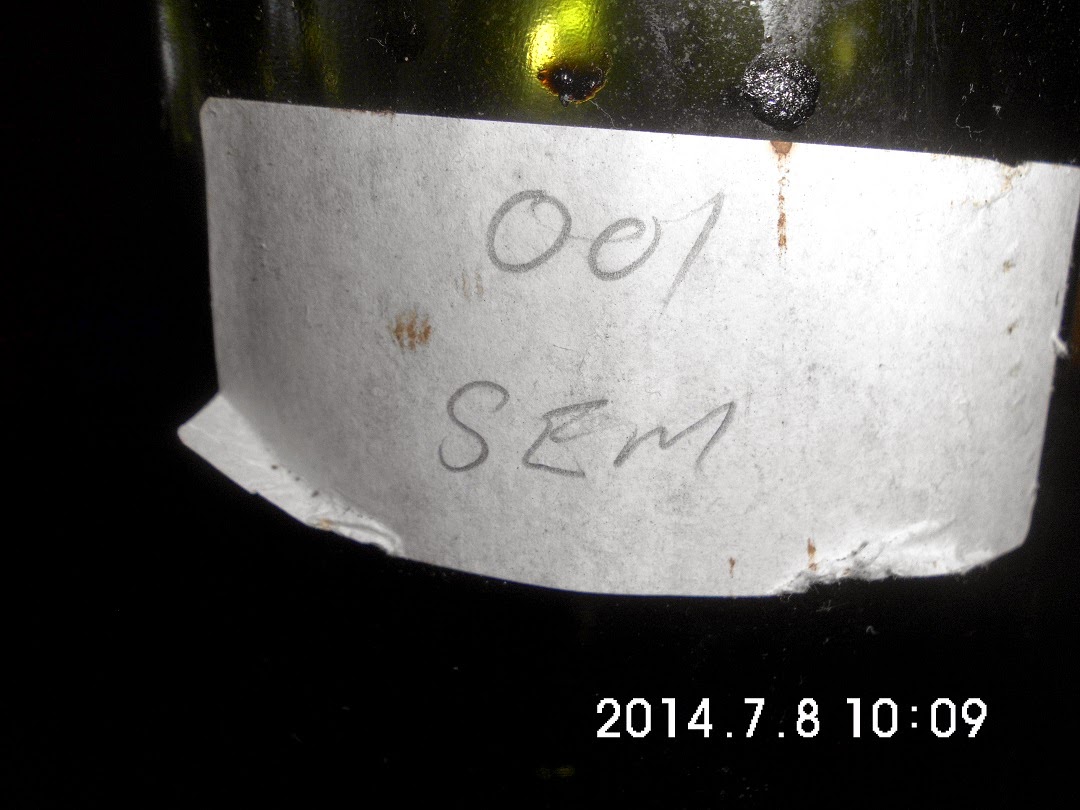
The only white in the box was "Sem 001". The HHF coding system means this is a Semillon 2010 batch 01. This bottle didn't have a screw cap but a cork which indicates it is from the last dozen of this batch. Every wine bottled here on HHF has one dozen under cork for long term aging and the rest under Stelvin Seal i.e. screw cap.

First impression was positive. There was no sediment despite being bottled unfiltered. So much for the commentators who say that bottling by the moon cycle is rubbish and wines need filtering.

Decanted the 750ml into a 375ml and a 185 ml leaving a single glass to enjoy. The nose was good, another promising sign. The first sip was unbelievable. This was an excellent wine, full of flavour and mouth feel. A tiny hint of those characteristics of a Hunter Semillon with a few years of bottle age. This is the point where you feel pretty pleased with yourself. All those past failures and mediocre results fade and you think only happy positive thoughts. It is worth the effort you say to yourself.

The excitement pulled Jean out of the other room and she investigated the wine in my glass. Colour: sparklingly clear with a hint of yellow, Nose: strange (not her strong point). Taste: "Wow, this is in the Didier Dagueneau league" (even if he did only use Sauvignon Blanc). So that was the end of the 2010 Semillon - we split the bottle. Just as well the entrée this evening was oysters.

The Wine


Sometimes when we pick the vineyard manager lets us have the box ends from the reserve block. But since this wasn't recorded in the vintage book we will never know if this was a factor.

Definitely, the lack of filtering adds more character. This is apparent in all the wines at HHF.

The Baume was 11.2 giving an alcohol level of 11.7. A bit higher than the usual 10.5 recommended for Hunter aged Semillons.

The pH was 3.24 which is about perfect.

The grapes after picking were chilled on skins for 18 hours then pressed and the temperature raised for yeast inoculation. New World Strain Chardonnay Yeast was used. Once the must had commenced fermenting the temperature was lowered and remained between 10 and 15 C for 6 days until the only a third of the sugar was present. Every day the must was stirred to add a little oxygen for the yeast and to circulate the sediment. An obscure practice of some French winemakers.

The wine was racked and 5 grams/litre of French Medium Toast Oak chips added. A little higher than the book recommends but then it did have  a fair bit of skin contact.

And there it sat for 6 months until bottling. Occasionally tasted and now after 4 years it has blossomed.

Inspired again for another vintage.

Monday, June 23, 2014

Williams Valley Wine Tasting Club

Well you've heard about our Cuisine Club and now we have a Wine Tasting Club. Nothing flash just four couples on a Saturday night tasting six wines (all red). We all brought palate cleansers such as cheese and other dips.

The wines were part of a tasting pack one of the group received and was willing to share. It contained not only the wines but numbered paper bags to hide the bottle identification and scoring sheets where we could jot down out perceptions on Colour, Smell and Taste. The total score was out of 20.

Not only was it fun but also interesting as we all read the guiding notes and attempted to score each category. Discussion went on during the whole exercise. Non of us are wine buffs, its just that we don't mind a good glass of wine and this evening contributed to our knowledge and helped us focus on what makes a good wine.

There was no winning wine as the group was equally divided between two styles of red i.e. the medium bodied and the heavier style.

The tasting was followed by a shared meal where all the participants brought dishes. A fun night. What a good way to get to know your neighbours.

Tuesday, June 10, 2014

Small Wine Press, NZ Compost Bins, Dogs at Work

In February while making some Tannat wine from our meagre harvest the screw thread on the baby press was stripped because of the significant pressure that was placed on it during winding.

After some research the only solution seemed to be a low torque Acme screw thread. Acme threads were easily available in 12 foot lengths. Getting a 300 mm piece of this with a nut seemed to be a real challenge until it was discovered that the scissor jacks used on most small cars use an Acme thread.

Finally, at the Dump Shop last week one was available. It was broken down to its component parts with the nut being welded to the top of the press and the thread had the handle attached. After welding, everything received a fresh coat of paint. The real test will be when we next use the device. This may not be until February next year.

Wine Press Base with Acme nut welded

Acme Screw Thread with handles attached
 

Further progress on the newly built NZ Compost Bins. With both of us working steadily all the timber was coated with used sump oil in a location close to where it will be finally assembled.

Loose planks coated with oil

The assembled sections painted. The sheets of iron protect the grass from the oil and allow any excess to flow to beneath the wall of the shed. This shed has experienced some Termite activity and any dripped oil will add a small future deterrent

Jean went across the river to work this morning and now that we have the dual cab work vehicle back with us she was able to take all the dogs with her as farm assistants. Nikki, the male had a serious neck problem a year ago and we only allow him to travel with a full body harness inside the vehicle. He loves being in the car and will sit there for hours without complaining.

The girls love being on the back and sticking their heads out from the sides to take in the smells as they travel back and forth.

Nikki isn't big on farm work and prefers to stay in the car and guard the farmhouse while the girls ride in the RTV while the cattle are moved and the paddocks harrowed.

The kids back from work. The girls on the back (Lisa the splotchy Cattle Dog Cross and Bill the Kelpie Cross) and the Alpha male inside


Saturday, April 26, 2014

Ciabatta, Watermelon, Rose, Perry, Garlic, Yogurt

Part of the preparation for lunch guests is some bread. In this case Ciabatta which requires starting a day earlier with the making of the Biga which is pretty much just a sourdough but using a little yeast. Tomorrow it will be used to produce those chewy free form loaves that go so well with baked Camembert and other dips.

Biga after 24 hours

Summer is finally at a close as we consume the last watermelon. Orange Glo a melon we tried for the first time appears to be late season ripening. If this is the case and not just good luck it will be perfect to carry us through until other fruits are ready. The fruit on offer at the moment is the last of the Dragon fruit and the first of the Cherry Guava. In less than a month the first of the Citrus i.e. Mandarin will be ready.

Orange Glow Watermelon

It is the time of month where some wine work needs to be completed i.e racking some of the reds that were pressed and demijohned a little over a month ago. This is the process to take them off the coarser sediment to prevent any unpleasant flavours in the wine. Today the Tempranillo was done. While in the Cave the Packam/Williams Perry was bottled. Only 15 litres or so producing about 40 half bottles. This Perry has a magnificent yellow/orange colour. Will look forward to sampling in a couple of weeks.

While bottling it was decided to also bottle the very small amount of Rose that we made. Only seven litres. The Merlot Rose was incredibly good. It had a balance of fruit and oak flavour and not that sickly sweet Rose that is prevalent in the shops. Just a refreshing luncheon wine. Will serve some to the guests on Sunday.

Merlot Rose

The Garlic planted last week has started to pop out of the ground. The bulk of the 450 cloves have now sprouted. A wonderful sight to the gardener.

Garlic

Unlike house work, food production is an ongoing task. Because of a slip up in planning on my part we had to go two nights without yogurt. But a batch is now made and a little draining tomorrow will provide us with a few weeks supply. There is a steady flow of production in the kitchen that doesn't always rate a mention in the blog. Cheeses, Butter, Yogurt, breads, scones and various other essentials are always in steady production in the background. All part of the process of a healthy lifestyle.

Yogurt made but not drained.


Sunday, March 30, 2014

The last of the Summer Wine (Cider and Perry)

According to our Orchard map which contains the layout of the trees with their details including when to harvest, the Williams Pear was due in February. So much for relying on memory and thinking it was March. Consequently the fruit was well advanced and soft and much of it was rotten. This is a side effect of bagging fruit i.e. it is not possible to see the progress without removing a bag. But then the Packham which is due in March was in peak condition and the combined yield provided almost two 20 litre buckets. Some was put aside for eating and the rest went towards Perry.

While out in the Orchard with the barrow and buckets it seemed wise to check the Cider Apples and the two eating apples Rich Red and Cox's Orange Pippen. Neither of the two eating apples had much good fruit. Just a season that wasn't productive for these two. In other years the Rich Red offers up some delicious produce.

The Cider Apples are Sweet Alford, Stokes Red, Yarlington Mill, Kingston Black and Bulmers Norman. Non of these produced well this year, leaving us with just under two 9 litre buckets of mostly miserable small fruit. One or two pieces of fruit did come to full size and the Sweet Alford was magnificent. These are mostly due to ripen in April/May but all were ready now and wouldn't last on the tree much longer.


The Harvest


Some of the pears were extremely large

Rather than muck around with small quantities of Apples it was easier to chuck the whole lot into the Scratter and make a Perry/Cider blend.

The scratter in action

Our guide for Cider and Perry recommends a Potential Alcohol of no less than 9% for good keeping qualities. The sugar levels when measured after pressing came in at about Brix 15.5 which is just under 9%. Our climate just won't allow the fruit to ripen any more, mostly due to the wet conditions arriving at the final stage of ripening. To get the desired result a little sugar was added to the juice to lift the potential alcohol level.

The pH was not ideal at around 5 and a little Tartaric Acid solved that problem. And so the scratting went quickly and the pressing carried on all night with a yield of a little over 12 litres which is fine. The juice has had CL23 yeast added and when the fermentation really kicks in it will go into a chilling unit at 10 C. A long slow cool fermentation really brings out the fruit nose in the final product.

As usual a big clean up afterwards. That is the last use of the Basket press for the year. After it dries out it will get a light sanding and a coat of non toxic paint before being put to bed. It has worked hard this harvest with over 400 KG of grapes and close to 100 KG of Apples and Pears.

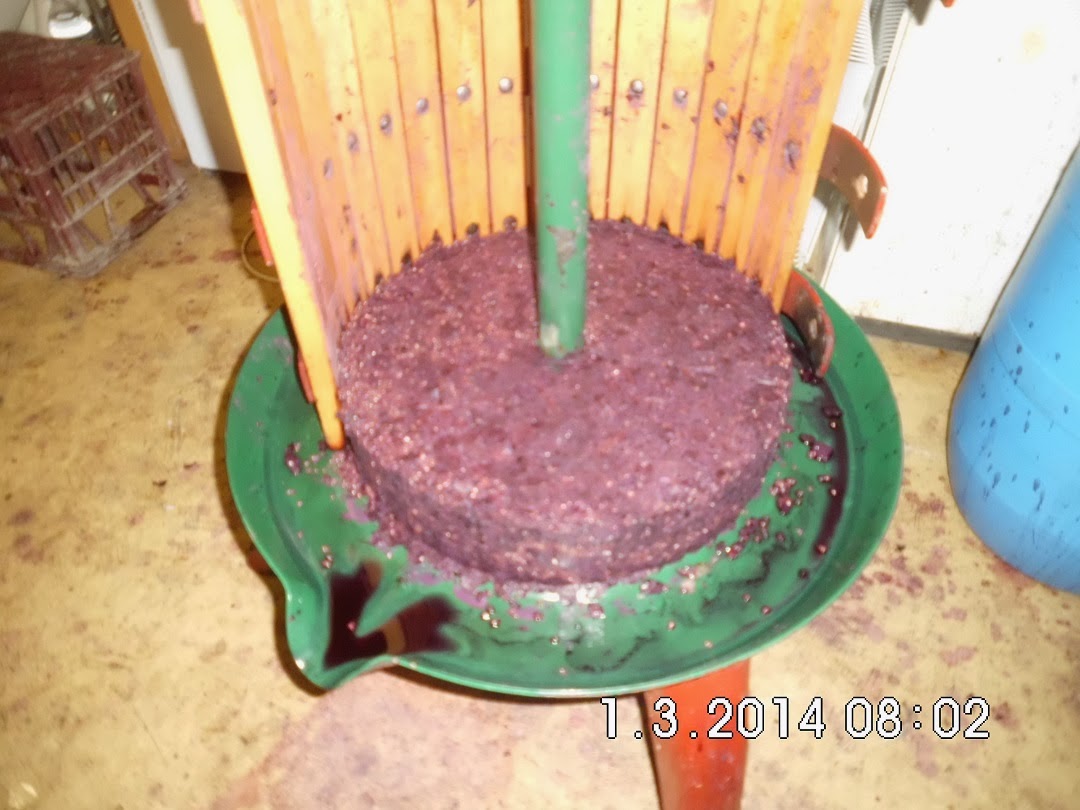
The cake after pressing. Something for the chickens to enjoy


We have been keeping back more fruit for eating fresh and enjoying the quality of the home grown product. Next year the objective is to keep more product on the tree after the main harvest to see if we can improve the length of time it can keep. This is hard in our temperate climate. If we were further south I'm sure it would keep for a few more months especially something like the Beurre Bosc.


Thursday, March 27, 2014

Red Winemaking Progress

A little over 40 days ago the first of the red wines were pressed and placed in demijohns under an air lock. Oak chips had been added to the demijohns. The Chambourcin had American Oak chips added at the rate of 3 grams per litre. In addition some American Oak dust had been placed in the must during fermentation. The Pinot Noir pressed a couple of days later had 3 grams each of American and French Oak added.

American Oak imparts a sweeter flavour and is higher in Oak aromas and adds more vanillin flavour.

French Oak imparts more subtle and spicy flavours.

Now 40 days later the wine has settled out a lot of sludge which is a mix of dead yeast cells, small pieces of pulp and grape skin and other bits suspended in the wine. This first racking is designed to take the wine off this sludge called, gross lees, so that it doesn't impart any bad flavours from this debris. After this racking the wine will continue to settle suspended particles but these fine lees are unlikely to be detrimental to the wine. Usually I don't rack again unless there is a significant build of lees. Most other winemakers rack every few months but my preference is minimum intervention.

This week is ideal for racking because the Bio Dynamic calendar shows the moon in the correct place for this type of work. It is the period where the moon is in descending or waning. During this period there is the least amount of turbulence in the wine.

Racking is merely siphoning the wine into a fresh demijohn using  food grade tubing with an attachment which sits in the bottom of the demijohn keeping the tube away from the lees.

The end result is a little less volume of liquid than in the input demijohn. This is where the extra small containers of topping up wine come in handy. They are handled gently to ensure none of their sludge enters the fresh demijohn. This first racking leaves behind a significant amount of sludge.

As part of this process the wine is sampled and tasted. I add some French Oak chips at 3 grams per litre to the Chambourcin to balance the wine but the Pinot Noir is excellent even at this early stage.

In future I'll use French and American Oak in a 50/50 mix as standard practice as it seems to provide the best result with the least amount of fussing.

Both these wines are in the only two 34 litre demijohns we own. There is just on 40 litres of Chambourcin in total when the topping up demijohns are included. The decision here is to transfer it to two 20 litre demijohns and reduce the number of containers from 5 to two.

I'm strapped for enough topping up material for the Pinot Noir and am faced with a dilemma. Use smaller containers and have a several batches or add another wine to the Pinot to top up the single large demijohn which is the former Chambourcin 34 litre which is now empty and cleaned.

I opt for using some Merlot in the Pinot. It is only a small percentage and Merlot and Pinot make a good combination. The 8% adulteration will not have negative consequences and having a single large container will make later handling simpler.

As usual there is plenty of cleaning after the event but it is satisfying to know that these wines are progressing nicely and early indications are that it will be one of the best vintages to date. The experimentation over the years is paying off with various techniques and practices becoming standardised as a preferred flavour and style evolves.

The remaining red wines were pressed two weeks after these and will now be racked in April during the appropriate moon cycle.

Tuesday, March 4, 2014

Uses for Grape Marc

A final clean up of the Cave today as part of the end of vintage. The last job was to break down the basket press and perform a thorough clean. There are still some pears and apples maturing in the orchard and the press will receive additional work between now and the end of April. After that it gets a coat of non toxic paint to the base plate and is put aside for another year.

Just as the grape marc was about to be tossed into the compost there was a pause and some light globes (LED) went off. There was the faint memory of a cheese we had seen at Simon Johnson's shop more than a decade ago. It was a cheese that had been stored in grape marc. We obviously tried a piece and found it interesting.

Grape Marc

After a quick check on the web a few options were uncovered.

Grape Marc Aged Tomme

here was a Havarti in the cheese fridge from last October that we felt was a bit dry. It went into a container shrouded in marc with a bit of freshly pressed wine. And as a proper test a nicer cheddar like cheese was also covered in marc and stored. These will stay like that for 2-3 months.


In Europe cheeses like this are made and stored for a period of months then coinciding with the end of vintage they are brought out and shrouded in grape marc for 3-4 months before consumption.

Just in case any of these cheeses turn out fabulous a few jars of marc were frozen. No need to wait until next vintage for the ingredients.


We finally caught up with a nearby farmer who had a stack of mulch silage round bales for sale at $30/~ton. We met up with him at 2.30 and loaded the ute and trailer as a bonus he chucked on a third bale as a bit of compensation for having to wait so long (at no extra cost). By good fortune we'd brought along a jar of our creamed honey as gift. Good swap. It always pays to sweeten a deal whenever possible.

Monday, March 3, 2014

The rain keeps coming

Beginning to become annoying this rain. They say you should never complain but there is still some washing on the line and just as it begins to get dry another shower hits.

We moved the cattle on HHF into one of our front paddocks which now had some good growth. Just so they wouldn't pig out we fed them their sprouted grain and some Lucerne. They seem very happy with green grass even whinging Warren was quiet.

After knocking over the early morning chores of feeding whoever needed feeding and opening pens for chickens and ducks we performed another Yoga session which seems to make us both feel better. Being a fast day we got ourselves busy after a green tea to take the mind off food.

Jean went across the river to harrow some paddocks. I thought it would be too wet but surprisingly the RTV left no tracks on the river paddocks when I was feeding the cows earlier that morning. Nothing like good alluvial soil. She arrived home soaking wet. apparently a heavy shower caught her by surprise while she was negotiating some paddocks which needed gates opened and closed as the harrows were brought across from the other side of the property.

The last of the grapes needed pressing today. Three batches of Tannat. One grown on HHF and two purchased batches only being different by the yeasts used. The first batch was very powerful but drinkable straight out of the press as was our very small home grown batch. Should develop well. But the real standout was the batch using VR21 yeast. What an amazing difference. So good in fact that two glasses were put aside to have with tonight's meal. This process of leaving the wine on skins for a minimum of 22 days does amazing things. A 50/50 mix of American Oak and French Oak chips went into the demijohns. This should really round off the wine.

Our tiny harvest of 3.8 KG needed the baby press.
Working in the Cave with clean floors is pleasant. Very annoying whenever wine splashes on to it. We have even been taking off our boots whenever we enter. That's the trouble with tidiness.

Being a fast day and having done yoga in the morning we decided to really punish ourselves and finish the day in the pool with light workout. It turned out that light was all we could do. At 4pm the pool had a lot of activity of the 5 lanes 2 were taken up with swimming club training. A third had someone doing laps and that left us to share the remaining two with the Learn to Swim class. Still all was not lost we completed our High Intensity Training session first with 3 x 30 second sessions and then went on to Aquarobics. The only bit we skipped was the swimming. Back home to dinner pre and wine making. A good day.

Saturday, March 1, 2014

Rain

The forecast was for 5-10 mm but for the 24 hours to 9am Friday morning we had 30mm and then by 9 am Saturday morning another 32 mm and it drizzled all day. As usual we missed the opportunity to trim edges and mow lawns earlier in the week and now the grass has run away and the ground too soggy to navigate. By the time it is dry enough in a couple of days it should be a nice height. Just when we were getting used to it being excessively dry and getting out of the habit of maintaining the lawn. What little hand mowing we did perform went into making compost. No drama, this growth will produce some excellent mulch for the gardens and around the fruit trees. Always a bright side.

The milk collection was left until this morning. Jean said I should find two smiling dairy farmers. I had to remind them but they dutifully stood side by side and put on broad grins.

We ventured into Raymond Terrace to pick up a garden fork. We have one really good one made from high tensile steel which never bends and it is getting a bit tatty. The prongs have worn down and are needle sharp. There is a second one we recycled from my mother's estate but it is mild steel and any excessive force bends the prongs. The Aldi version said high tensile and a little testing in the shop looked promising and so at $9 it found a home.

Rather than go to the pool so late in the day we dusted off a book on Core Strength Training and followed the instructions. Five minutes of aerobic activity on the exercise bike. Stretches for about 20 minutes and then performed all the Core Strength exercises once just to get the hang of it. It didn't feel like we were doing much but by the end of an hour of grunting, groaning and laughing we were pretty sweaty. An hour later we were feeling a bit sore as well. Just as well we didn't perform the 6-8 repetitions. At least we made a start.

Why do this? Jean ran the tape measure over us this morning and we hopped onto scales. She has a beautiful BMI of 23 which is easy when you are 6'1". I on the other hand bowl up with a BMI of 29 - not good. Shorter and obviously fatter around the middle. One way to address this is work on the middle bit i.e. Core strength. Just clip a few inches off and the BMI starts to look a bit more respectable. Since she raised the issue we will now both suffer while I address my inadequacy.

Well the wine making moves along. The press needed dismantling and cleaning and the Beurre Bosc Perry had slowed to a trickling bubble and was ready for racking. No 15 litre demijohns remaining and so dipped into the stock of 5's filling three plus a 750 ml.

A wet day is a good day to address the cleaning of the Cave. And so it started with knee pads, a scrubbing brush and a bucket of ammonia water. Hands and knees just like in Upstairs Downstairs only I just did a small section. The plan is to do a little each day. It does look a lot better.

Friday, February 28, 2014

Shiraz, Merlot and Tempranillo

Today was a big day for pressing grapes. Three varieties have been sitting on skins for 23 days soaking and breaking down to maximise the extraction of all the goodness possible.


Shiraz went first. Barely 35 kilograms producing a little over 19 litres after 4 litres was drained for Rose before fermentation. The demijohns had both American Oak and French Oak added in a 50/50 mix equaling 6 grams per litre.

Leaving the Shiraz pressing in place the Merlot was tipped in over the top. Starting with only 30 kilograms and having already taken out two litres the result was just over 17 litres. It received the same Oak treatment as the Shiraz.

Finally the Tempranillo. Only 21 kilograms yielded just over 12 litres after the earlier 2 litre Rose siphoning. Identical Oak treatment for it as well.

The Merlot was a much juicier grape providing a better yield while the Tempranillo benefited from being the last variety pressed. Just before it was added the previous grape Marc was broken up which would have added a little more liquid and of course being the last pressing of the day it received a very solid pressing.
 
After pressing 70 kilograms of grapes there is very little marc remaining
 
In a few days the Tannat will be ready for pressing and just as well it is the last for the vintage as we are getting short on demijohns, especially the smaller 5 litre ones. The problem has been all the experimental batches of white which chewed through our little containers.
 
Our forest of air locked demijohns.
 
Filling demijohns always starts with some calculations to estimate which is the largest sized demijohn that can be easily filled then progressively smaller containers are utilized right down to even a 175 ml bottle which can be used for topping up. The Oak chips that were added eventually absorb water and sink leaving a larger than desired air pocket which needs to be filled as soon as possible to prevent oxidisation of the wine.
 
Pressing is an interesting process. At first you jiggle the ratchet handle just finger tip lightly to allow time for the juice to escape then gradually over a couple or more hours additional pressure is required. It is important not to rush the process otherwise juice may become trapped in pockets. Gradually over time a lot of force is required to increase pressure. Eventually almost no juice results even after letting it sit for a few hours and the pressure gets to point that it cannot be increased.

There are periods where the press can be left alone while juice continues to drain. This is the ideal time to carry on with other cellar tasks such as topping up containers or racking some that have gross lees thick in the base of the demijohn. There is a never ending job of washing out containers and cleaning.

Originally the cleaning was done in the laundry and there was a significant amount of running backwards and forwards dripping water everywhere. Now, having a laundry tub and double sinks in the Cave along with hot and cold rain water is such a great benefit.
 
From about this time forward planning commences for the 2015 vintage. Notes are made as to further experiments or changes to techniques. Once we have had a chance to try the finished wines in a few months further refining of methods will be noted. We also look at our stores of yeasts etc to see if anything needs replenishing.
 
And no we will not purchase any more demijohns otherwise the pressure will be there to make more wine.

Thursday, February 27, 2014

Paying for the Grapes

Today was really an outing for the dogs. They love their trips in the car. The two girls on the back and Nikki in the back seat.

It was time to settle up with the two vineyards where we purchase grapes. I'd telephoned ahead a couple of days ago to let them know we would call past and pay our bill. In total we had picked 370 KG of grapes over seven varieties plus our own Chambourcin. One of the vineyard managers has two small children and they had tried out creamed honey. Consquently he was pretty excited about the large jar that accompanied the envelope of cash. Sweetening the deal so to speak.

We called in at a few winery cellar doors to look at their offerings but decided not to taste as we would not be purchaseing anything from their lists. They had some interesting wines but these were out of our price range coming in at bteween $35 and $44. No doubt the quality is there but it would be wasted on our ordinary palates.

There is a high point near one of our vineyards with a picnic area which is an ideal place for a thermos of coffee and scones and safe for the dogs to have a run. The entire valley with its vineyards always look spectacular with the long straight rows and landscaped gardens.

I can understand why people would move to the area to be exposed to the lifestyle and the romance of the industry. You could even start or buy a small vineyard and turn a fortune into a smaller one.

We returned home quite late in the afternoon after a full day. The dogs exhausted from hours of straining on their leads as they took in the sights and smells of the trip.

Another adventure.

Wednesday, February 19, 2014

Picking up Ideas

It's useful to read other people's blogs. Reflecting on some adjustments we have made to doing things around HHF in recent times it highlighted how sharing knowledge has improved our own activities.

Most recently Paola Spades and Spoons wrote about wine making. In one post she mentioned the volume of preservative used in their wine in terms of grams/litre. Our measurements are done in ppm. Out of curiosity a conversion was performed and it showed a big discrepancy with HHF being on the high side. It turns out our winemaking notes were incorrect, fortunately because we calculate the additive on the litres not the kilograms the discrepancy was not as bad as it could have been. Our notes are now modified.

Gavin Webster's Little Green Cheese  published a podcast on brining. What to do with brine once you've salted the cheese has always been a problem at HHF. As we make so much cheese i.e. twice each week there is always the issue of brine disposal. Not any longer the podcast provided a solution for the brine - clean and reuse.

Liz at Eight Acres is always throwing forward interesting ideas and trying new things. Her permaculture posts are thought provoking and have encouraged us at HHF to rethink our processes. Her last post on deodorant is particularly poignant as it has been a couple of months now since soap or shampoo graced my body. I'm curious to see if Liz will take the next big step.

These are just three recent examples of benefitting from the willingness of others to document their knowledge and experiences.

Many other bloggers post interesting and thought provoking pieces and sometimes they are just good reads or listens.

Linda at Greenhaven 
Dani at Eco Footprint South Africa
Matron of Husbandry at Throwback from Trapper Creek
Fiona at Life at Arbordale Farm
Barb at Barb's Backyard
Jack at The Survival Podcast

As with all things not every post from HHF is useful, interesting, relevant or even well written but the objectives remain unchanged. To document what we do as a record for ourselves as well as offering the information to others in case they find it helpful. In each post we attempt to improve our writing skills. They say it takes 10,000 hours to get good at something, don't know if that is really true but we continue to practice.

Friday, February 7, 2014

HHF Tannat

We harvested our own Tannat grapes. The first crop from these relatively young vines. A whopping 3.8 KG.

The bunches were frozen for 24 hours which with such a small quantity didn't take a lot of effort. The sugar came in at 26.5 Brix and the pH was 3.9 which was adjusted down with Tartaric Acid. Once defrosted BDX yeast was added. All this is in a small stainless steel bucket.

And that is a short post.

Rehydrating yeast

The cave is getting a little crowded now that vintage is nearing the end