Search This Blog

Friday, February 7, 2014

HHF Tannat

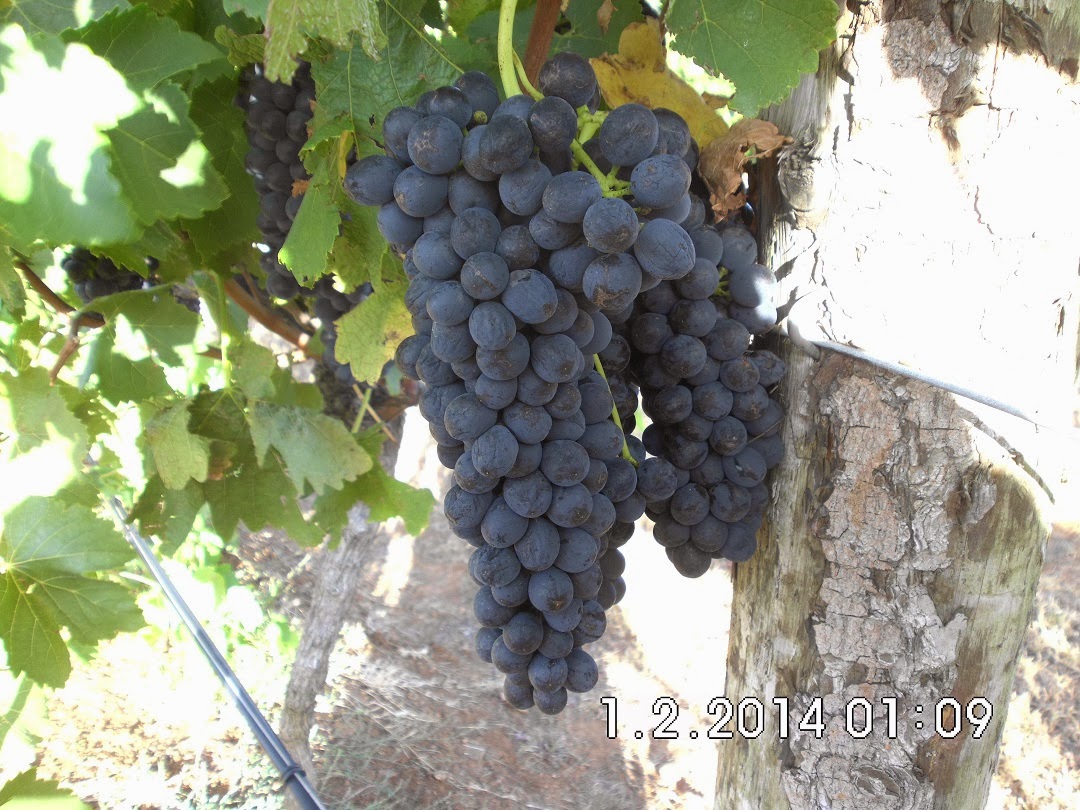
We harvested our own Tannat grapes. The first crop from these relatively young vines. A whopping 3.8 KG.

The bunches were frozen for 24 hours which with such a small quantity didn't take a lot of effort. The sugar came in at 26.5 Brix and the pH was 3.9 which was adjusted down with Tartaric Acid. Once defrosted BDX yeast was added. All this is in a small stainless steel bucket.

And that is a short post.

Rehydrating yeast

The cave is getting a little crowded now that vintage is nearing the end

Thursday, February 6, 2014

Termites

The week before last I grabbed an empty 5 litre brown demijohn from the bottom storage shelf in the cave to use in the wine making. We have lots of these stored on the higher shelf and this was the only one sitting on the bottom shelf due to space shortage. My eye caught an unusual mark on the shelving. A distinctive colour change from the shiny clear lacquer finish. A look at the base of the demijohn confirmed my thought and then an inspection with a torch confirmed my disbelief. Termite activity and live ones scurrying away from where the demijohn had been.

The mark of termites


After calls to three pest control companies, one was found which did not start the conversation about how many pages were included in their site report. The earliest any one could conduct an inspection was ten days away.

Not performing any intervention activity in the interim was reinforced something I vaguely remembered from many years ago when talking with an entomologist turned pest inspector. In those days the treatment was to gently open one of their tunnels and lightly and gently dust some participants with arsenic. Apparently individual termite behaviour is to return to the colony with food and come in contact with the queen who licks them and tnd thus dies bringing an end to the colony breeding.

Now the treatment is more sophisticated.  Special baits are inserted in the areas of activity which contain a harmless to humans chemical developed by the CSIRO. Termites shed their exterior shell on a very regular basis. This chemical prevents them from shedding which causes them to die.

So for the time being they are left alone to continue their destructive work. At this point we had no idea as to the extent of their activity in the cave. The building is soft wood framed with steel exterior cladding and Gyprock clad interior. Whether they had commenced destroying the roof supports of wall supports we had no idea and would not find out for 10 days. And I'm sure it was not covered by insurance.

Today was the day and the man arrived. He confirmed the mark on the shelf was termite damage. We lifted off a board in the ground level shelving to expose a massive level of activity. It appeared the shelving about three metres in length was a mass of very busy termites. The noise level was quite distinct -  a steady hum of activity. Back went the board so as not to disturb them. They like moisture and no light.

The next step was to approximate the size and extent of the activity and then find the point of ingress. The good news was they were contained no higher than a couple of hundred millimetres up the wall and mostly in the bottom shelving. Well it was good news that the roof would not collapse. The exterior metal sheeting could at least be removed reasonably easily later when the colony was deceased and any timber replaced and splints installed for structural supports. Not too serious so far.

After a long search the ingress point was found and left undisturbed. We discussed remedial works to be done later to reduce further risks. Not too hard. Just leave about 75 mm of slab exposed and fix the leaky gutter which kept the ingress point moist. The exposed slab is a partial deterrent but it also allows for easy inspection.

A thorough inspection of the house revealed no activity and some suggestions were made as to preventative actions for it..

The removal of the colony will take many weeks as baits are inserted, checked and replaced until finally the colony dies. Two options take a fixed price of $2000 plus GST or pay per visit until the job is done. Oh well fixed price sounds good and todays visit is deducted from the fixed payment.

What alternatives does one have?

And of course he had no spare baits with him to start the treatment. Being fully booked up his next visit would not be for another two weeks unless there was a cancellation of his appointments.

We wait and live with our termites.

Wednesday, February 5, 2014

Tannat

Another 4 am start. This time to pick Tannat our favourite grape variety.

Tannat is mostly found in Madiran where they make these powerful full bodied robust wines that age incredibly. They tend to drink the wines young rather than let them age. Consequently the longevity of males in Madiran is higher than the rest of France. There is probably a terroir factor involved as well. Although this is Hunter Valley Tannat and it may not contain all the longevity factors of its French grown cousin we are willing to give it a chance.

The fruit this vintage was exceptionally good. Healthy large bunches hung from the vines. Some of the bunches had berries that had commenced dehydrating and concentrating the sugars and improving the skin to juice ratio. The brix at crush showed 25 which is excellent. The pH came in at 3.76 indicating a ripe fruit but needed some Tartaric Acid to bring it closer to 3.5. The taste test was the best indication of ripeness. The sweet flavours had no unripe greenness and I tested a lot of bunches as picking progressed.

The picking of Tannat is an absolute pleasure the bunches have long stems and hang low on the vine. It went so quickly and with the fruit in such a good state that a little extra was picked resulting in an 80 KG harvest.

At HHF the two barrels went straight into the freezer while breakfast was consumed and a little work performed across the river. In the afternoon the grapes went through the crusher/de-stemmer and the must went back to the freezers to get it down to Minus 3 C.

Once again we intent to try preliminary freezing as a way to extract the maximum colour and phenolics by shattering the cells in the skin.

Apologies to Gavin Webster and his followers on Greening of Gavin for our over use of energy in wine making but we promise to compensate somewhere else. Sometimes the passion to produce the best possible end product overpowers all else.

Tuesday, February 4, 2014

2014 Vintage Update

Shiraz, Merlot, Tempranillo

After having frozen these three batches to below 0C it was time to defrost them so as to add the yeast. It took all day and night to have the temperature rise into the high teens early twenties. This morning The yeasts were rehydrated in grape juice taken from each batch that had been warmed to 38 C. Then after allowing the fermenting yeasts to cool to within 10 C of the main batches these starter batches were added back.

Two new yeasts are being tried both from Vintners Harvest an American company. The yeasts were sourced from a local home brew shop.

The Shiraz has VR21 which will go up to 15% alcohol the Shiraz has a high Brix reading of 24 and will need this.

Exceptional strain for full fruit red varietal wines with good structure, balance and colour. Excellent strain for red country wines.” Says the manufacturer.

The Merlot and Tempranillo have R56.

Perfect for rich full bodied red wines with exceptional full flavoured complexity

Chardonnay

The Chardonnay was racked after the intial fermentation slowed. Now it rests in airlocked demijohns, occasionally giving off a little CO2 as the last bits of sugar are consumed by the yeast cells. Some of the demijohns wee racked to remove the gross lees and now it was time to try some further experiments. Some of the batches that had good skin contact now had few American Oak chips added. Just to see if there would be any flavour improvement. And yes an un-oaked demijohn was kept of each as a comparison.

Sauvignon Blanc

These batches are in demijohns under refrigeration to keep the fermentation temperature between 12 and 15 C. They are bubbling away slowly. The airlocks aren't bubbling because they don't have water in them. Instead there is a little wad of cotton wool. This was recommended in one technical reference to enable H2SO2 to more readily escape. And it is escaping. There is a distinct rotten egg smell when the doors of the refrigeration units are opened.

Rose

These draining's from the Shiraz, Merlot and Tempranillo batches are all fermenting under airlock also under refrigeration. Once they are nearly finished they will be racked and a little addition of oak chips made just to add another dimension.

Chambourcin

Has pretty much finished its fermentation but some skins are still apparent on the surface. The goal is to have these skins in contact with the wine for a minimum of 22 days before pressing and storing in demijohns with Oak chips to settle and age. There is a plastic sheet covering the container to keep out bugs and every day a little CO2 is squirted over the surface to add some further protection against infection. This is the nervous part of the process. While it was madly fermenting the CO2 gas produced as a by-product protected the wine but now the only protection is the small amount of Potassium metabisulphite that was added at the crush and the daily burst of CO2.

Pinot Noir

The fermentation has slowed but not finished. The skins rise but not much and a once or twice daily plunging occurs. This is also now under plastic protection and also getting a whisp of CO2.

Monday, February 3, 2014

Burbles

Burbles is one of our two house yard hens. Born in 2003 she became a member of this minority group through unusual circumstances.


She was one of a number of chicks hatched naturally by one of the experienced mums in the chook house. But for some reason she kept jumping out of the nest after birth. Mum was a bit distraught and we put her back several times.

On that hot day, we encountered a large Brown snake in the hen house. We backed off and waited for it to depart. Of course up in the nesting box mum was safe with her newborns, but one chicken was missing.  Well that explains the snake's interest we said sadly.Then there was a very audible pip pip pip from the back of a nesting box at ground level, followed by the appearance of the noise maker. 

For safety reasons the constantly escaping chick was taken into our house.  She had just hatched and had to be kept warm and safe. As she refused to stay in the nest, she had to live with us. That meant she also had to come to work with one of us. It was easier for Jean to take her; the chick happily sat in a pocket of Jean's for warmth and joined Jean for lunch. The chick was also very happy following Jean down corridors and into offices. She was a good companion, also chatting away. Her name came from the sounds she always makes.

When she was small, we kept her on the bench in the kitchen in the evening where she took advantage and helped clean up crumbs.


Eventually she grew into a magnificent Rhode Island Red fowl. And now at 11 years old she hasn't laid eggs for some years and has been designated a "Companion Fowl". All her life she has always enjoyed a quiet lap sit. When younger, she practised to be a hairdresser by removing any grey hairs from Jean. Now that those out number the rest the behaviour has ceased. Burbles is probably overwhelmed.

She now sleeps outside our bedroom in a small hollow she has made for herself in the warm soil. Burbles spends her days circumnavigating the house and venturing out into the wider garden. Most mornings start with a cup of tea and a sit with Burbles.


Sunday, February 2, 2014

Wine making continues, snakes

We kept three 200 litre drums near the chook house to store chicken manure prior to using in compost. Urgently needing a drum to store some feed I grabbed the shorter of them for a clean out. It seemed a bit heavy and a quick inspection showed about a foot of water lying in the bottom having entered via a hole in the lid. Although a bit dark inside there seemed something else. This turned out to be a snake which looked a bit quiet but alive.

identifying the species was difficult. At first it looked like a pale green snake but it had a lighter underbelly. Was this a Brown or Black which hadn't seen daylight?

Tentatively I rolled the drum over (away from me) and the water rushed out but not the snake. OK then the drum was turned upside down. The tail was evident and pinned under rim of the drum. Flipping the drum on its side to allow the thing to escape was the next step. Except it dove straight back inside. This happened four times. Giving up I rolled the drum (carefully) away from the chook house and left it alone.

A quick flick through the Dangerous Snakes of Australia guide yielded nothing useful other than it could have also been a Tiger snake. None of the photographs was convincingly identical although some looked similar. The only way to tell was to pick it up and compare its various head features against the drawings in the book. Being content to remain ignorant I chose another drum to clean.

But given its lack of aggression it was either harmless or just pooped from being in the drum. It remained in the drum for most of the afternoon before suddenly disappearing. Hopefully away from the chook yard.

The winemaking continues.

The three batches collected on Saturday (Shiraz, Merlot, Tempranillo) are still chilling. It seems that to freeze a large batch of grapes a lot of time in the freezer is required. The temperature probes are indicating a slow progression to the below 0 C that is required. Progress was made in improving the skin to juice ratio by removing 10% of the juice in the bottom of each fermenter before it froze solid. This is now bubbling away as Rose.

Saturday, February 1, 2014

Shiraz, Merlot and Tempranillo

Up at 4 am today to try and get to the vineyard by 6 am. They were picking Shiraz starting at 3 am but that's a bit early for me and they have headlights on their picker whereas I use sunshine.

The vineyard always looks wonderful in the light with the perfect rows and the large expanses of water.


Caught up with the vineyard manager on arrival, he looked tired. We chatted for a while and apart from the Shiraz it was mentioned that the Merlot looked good as did some of the Tempranillo. You might all say "but you were cutting back on varieties this year and  merlot was one of the varieties being let go".


Yes well it was early and the temptation was just too much. But to compensate smaller quantities of each were picked meaning overall the total weight was less. Of course that will probably play havoc with the organisation of demijohns.


This year we've been giving freshly robbed honey as gifts to the vineyard managers. To sweeten the deal for them. It never hurts to be generous with people that take time out of their busy day to speak with you and provide an opportunity to obtain good fruit.


The grapes picked were all in the upper most rows in the vineyard and using the refractometer it was possible to be selective and choose the best quality fruit.


All three of these varieties have big easy to access bunches and picking went very quickly. All done by 8.30 and on the road home.

In the end the result was:

Shiraz, Brix 24, pH 3.73 just a little Tartaric adjustment done to narrow the margin between ideal and ok.

Merlot, Brix 23, pH 3.6 - perfection

Tempranillo, Brix 22, pH 3.6 again perfect.


The usual routine is to arrive home, unload the containers into chilling units and have a cup of tea while going through the accumulated notes on each variety and just make sure everything is clear about which processes will follow. The Vintage book is written up with a page for each variety, a batch number assigned, date picked and weight. The batch number is the year 4 and the sequence number e.g. 05 for Shiraz. That translates to 405 and is written on each container for tracking.


The weight is important as that will be the basis for later payment at the end of picking but also all calculations for additions of Sulphur and Oak is based on weight. In fact it is based on litres and to arrive at litres a yield of 60% is assumed. 100 KG results in 60 litres which is usually pretty close each year.
 
The crushing and de-stemming went quickly with one batch after another processed and put away and everything thoroughly cleaned afterwards.

As usual a Google Scholar search is performed just to see if there is any new research into these varieties and by chance a very interesting article is uncovered. Improved colour and phenolic extraction can be achieved by freezing the grapes before fermentation. The freezing explodes the cells in the skin increasing the extraction by as much as 50%. No time like the present to try this little technique. In addition there will be the 10% Saignee  i.e. bleeding off the juice to make rose and increase the skin to juice ratio. A few days of cold soaking will correspond with the freezing and at the end sitting on skins for a total of 22 days. This should really extract all the goodness and colour to make a powerful wine.

This is an exciting time at HHF with so much going on and the expectation of some wonderful wines in the near future. The opportunity to become immersed in the whole wine making process and the learning opportunity associated with the science of making good wine.

With everything tucked away and chilling it was time for an early night.